Short answer: a sliding door locks when a hook on the panel's edge swings into a keeper (strike) on the frame. If the hook closes above or below the keeper, the lever moves but nothing catches. The fix, in the order Milgard, Pella and Andersen give it: make sure the panel isn't dropped (roller screws), then slide the keeper up or down until the hook lands in it, then fine-tune how tight it locks. If the lock does nothing even with the door open, the part itself is broken, which is a hardware swap or, on a worn-out door, a reason to get matched with a dealer for a new one.
On Scottsdale and Paradise Valley patios the usual triggers are rollers wearing down after years of dust in the track, a keeper whose screws worked loose, a panel that came out for cleaning and went back a little low, and summer sun on a dark frame. None of these needs a permit or a new door. A slider that won't lock is also a security problem (Andersen's own instructions say a misaligned lock "may result in loss of building security"), so it's worth fixing this week, not next season.
First, a 30-second test: is it the lock or the alignment?
Open the door a few inches and work the lock lever with the panel away from the frame. Watch the edge of the door:
- The hook swings out and back smoothly. The lock works. The problem is where it meets the keeper, so it's an alignment fix. Andersen says exactly this: if the lock activates normally with the door open but not closed, the door needs to be adjusted (Andersen).
- The hook doesn't move, or the handle spins. Something inside is broken: the latch lever, the snib (Milgard's name for the part that engages the lock) or the lock body. Skip to When the lock itself is broken.
- The hook moves but it's stiff. Look for dirt, sand or a bent hook. If it's smooth open and stiff closed, it's dragging on the keeper, which is alignment again.
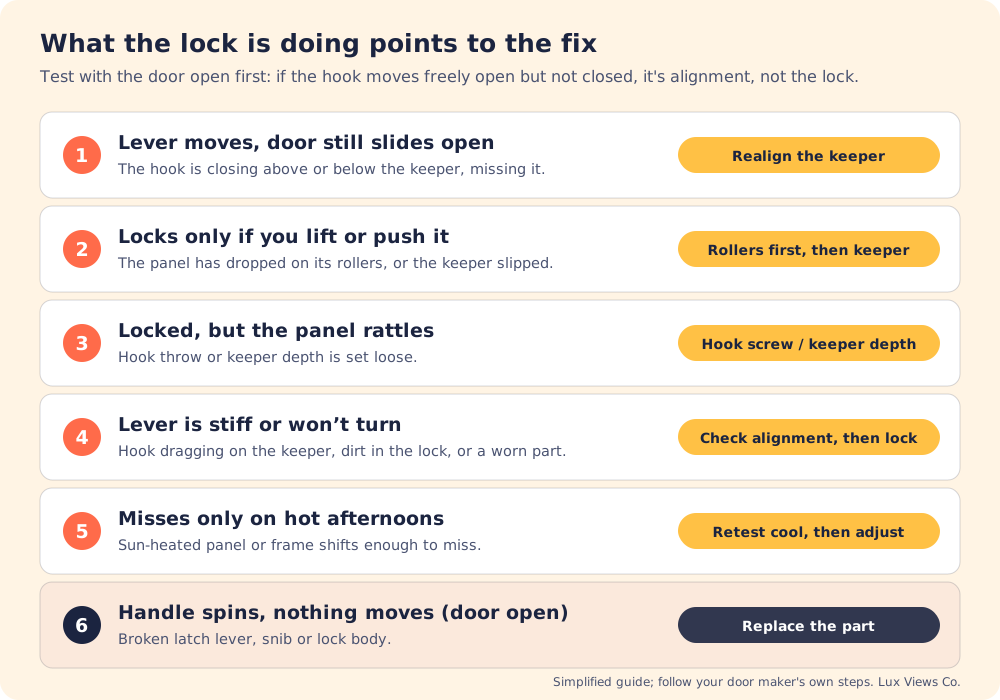
Then close the door slowly and watch the gap at the lock side. If the panel's edge sits lower or higher at the top than at the bottom (an uneven reveal against the frame), the panel isn't square in the opening, and that's the roller step.
How a slider's lock actually catches
Most two-panel sliders use the same idea under different names. A hook (Andersen calls it a reachout lock; Milgard's version has an engagement tongue on the snib) swings out of the moving panel's edge. A keeper, strike or latch receiver is screwed to the frame, usually in a slotted mount so it can move up and down. When the panel is closed tight, the hook swings up into the keeper's opening and pulls the panel snug. Multi-panel doors add shoot bolts at the top and bottom of the second moving panel, with their own keepers in the head and sill.
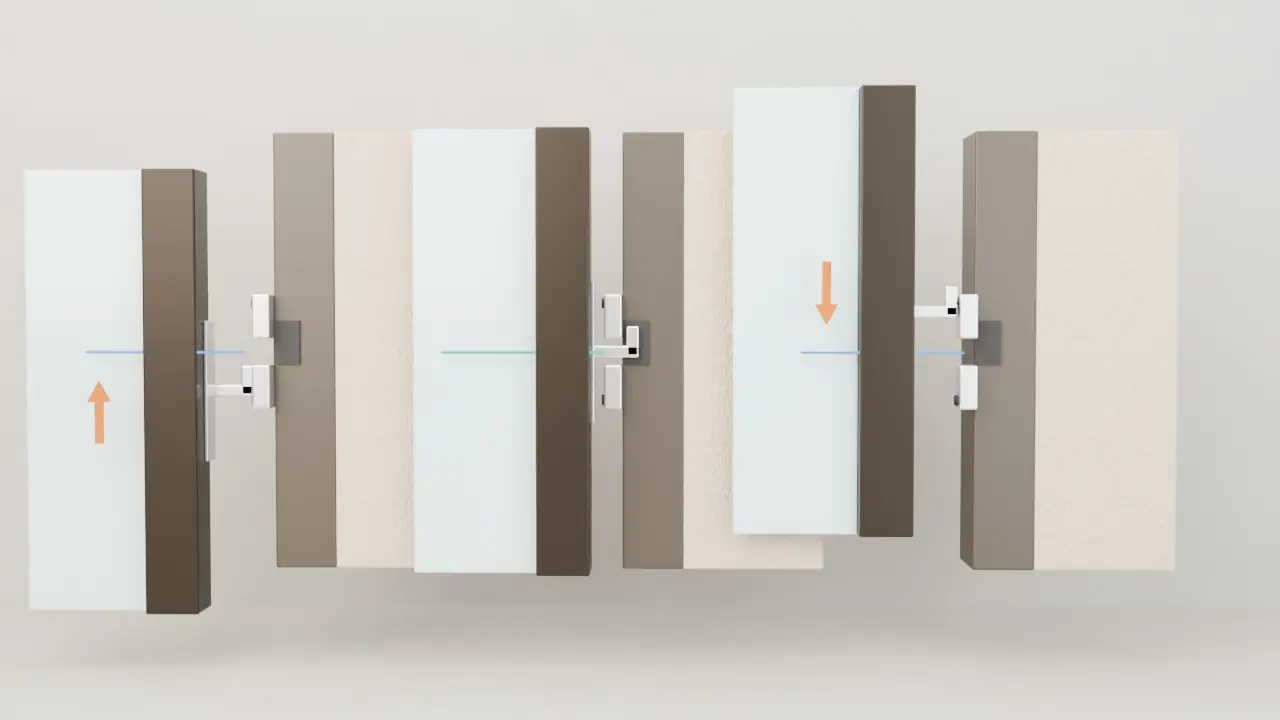
Milgard puts it plainly in its lock instructions: the engagement tongue "must run into the Milgard logo" on the strike cover to latch, and "if it is above or below the logo, the lock will not engage" (Milgard (PDF)). Andersen's version is a ">TARGET<" mark on its latch receiver that the lock button has to line up with (Andersen hardware guide (PDF)).
Step 1: Clean the track and the lock edge
Before you adjust anything, vacuum the sill track and wipe the hook and keeper. Sand and grit in the track lift or tilt a panel, and a panel that won't roll fully closed won't let the hook reach. If the door is also hard to slide, start with our hard-to-open slider guide, which covers track cleaning and each brand's lubricant rules (they disagree, and several say no WD-40). Close the door all the way and try the lock again; sometimes this is the whole fix.
Step 2: Set the panel height with the rollers
Pella's first instruction for a vinyl slider that won't lock tight is to adjust the rollers: unlock and open the door, then turn the adjustment screw at the bottom of the panel clockwise to raise the panel or counterclockwise to lower it, and check the alignment (Pella). Pella adds that after a roller adjustment, the lock may need adjusting too, so do the rollers first and the keeper second.
- Aim for an even reveal. The panel's edge should sit parallel to the lock-side frame from top to bottom. Adjust one end at a time in small turns and recheck.
- Don't overdo it. JELD-WEN's vinyl patio door guide warns that "adjusting door too high may allow water and air leakage," and says to raise the rollers only enough to clear the sill track and keep the weatherstrip hidden when the door is closed (JELD-WEN (PDF)).
- Take the weight off the screw. On some doors you lift the panel slightly while turning so the screw doesn't strip; JELD-WEN says this for its doors, and Milgard says not to use battery or air tools on its roller screws.
- Find the right screw. JELD-WEN notes that on some of its doors the roller adjustment screw sits right next to the screw that attaches the roller, and loosening the wrong one detaches the roller.
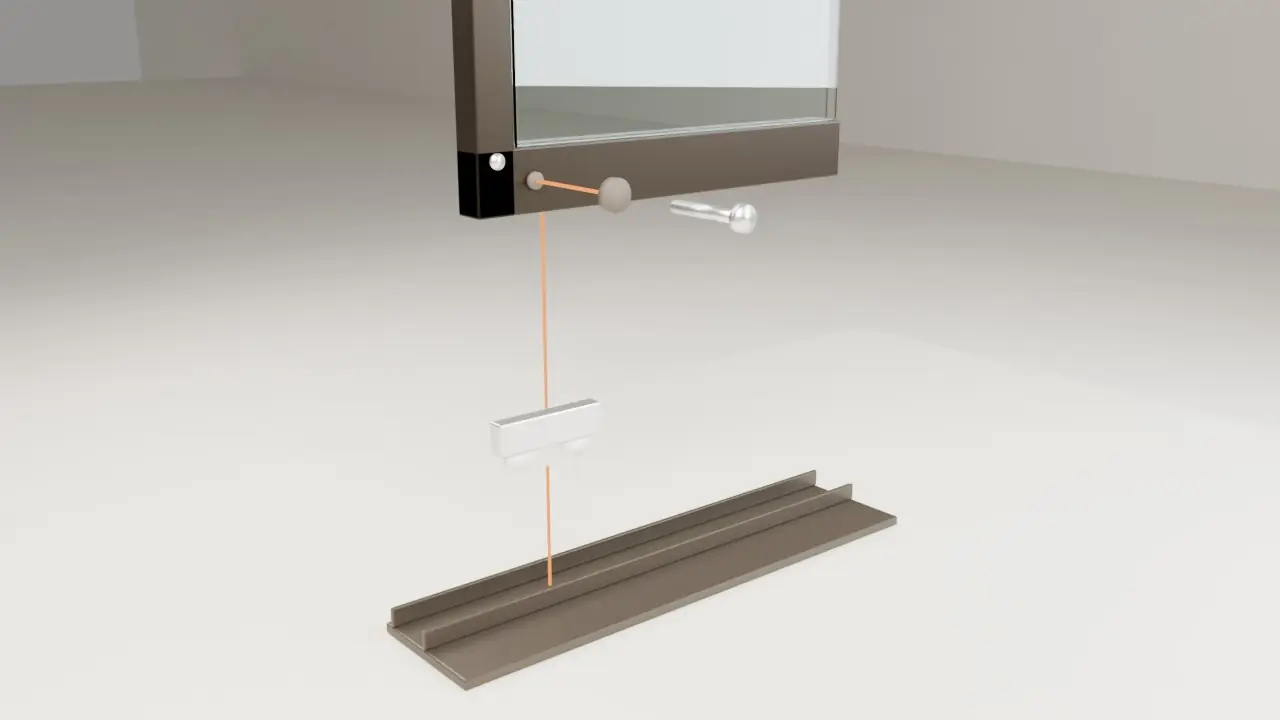
If the screw turns but the panel doesn't move, the roller may be broken. That's a roller replacement, which means taking the panel out; see how to remove a sliding glass door panel.
Step 3: Move the keeper to meet the hook
With the panel square, line the keeper up with the hook. The method is the same idea on every brand, with small differences:
| Door | What the manufacturer says |
|---|---|
| Milgard two-panel sliders | Pry off the center cover of the strike with a putty knife to reach the adjustment screw. Remove the top and bottom screws, loosen the center screw, slide the strike up or down, tighten, snap the cover back, and close the door to check that the pin lines up in the center (strike PDF; lock and handle PDF). Milgard rates it medium difficulty, about 15 minutes. |
| Pella vinyl sliders | Mark the keeper's current spot with a pencil, remove all four screws and the keeper, slide it up or down to align with the lock, and put the screws back in their original holes. Then shut the door and operate the lock (Pella). Pella's wood and fiberglass sliders have upper and lower strikes that move the same way (wood; fiberglass). |
| Andersen gliding doors (A-Series, 400, 200) | Close the panel and line up the lock button with the ">TARGET<" area on the latch receiver; slide the receiver up or down and tighten its screws. Then close the door tight and check that the latch lever moves smoothly and engages (PDF). Doors from 1994 to 2005 adjust by moving the receiver pin side to side or up and down (Andersen). |
| Andersen 100 Series (Tulsa hardware) | Move the panel to the jamb, check the receiver against the lock, loosen the receiver screws slightly, align, and retighten without overtightening; the guide shows a shim behind the receiver (PDF). |
| JELD-WEN vinyl patio doors | If the lock doesn't properly engage the strike plate, loosen the strike plate screws and move it up or down until the latch engages (PDF). |
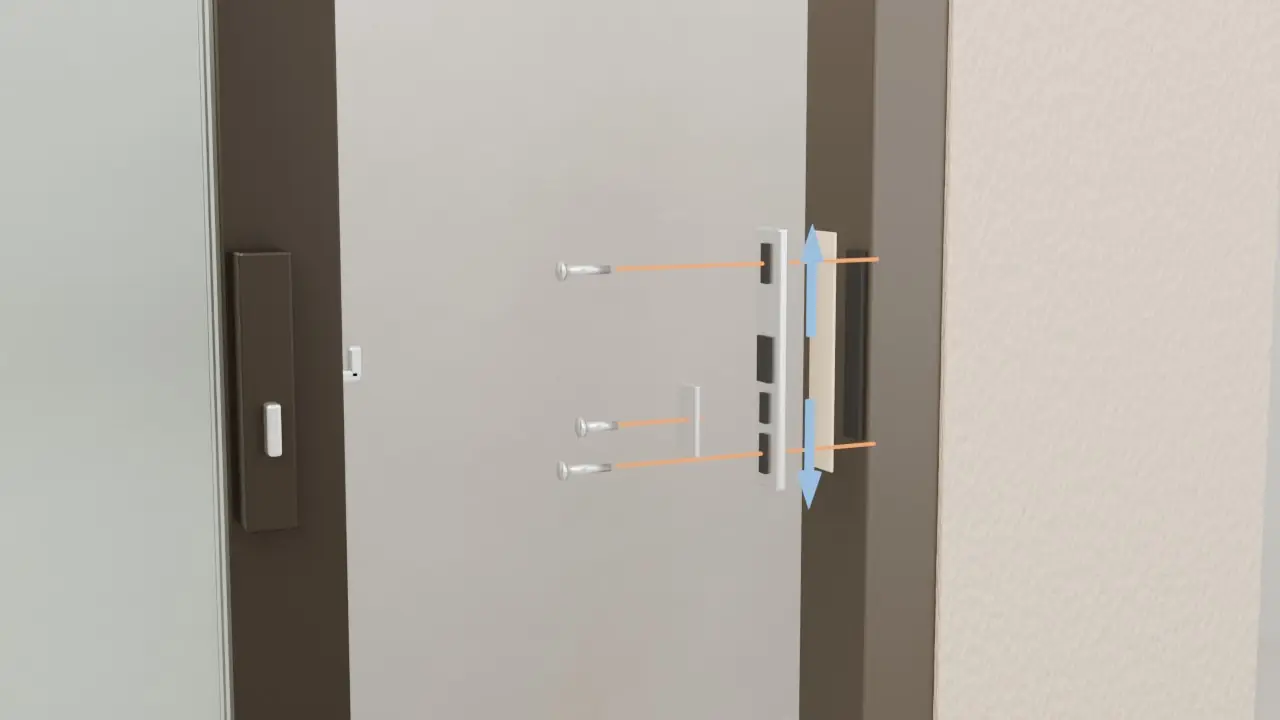
A trick that works on any brand: with the door open, put a strip of painter's tape on the frame, then close the door gently with the lock lever in the locked position until the hook just touches the frame, and mark where it lands. Milgard's screen-lock instructions use the same painter's-tape method to find where a keeper belongs (Milgard (PDF)). Move the keeper so its opening is centered on your mark.
Step 4: Set how tight it locks
Once it catches, check that it locks snugly. A door that locks but rattles, or one that locks so tight the lever fights you, has an adjustment for that too:
- Hook throw. JELD-WEN: if the door doesn't lock or is loose when locked, turn the latch adjustment screw in half-turn steps; clockwise extends the hook (looser), counterclockwise retracts it (tighter). Premium doors have a double latch and two screws (JELD-WEN (PDF)). Pella's vinyl doors have a lock-throw screw on the latch too.
- Keeper depth. Andersen's receivers have an IN/OUT adjustment screw: toward IN for a tighter fit against the weatherstrip, toward OUT for a looser one. Its current guide says to turn the screw clockwise until snug, then back off in half-turn steps if the lock is too tight. On the 100 Series with Tulsa hardware, turn the adjustment screw clockwise if the lock won't engage and counterclockwise if it engages too tightly.
- Snug matters for more than security. A loose lock lets the panel sit off its weatherstrip, which shows up as a draft at the center seam; see drafty windows and doors.
Multi-panel and pocket doors: shoot bolts
On doors with two moving panels that meet in the middle (OXXO, or a stacking multi-slide), one panel usually locks into the other, and the second panel is held by shoot bolts into the head and sill. If the main lock won't catch, check that the second panel is fully closed and its bolts are engaged first.
- Milgard OXXO doors: adjust the rollers on both panels so the sight lines are equal, close them and check that the active panel latches into the passive one; if not, adjust the strike and/or the passive panel's rollers. The shoot bolt strikes at the head and sill are slotted and move into position (Milgard (PDF)).
- JELD-WEN multi-panel doors: the shoot bolt only has 7/16 inch of adjustment, and if it hits the frame header it won't fully lock; leave a 1/16 inch gap at the header (JELD-WEN (PDF)).
Big multi-slide and pocket systems use heavier panels and often multipoint hardware. If you can't see an obvious slotted keeper, have a repair specialist or the brand's service team handle it. Our multi-slide vs. bifold guide explains how those systems carry their weight.
Hot afternoons, monsoon storms and Valley dust
A few local patterns are worth knowing before you start moving hardware:
- It only misses in the afternoon heat. UK door maker Everest notes that heat from hot weather or direct sunlight can make a patio door expand enough to stop it locking (Everest). If a west-facing slider misses only on hot afternoons, retest it early in the morning. If it locks fine cool, a small keeper adjustment made in mild weather is better than one made at 4 p.m. in July.
- Lock it for storms. Andersen's sliding doors reach their rated water and air performance when closed and locked, which is one more reason a lock that catches matters in monsoon season; see sliding door leaks when it rains.
- Dust gets into the lock. Wipe the hook and keeper when you clean the track. Use only the lubricant your door maker allows; Pella, for example, warns against oily lubricants because they collect dust.
- Pool doors. If the slider is part of your pool barrier, check its alarm or self-closing, self-latching hardware after any adjustment. Scottsdale's amended pool code (section 305.4) covers doors that open directly to a pool (Scottsdale (PDF)).
When the lock itself is broken
If the hook won't move with the door open, or the handle spins freely, the adjustment steps won't help. The common parts:
- Snib or latch lever. Milgard's instructions for replacing the lock snib: remove the mounting-plate screws (hold the handle so it doesn't fall), slide out the handle and the snib, insert the new snib so its two grooves catch in the door, and reassemble (Milgard (PDF)). Andersen says to inspect the flat bar on the back of the latch lever; if the tailpiece is broken or twisted, the lever needs replacing (Andersen).
- Lock body, trim set or receiver. Andersen publishes replacement steps for the trim set, reachout lock and receiver, by product and year (Andersen).
- Keyed locks. If the key turns but the hook doesn't, or the key won't turn, it's the cylinder or its linkage. Check with your door maker for the right part.
- Hardware that isn't made anymore. Older sliders sometimes use locks that were discontinued years ago. A sliding door repair specialist may have a retrofit kit, or it may be the push to replace the door.
Permits: the City of Scottsdale's Home Improvement page lists repairing or replacing hardware and glass panes as no-permit work. In Paradise Valley, ask the Town's Building Division through its Citizen Portal before replacing a whole door.
Repair it or replace the door?
Most lock problems are a 15-minute adjustment or a hardware part. A new door starts making sense when the lock keeps drifting out because the panel or frame has moved: rollers you've replaced still leave an uneven reveal, the sill is worn or bent, or the frame is out of square. It also makes sense when the door has other problems at the same time, like fogged glass, a leaking sill or heat pouring through single-pane glass. Our sliding door repair vs. replacement guide walks through that call.
A new slider is also a chance to upgrade the hardware. Ask dealers about multipoint locks, keyed exterior handles and how the lock is adjusted, and make sure the glass and frame meet the Valley's heat; our Low-E glass guide covers what to ask for. A whole-door replacement can need HOA review if the frame color or glass changes; see HOA rules by community.
Questions to ask a repair specialist or dealer
- Is this an alignment problem or a broken part, and which part?
- Are my rollers worn, or just out of adjustment?
- Is the replacement lock the same brand and series as my door, or a universal retrofit?
- After the repair, will the door lock without lifting or pushing, and how is it adjusted later?
- If you recommend a new door, what lock and keeper does it use, and is it adjustable?
- For a new door: what permit does the city or Town need, and who pulls it?
Get matched if it's time for a new door
If your slider keeps losing its lock because the door itself is worn out, Lux Views Co. can connect you with independent, licensed dealers in Scottsdale and Paradise Valley who work with sliding and multi-slide doors. It's free, and there's no obligation. Fill out the short form below and tell us what's going on with your door.
Sources
- Milgard: How to adjust sliding glass door lock and handle (PDF), How to adjust a strike plate on a two-panel sliding door (PDF), OXXO strike adjustment (PDF), How to replace the lock snib (PDF), Patio door screen and lock (PDF), How-to guides
- Pella: Trouble locking vinyl sliding patio door, wood, fiberglass, screen door care (oily lubricants)
- Andersen: Replace and adjust locking hardware on gliding patio doors, Inspecting and replacing the latch lever, Hardware and reachout lock instructions 0005414 (PDF), 100 Series Tulsa hardware 9020084 (PDF)
- JELD-WEN: Vinyl patio doors product guide JPG008 (PDF)
- Everest: My patio door won't lock
- City of Scottsdale: Home Improvement, Pool code section 305 with amendments (PDF)
Frequently asked questions
Why won't my sliding glass door lock?
Usually because the hook on the door's edge is closing above or below the keeper (strike) on the frame, so it has nothing to grab. That happens when the panel drops on worn or loosened rollers, or when the keeper's screws loosen and it slips. Andersen says that if the lock works normally with the door open but not when it's closed, the door needs adjusting, not a new lock.
How do I adjust the latch on a sliding glass door?
Most makers give the same order: set the panel height with the roller screws first, then loosen the keeper on the frame, slide it up or down to line up with the hook, and retighten. Milgard has you pry off the strike cover with a putty knife to reach a center adjustment screw; Pella says to mark the keeper's old spot before you move it. Then test and repeat.
Why does my sliding door only lock if I lift it or push it?
Lifting the panel tells you it has dropped: the hook is closing below the keeper. Raise the panel with the roller adjustment screws (clockwise raises on Pella and Milgard doors) until the reveal is even, then fine-tune the keeper. JELD-WEN warns not to set the rollers too high, which can let in water and air; go just high enough to clear the sill track.
Why won't my patio door lock in hot weather?
Sun and heat can make a door panel or frame expand enough that the hook misses the keeper, which door maker Everest points out for patio doors in direct sun. If yours only misses on hot afternoons, retest in the cool of the morning before you move the keeper; if you adjust it only on a hot day, it may be off again in winter.
My sliding door lock is loose when locked. How do I tighten it?
Many sliders have an adjustment screw on the edge of the lock that sets how far the hook reaches. JELD-WEN says to turn it in half-turn steps (counterclockwise retracts the hook and tightens the lock on its vinyl doors), and Andersen's latch receivers have an IN/OUT screw for a tighter or looser fit. Directions differ by brand, so check yours.
Can I replace a sliding door lock myself?
Sometimes. Milgard shows homeowners how to replace the lock snib (the part that engages the lock) by removing the handle's mounting screws, and Andersen sells trim sets, reachout locks and receivers with step-by-step guides. Match the brand, series and age of your door; discontinued hardware on older doors is where a repair specialist or a new door comes in.
Do I need a permit to fix a sliding door lock in Scottsdale?
No. The City of Scottsdale's Home Improvement page lists repairing or replacing hardware and glass panes as work that doesn't need a permit. Replacing the whole door is different: window replacement falls under the city's Minimum Window/Door Permit, so have the dealer confirm what a full door replacement needs.