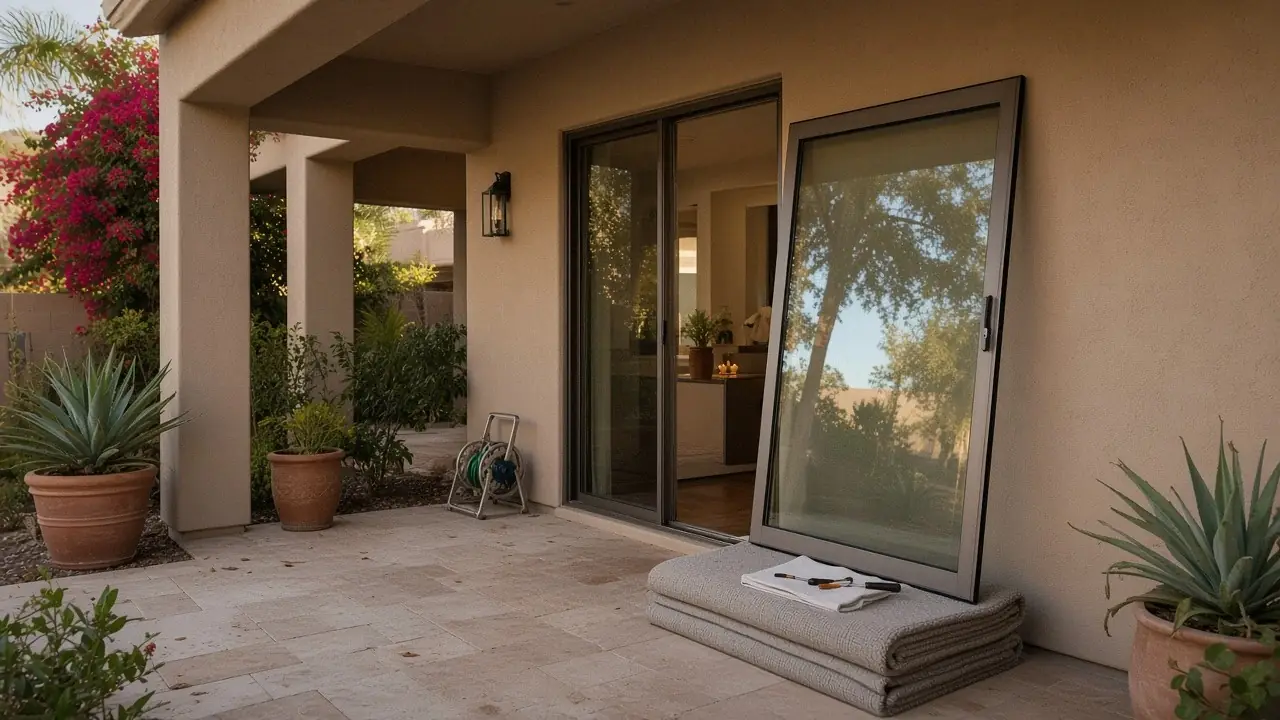
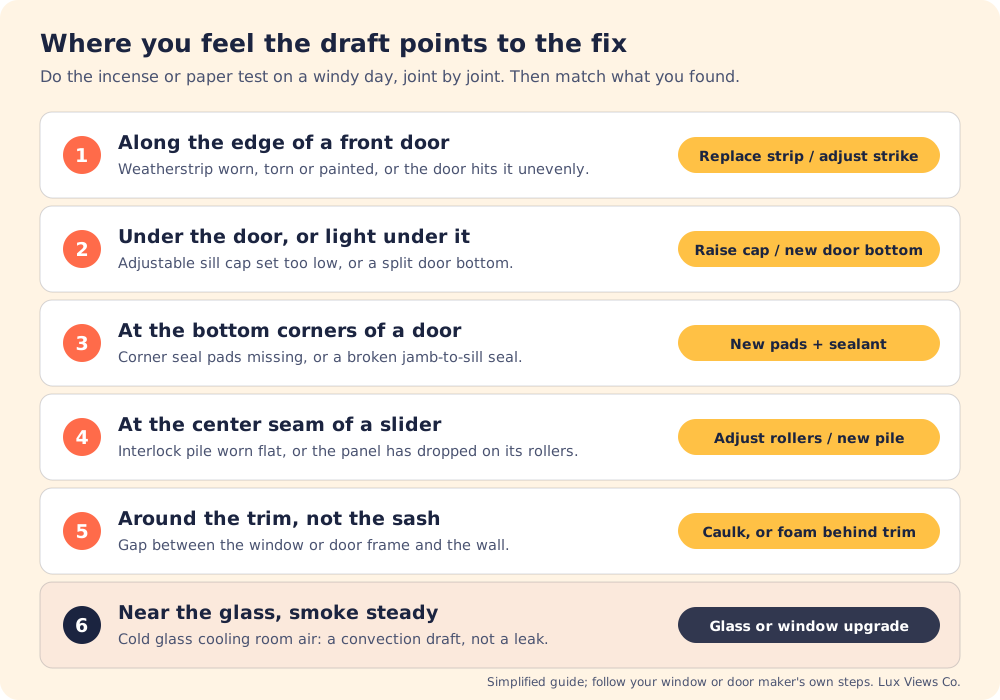
Short answer: most drafts come from one of a few places you can find yourself with a stick of incense: a worn or torn weatherstrip around a door, an adjustable sill cap set too low under it, the interlock at the center of a sliding door, or a gap between the frame and the wall behind the trim. Weatherstripping, a sill adjustment, a new door bottom or caulk fixes many of them for very little. If the frame is racked, the sash or hardware is broken, or the "draft" is really cold single-pane glass, that's when a new window or door makes sense, and when it's worth getting matched with a licensed, independent dealer.
Drafts aren't only a winter thing in Scottsdale and Paradise Valley. The same gaps that let in a chilly morning in January let in hot, dusty air in July. The Department of Energy's Building America Solution Center puts it plainly: air leaks around windows and doors cause drafts, let in dust, pollen, insects and noise, and cost you heating and cooling (PNNL Building America Solution Center).
Step 1: Find the draft
You need two things: a windy day (or the A/C or a bath fan running, so air is moving) and a way to see it.
- Incense test. ENERGY STAR's method: hold a lit incense stick next to the seams and the sash and watch whether the smoke gets pushed one way. If it does, you've probably found a leak (ENERGY STAR). The NFRC consumer guide describes the same test with a candle moved slowly along each joint, and warns not to set drapes or blinds on fire (NFRC consumer guide FAQ).
- Paper test. Close the window or door on a sheet of paper. If it slides back and forth easily, that seal could be tighter (ENERGY STAR).
- Daylight test for doors. With the lights off inside, look for daylight around the edges and under the door. Therma-Tru's troubleshooting guide treats "a draft / light is coming in around the door" as the same problem (Therma-Tru troubleshooting guide).
Test each joint separately. The NFRC guide makes the key split: air coming in between the frame and the house is an installation and sealing problem, while air coming in between the sash and the frame is a weatherstrip, adjustment or window problem.
Is it a leak, or cold glass?
If the smoke stays steady but the room still feels drafty near a window, the window may not be leaking at all. The NFRC consumer guide explains that a cold window surface cools the room air beside it; that air gets heavier, sinks toward the floor and is replaced by warmer air, which is then cooled too. The result is noticeable air movement that isn't outside air, and NFRC says replacing the window with an energy efficient one is the fix (NFRC consumer guide FAQ). Its design guide notes the same thing: higher-performance windows with lower U-factors keep the inside glass warmer, which means more comfort (NFRC cold-climate design guide (PDF)).
That matters in older Valley homes. If your house still has its original single-pane windows, the glass itself is the cold (and, in summer, hot) surface, and sealing the frame won't change how it feels. If that's your house, see the 1970s & 80s McCormick Ranch window guide and how long windows last in Arizona.
Front doors: weatherstrip, sill cap, door bottom
Entry doors have three seals that wear: the weatherstrip in the jamb that the door closes against, the door bottom (sweep or gasket) on the bottom of the slab, and the sill or threshold under it, which on many doors has an adjustable cap. Small foam corner seal pads close the joint where the jamb meets the sill.
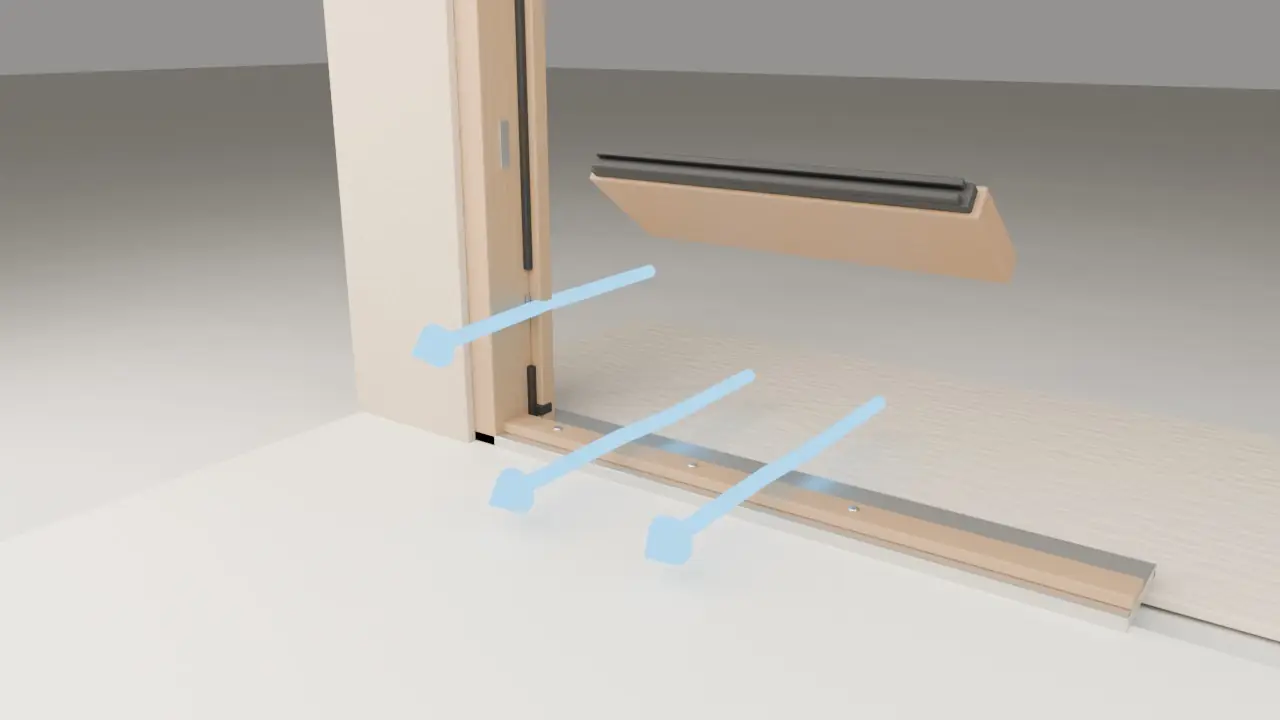
Therma-Tru's troubleshooting guide lists the usual causes of a draft or light around the door (Therma-Tru):
- Weatherstrip missing, painted, cracked, torn or damaged: replace it. Weatherstrip that got painted along with the trim stops compressing, so it counts too.
- The door doesn't meet the weatherstrip evenly (it hits the top or bottom first): the lock-side jamb needs to be realigned and reshimmed. That's usually a job for a door specialist.
- Bottom corner seal pads missing: replace them.
- The door moves in and out when latched: adjust the strike plate for a tighter fit.
Under the door. Therma-Tru's owner's manual says an adjustable threshold cap is set right when it's snug and slightly difficult to pull a dollar bill out from under the closed door, and the bill comes out without tearing. Check it at each adjustment screw (Therma-Tru owner's manual (PDF)). If the door bottom gasket is splitting, cracking or pulling away from the slab, the manual says to replace the door bottom. It also recommends inspecting the whole door system at least once a year, including weatherstrip and door bottom wear.
Replacement weatherstrip and door bottoms are made to fit specific door systems, so match the brand and profile. The easiest way is to find the maker's label on the door edge or frame and order the part for that door. On a door that's out of square, sagging, or has a humped or damaged sill, Therma-Tru's fixes involve reshimming jambs and resealing under the sill, which is a door specialist's work rather than a weekend fix.
Sliding glass doors: the interlock and the rollers
On a slider, the weak spot is usually the interlock, the vertical seam where the moving panel hooks onto the fixed panel. JELD-WEN's patio door guide explains that the interlocks join when the door closes and that a strip of weatherstrip in the interlock makes the seal; sliding door weatherstrip also runs around the perimeter of the moving panel (JELD-WEN wood patio doors guide (PDF)).
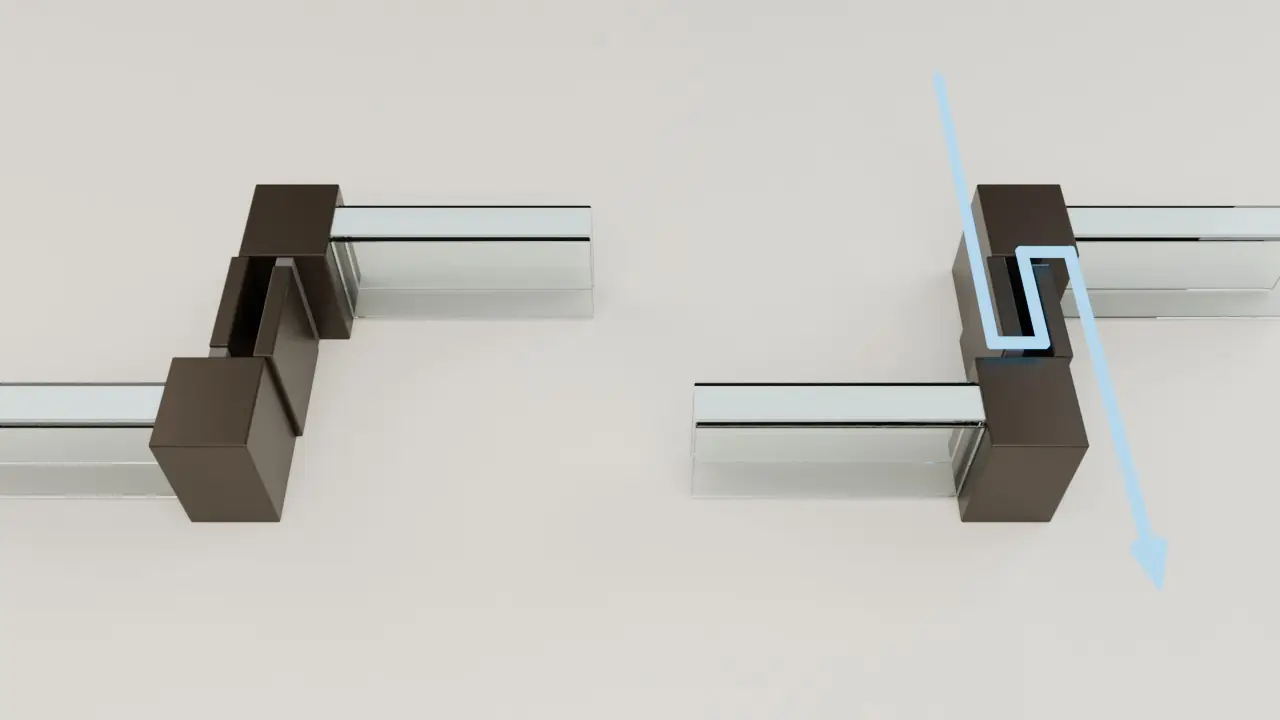
What to check, in order:
- Clean first. Milgard's care guide says to inspect and clean weatherstrip with a damp cloth or mild soap and water, rinse and dry it, and replace damaged weatherstrip promptly. It also says to vacuum or wipe the tracks, which matters after dust storms (Milgard care and maintenance guide (PDF)).
- Check the panel's line-up. If the moving panel has sagged on worn rollers, it may no longer meet the interlock squarely. JELD-WEN's guide says to adjust the rollers just high enough to clear the sill track and keep the weatherstrip hidden when the door is closed, and to check for an even, parallel gap as you almost close the door. Its warning: adjusting the door too high may let in water and air.
- Replace worn weatherstrip. JELD-WEN's steps for interlock weatherstrip: remove the moving panel, pull the old seal, cut the new one to length and press it into the same groove. To order, measure each piece, add about 10 percent and round up to the nearest foot.
Taking the panel out for weatherstrip or rollers is a two-person job; see how to remove a sliding glass door first. If the panel drags or sticks too, why a sliding door gets hard to open covers rollers and tracks.
Windows: weatherstrip and caulk
For the moving parts of a window, the fix is weatherstrip; for the joints that don't move, it's caulk.
- Weatherstrip seals the sash to the frame. The NFRC guide says it should compress when the sash is shut, should go on clean, dry surfaces above 20°F, and wears out over time: felts absorb moisture, brush or pile types mat down, and plastics and rubber get brittle or sticky (NFRC: caulking and weatherstripping). The Building America guide's steps: remove the old weatherstrip, clean with dish soap and water, let it dry, cut and install the new strip, then open and close the window to make sure it still closes completely.
- Window type matters. The UMass Amherst Building and Construction Technology program notes that hinged windows like casements and awnings clamp much more tightly against their weatherstripping than sliding and double-hung windows (UMass Amherst BCT). Sliding windows rely on pile weatherstrip that wears the same way a sliding door's does.
- Caulk seals fixed joints, including the joint between the frame and the wall. The NFRC guide says caulk works for cracks and joints no more than a quarter inch wide, that old caulk or paint should be removed first, and that it needs temperatures above 45°F to set and adhere. Pick a mild day, and check the tube's own temperature and sun limits for exterior work.
- Bigger gaps behind the trim. ENERGY STAR's project guide covers removing interior trim and filling the gap between the window or door frame and the wall with low- or non-expanding foam, or backer rod, then caulk. It warns not to force backer rod in so hard that it bends the frame, and points homeowners in pre-1978 homes to the EPA's lead-safe renovation guidance before disturbing paint (ENERGY STAR).
One rule outside: never caulk the weep slots at the bottom of a window or slider frame. They drain water out, and sealing them is how a draft fix turns into a monsoon leak. See how to stop a window leaking when it rains.
When the window or door is the problem
Seals can't fix everything. The NFRC guide says that if an installation twists or racks the window frame so the sash weatherstrip can't seal, removing the window to correct it may be necessary, and that if the window is square and still leaks between sash and frame, the problem may be the window's construction or design (NFRC FAQ). A new window or door is worth pricing when:
- The frame is racked or out of square, or a door no longer meets its weatherstrip evenly even after adjustment.
- The sash, locks or rollers are broken and parts aren't available.
- It's single-pane, and the cold or heat is coming through the glass.
- There's more going on: foggy glass, leaks, or a door that's hard to open.
If you do replace, ask for the air leakage (AL) rating. ENERGY STAR Version 7 requires 0.3 cfm per square foot or less for windows and sliding doors and 0.5 or less for swinging doors (ENERGY STAR V7 specification (PDF)). The model energy code, IECC section R402.4.3, uses the same limits for windows, sliding glass doors and swinging doors tested to NFRC 400 or the North American standard (UpCodes: R402.4.3). AL is optional on the NFRC label, so it isn't always printed there. Lower is better, and the UMass article suggests looking for certified rates under 0.30. For glass, see Low-E glass types compared, and for the whole package, the best windows for Arizona heat.
Permits and HOA rules
Fixing a draft usually doesn't need a permit. The City of Scottsdale's Home Improvement page lists repairing or replacing non-structural items such as glass panes, hardware and trim work as work a homeowner or their contractor can do without a permit or city approval. Adding or replacing windows is different; it falls under a Minimum Window/Door Permit, with the exception of replacing only the glass in an existing frame (City of Scottsdale). In Paradise Valley, check with the Town's Building Division through the Citizen Portal before replacing a window or door. See permits for windows and doors.
HOAs care about what shows from the street. Exterior caulk, paint and new frame colors may need to match approved colors, and some communities spell out who handles the stucco and caulk around a new window. The city page itself reminds homeowners that subdivision CC&Rs may govern items the city doesn't regulate. Check the Scottsdale HOA window rules directory for your community.
Questions to ask a dealer
- Is the draft coming through the seals, around the frame, or through the glass? Can you show me?
- Can this be fixed with weatherstrip, an adjustment or new rollers, or does the window or door need to be replaced, and why?
- If replacing: what's the air leakage rating of the product you're quoting, and the U-factor and SHGC?
- Retrofit or full-frame, and how will the joint between the new frame and the stucco be sealed? (See retrofit vs. full-frame.)
- For a front door: is the sill adjustable, and are the weatherstrip and door bottom replaceable parts?
- What permit and HOA approvals will this need, and who handles them?
Get matched with a dealer
Lux Views Co. is a free referral service, not a contractor. If the seals aren't the whole story, fill out the short form below and we'll match you with licensed, independent dealers who serve Scottsdale and Paradise Valley. They can see the window or door in person and put the recommendation and full scope in writing. See also window replacement, door replacement and sliding and patio doors.
Sources
- PNNL Building America Solution Center: Add Weatherstrip to Windows and Doors
- ENERGY STAR: Sealing Behind Window & Door Trim; Residential Windows, Doors and Skylights Version 7.0 specification (PDF)
- NFRC Consumer Guide to Windows: FAQ; Caulking and Weatherstripping
- UMass Amherst Building and Construction Technology: Windows: Understanding Energy Efficient Performance
- Therma-Tru: Troubleshooting Guide; Owner's Manual (PDF)
- Milgard: Care and Maintenance Guide (PDF)
- JELD-WEN: Wood Patio Doors product guide (PDF)
- UpCodes: R402.4.3 Fenestration Air Leakage
- City of Scottsdale: Home Improvement permits
Steps are summarized from each source's published guidance as of November 2, 2026. Follow the instructions for your specific window or door, and keep any open flame away from curtains and blinds when testing. Lux Views Co. is not affiliated with any manufacturer named here.
Frequently asked questions
How do I find where a window or door draft is coming from?
On a windy day, hold a stick of lit incense along each joint (where the sash meets the frame, where the frame meets the wall, and around the door edges and bottom) and watch for smoke that gets pushed sideways. ENERGY STAR also suggests a paper test: close the window or door on a sheet of paper, and if it slides out easily the seal could be tighter. Keep any flame away from drapes and blinds.
Can you fix drafty windows without replacing them?
Often, yes. Worn weatherstripping can be replaced, gaps of a quarter inch or less around trim can be caulked, and larger gaps behind interior trim can be filled with backer rod or low-expansion window and door foam. Replacement makes more sense when the frame is racked so the sash can't seal, the hardware or sash is broken, or the window is single-pane and the 'draft' is really cold glass.
Why does cold air come in under my front door?
Usually the door bottom isn't meeting the sill. Many entry doors have an adjustable sill cap with screws: Therma-Tru says it is set right when a dollar bill pulled from under the closed door is snug and slightly hard to pull out but doesn't tear, checked at each screw. If the door bottom gasket is split or pulling away, it needs to be replaced.
Why is there a draft in the middle of my sliding glass door?
The center seam is the interlock, where the moving panel hooks onto the fixed panel. Drafts there usually mean the pile weatherstrip is worn or the panel isn't lined up with the interlock. JELD-WEN's guide says to adjust the rollers just high enough to clear the sill track and keep the weatherstrip hidden, and warns that setting the door too high can let in air and water. Worn interlock weatherstrip can be replaced.
My window feels drafty but the incense smoke doesn't move. Why?
It may be cold glass, not a leak. The NFRC consumer guide explains that a cold window surface cools the room air next to it, that air sinks toward the floor and is replaced by warmer air, and the circulation feels like a draft. Single-pane windows, common in older Valley homes, do this the most. Better glass or a new window is the fix, not caulk.
What air leakage rating should new windows have?
ENERGY STAR Version 7 requires windows and sliding doors to be rated at 0.3 cfm per square foot or less, and swinging doors at 0.5 or less. The model energy code (IECC section R402.4.3) uses the same limits for new windows, sliding glass doors and swinging doors. The rating is optional on the NFRC label, so ask the dealer for it.
Do I need a permit to fix a drafty window or door in Scottsdale?
Not for repairs like hardware or trim. The City of Scottsdale's Home Improvement page lists repairing or replacing non-structural items such as glass panes, hardware and trim work as no-permit work. Replacing the window or door itself falls under the city's Minimum Window/Door Permit. HOAs may still have rules on exterior caulk and paint colors.