Short answer: first figure out where the water shows up. Water on the sill during a storm usually means the window's weep slots can't drain, so clear them and test the drainage (Milgard and Andersen both say some water in the sill is normal). Water at the sides or top points to the sealant joint, the flashing around the opening, or the wall above. Find it with a gentle hose test, low to high, before you caulk anything, and never caulk the bottom edge or the weep slots: that traps the water inside.
First: is it a leak, or is the window doing its job?
Most windows aren't sealed watertight at the bottom. Rain runs down the glass, some of it gets into the sill or the lower track, and small slots on the outside face of the frame (weep holes) let it drain back out. The makers are clear about it:
- Milgard says in its FAQ that water on the inside of a window during a storm "may be present," because its weep system drains water to the outside "as it builds up on the sill or outside track."
- Pella's cleaning instructions say to keep the weep holes clear of dirt and debris with a small, soft brush so the sill can drain.
- Andersen calls its sill design a "contain and drain" system that briefly holds water and releases it through exterior weep holes (Andersen Help Center).
So a little water sitting in the track during a monsoon downpour isn't a defect. It's a leak when water doesn't drain, stays after the rain stops, spills over the inside edge of the frame, or shows up anywhere other than the sill: the sides, the top, the drywall, the ceiling or the floor.
Where the water shows up tells you where to look
Dry the area, then watch where the water appears first in the next storm or during the hose test below. Take photos before it dries; they help any repair specialist or dealer later.
| Where you see water | Most likely cause | Who usually fixes it |
|---|---|---|
| Pooled in the track, not draining | Blocked weep slots or covers, dirt in the track | You (cleaning), then a repair specialist if it still won't drain |
| Spilling over the inside edge of the sill in a hard storm | Weep system overwhelmed or blocked; wind-driven rain; window left unlocked | You first, then a repair specialist |
| Under the window, on the wall or floor below | Missing or damaged sill pan, caulk across the bottom edge, frame corner joint | Professional |
| Down the sides of the frame | Failed sealant between frame and stucco, side flashing gap | Professional (sealant can be a small repair) |
| At the top of the frame | Head sealant, missing head flashing or drip edge, water from above | Professional |
| On the wall or ceiling above the window | Stucco cracks, roof edge, gutter or roof-to-wall flashing; the window may be fine | Roofer or stucco specialist, plus window check |
| Between the panes of glass | Failed seal in the glass unit, not a rain leak | See our foggy double-pane guide |
Monsoon storms make this harder, because they often bring rain sideways from one direction. If a window only leaks when the storm comes from the southwest, write that down: it narrows the search to the exposed side of the house.

Step 1: Clear the weep slots
This is the fix for most sill leaks, and it's free. Weep slots are small horizontal openings on the outside bottom of the frame, sometimes behind a flap or cover. On sliding windows there are often matching holes inside the track as well.
- Find them. Look along the outside bottom of the frame. If you can't find any, look closely for paint or caulk smeared over them. The Department of Energy's Building America guide to cleaning window weep holes warns that caulk over the weeps is a common cause of trapped water.
- Pop off the covers. Milgard's instructions use a putty knife to lift each weep cover and check that its flap moves freely.
- Clear the channel. A pipe cleaner, small bottle brush, paper clip or crochet hook works. Pull debris out rather than pushing it deeper. Andersen and Pella also recommend a pipe cleaner or a small, soft brush.
- Clean the track. Vacuum dust and sand out of the sill track. On many sliding windows you can lift the sash out for better access; Milgard's sliding-window care sheet shows how.
- Put the covers back so wind can't blow straight in.
A good time to do this is in late spring, before the monsoon season. The National Weather Service defines Arizona's monsoon season as June 15 through September 30. Milgard's own advice is to clean weep holes "when excessive rain is anticipated."
Step 2: Test the drainage
Once the weeps are clear, prove they drain:
- Quick test: pour a cup of water into the track (or mist the outside of the glass) and watch the weep slots from outside. Water should come out. That's the check in the Building America guide.
- Milgard's 10-minute test: with the sash out, tape over the weep holes, fill the track about halfway, and wait at least 15 minutes. If the water level doesn't drop, there's no leak in the track itself. Then pull the tape and make sure it drains freely. Milgard's printable version is here.
If the water level drops while the weeps are taped, water is escaping somewhere it shouldn't, often through a frame corner or the joint under the window. That's a job for a professional.
Step 3: Look at the joint between the window and the stucco
On most Scottsdale and Paradise Valley homes, the window sits in stucco, and a bead of sealant covers the joint where the frame meets the wall. Years of sun take a toll on that bead. Walk around the outside and look for:
- Sealant that's cracked, shrunken, hard, or pulling away from the frame or the stucco
- Gaps you can see into at the corners
- Hairline cracks in the stucco running from the window corners
- Dirt trails or stains on the stucco below a corner (water has been running there)
Sealant on the sides and top is meant to be continuous. The bottom is different: Andersen's guide to installing windows for continuous water control seals the sides and top of the window's flange but leaves the bottom unsealed "to allow water to escape." If someone has run a fresh bead of caulk across the bottom of the frame, that bead may be the reason the sill now fills up.
Step 4: Find the source with a gentle hose test
If the weeps drain and you still can't see the problem, recreate the rain. You need a garden hose, a helper inside with a towel and a phone camera, and patience.

- Start low. Spray the sill and the bottom corners for several minutes while your helper watches inside.
- Move to one side, then the other. Keep the spray on that zone only.
- Then the top of the window.
- Then the wall above, including any roof edge or gutter close by.
- Stop when water appears. The last zone you wet is the likely entry point. Dry everything and repeat that zone to confirm.
Keep the spray gentle. Milgard says never to use high-pressure water hoses on its windows, and pressure can force water where rain never goes. Professionals who investigate leaks follow FGIA's AAMA 511 guideline for forensic water testing of installed windows, which tests the window and the joint around it separately. If your simple test is inconclusive, that's the kind of testing to ask for.
What not to do
- Don't caulk the weep slots or the bottom edge of the frame. It traps water in the sill and the wall.
- Don't power-wash windows or blast them with a nozzle. Pressure pushes water past seals that hold up fine in normal rain.
- Don't smear caulk over every joint you can see. If the water is getting in behind the stucco or at the flashing, surface caulk hides the leak while the wall stays wet.
- Don't ignore it until next monsoon. Soft drywall, bubbling paint, a swollen baseboard or a musty smell below a window can mean water has been getting in for a while.
When it's the flashing, not the window
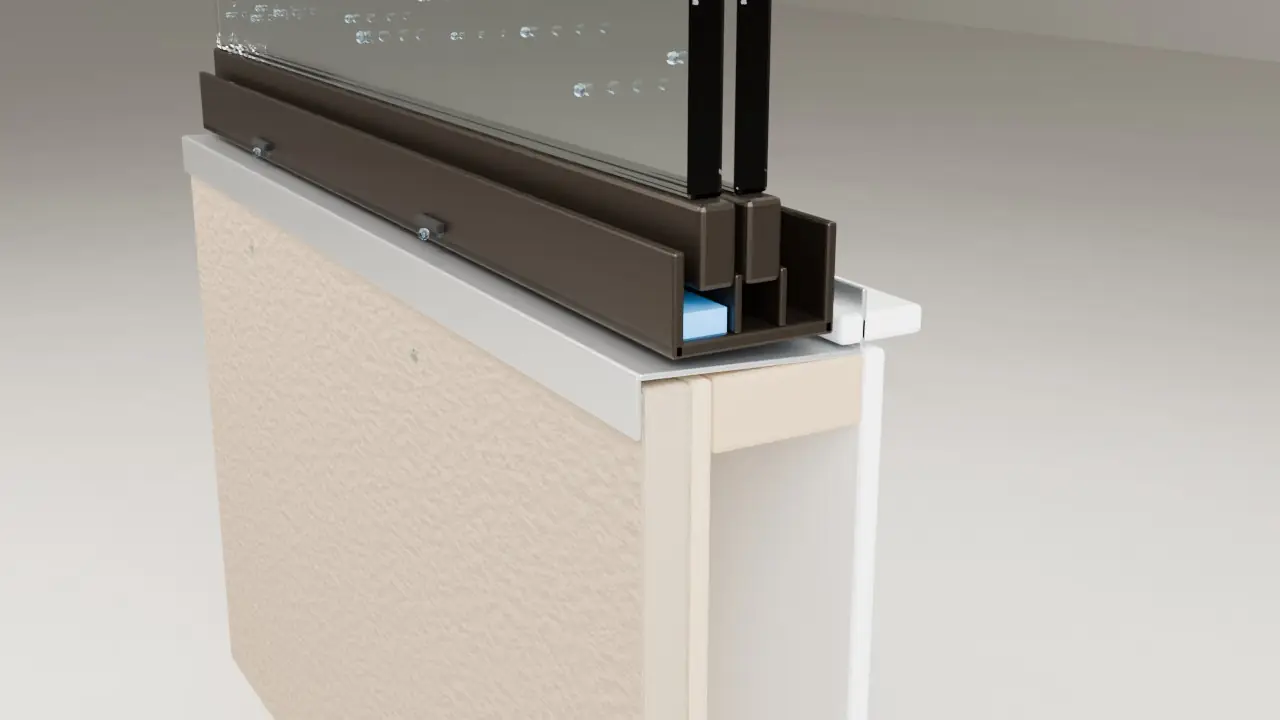
A window is only one part of the wall's water protection. Behind the stucco, there's a weather-resistant barrier (building paper or wrap), and around the opening there should be flashing that sends any water that gets past the window back outside. The order of the layers matters: each layer should overlap the one below it, like shingles.
The Department of Energy's Building America guide to window and door flashing describes the sequence:
- A sill pan at the bottom of the opening, angled to drain water out.
- Flashing along the sides (jambs), lapped over the sill pan and under the head flashing.
- Head flashing at the top, lapped over the side flashing, with the barrier above lapped over it.
- Weep holes left open at the bottom of the window.

When a sill pan is missing, a side strip is lapped the wrong way, or the head flashing is gone, water gets behind the stucco and can show up at the window even when the window itself is fine. You can't fix that from the outside with caulk. It means opening up the wall around the window, which is why a flashing leak and a window replacement often end up being the same project.
Retrofit or full-frame: why it matters for leaks
If you're replacing leaky windows, the installation method decides whether the flashing gets fixed:
- A retrofit (insert) window goes inside the old frame. It's less disruptive, but it relies on the old frame and whatever flashing is already in the wall.
- A full-frame replacement removes the old frame down to the opening. That lets the opening be inspected, repaired, and flashed with a new sill pan before the new window goes in, then the stucco is patched.
If water is getting into the wall around a window, ask for the full-frame option to be quoted, and ask how the opening will be flashed. Our retrofit vs. full-frame guide covers the trade-offs in more detail.

When a new window makes more sense
A leak alone isn't a reason to replace a window. It starts to be one when:
- The frame or sill is cracked, warped, or sloped toward the house
- The leak keeps returning after the weeps, sealant and weatherstrip have been fixed
- Testing points to the flashing around the opening, which means opening the wall anyway
- The windows are original single-pane or early dual-pane units that are also hot, drafty, or foggy between the panes (see how long windows last in Arizona)
If you are replacing, it's also a chance to choose hot-climate glass; our best windows for Arizona heat guide covers the ratings and the current SRP window rebate terms.

Permits and HOA approval
- Scottsdale: the city's Home Improvement page lists replacing just the glass in an existing frame as no-permit work, and adding or replacing windows under a Minimum Window/Door Permit. Sealant and weep cleaning are maintenance. See our permit guide for the details.
- Paradise Valley: applications go through the Town's online Citizen Portal; ask the Building Division what a window replacement needs, and check hillside rules if your lot is on a slope.
- HOAs: most master-planned communities review new windows. Some also set rules for the stucco and caulk work that comes with them. Gainey Ranch's Pavilions Standards and Rules (updated March 2025), for example, make the owner responsible for stucco repairs, patching and perimeter exterior caulking after a window replacement, require the stucco to sit within 3/8 inch of the frame to allow for the perimeter caulk, and require the patched texture to match. See HOA window and door rules by community.
Questions to ask a repair specialist or dealer
- Where exactly is the water getting in, and how did you confirm it?
- Is this a window problem, a sealant problem, or a flashing or wall problem?
- Can it be repaired, and what would a repair include?
- If you recommend replacement, are you quoting retrofit or full-frame, and why?
- How will the opening be flashed? Will there be a sill pan, and how do the side and head flashing lap?
- Which edges get sealant, and how do you keep the bottom edge and weep slots open?
- How will the stucco be patched and painted to match, and does my HOA have rules for that?
- What do the product warranty and the installation warranty each cover if it leaks again?
Get matched if the fix is a new window
If your leak turns out to need new windows or a re-flashed opening, Lux Views Co. can connect you with an independent, licensed dealer in Scottsdale or Paradise Valley. It's free, and there's no obligation. Fill out the short form below and tell us which windows leak and when.
Sources
- Milgard: Frequently Asked Questions (water during storms, weep cleaning), Window and door care tips, How to test the weep system, How to maintain your sliding window, Care and Maintenance Guide (no high-pressure hoses)
- Andersen: Water standing in the sill (contain and drain), Clean weep holes, Installing windows for continuous water control
- Pella: Cleaning Pella windows and patio doors
- U.S. Department of Energy, Building America Solution Center (PNNL): Clean window weep holes, Look for missing window and door flashing
- FGIA: AAMA 511-22, guideline for forensic water penetration testing of fenestration products
- National Weather Service Phoenix: monsoon season (June 15 to September 30)
- City of Scottsdale: Home Improvement
- Gainey Ranch Community Association: The Pavilions Standards and Rules (Section 26)
Frequently asked questions
Why does my window leak only when it rains hard?
Most windows are built to let a little water into the sill and drain it back out through weep slots on the outside of the frame. In a hard, wind-driven monsoon storm, water can arrive faster than a partly blocked weep system drains it, or wind can push it through a sealant gap that stays dry in light rain. That's why a window can be dry for months and leak in one storm.
Is water in my window track normal?
Some water is. Milgard says it's normal for water to build up on the sill or in the outside track during rain because its weep system drains it to the outside, and Andersen describes its sill as a contain-and-drain system that holds water briefly and releases it outside. It's a problem when the water doesn't drain, stays after the rain stops, or spills over the inside edge of the frame.
Why is my window leaking from the top?
Water at the top of the frame usually isn't coming through the window itself. Common sources are a failed sealant joint at the head, missing or poorly lapped head flashing, cracks in the stucco above, or water from a roof edge or gutter running down the wall and getting behind it. Test the window first, then the wall above it, to tell them apart.
Why is my window sill leaking when it rains?
Start with the weep slots on the outside bottom of the frame. If dirt, bugs or paint block them, the sill fills up and water spills inside. If the weeps drain fine, the leak may be under the window: a missing or damaged sill pan, or caulk that was run across the bottom edge and trapped the water it was supposed to let out.
Should I caulk around a leaking window?
Only after you know where the water gets in, and never across the weep slots or the bottom edge of the frame. Andersen's installation guidance seals the sides and top of a window but leaves the bottom flange unsealed so water can escape, and the Department of Energy's Building America guide warns not to seal weep holes. Fresh caulk over a flashing problem usually hides it for a while instead of fixing it.
Can a leaking window be repaired, or do I need a new one?
Many leaks are repairs: cleaning weep slots, replacing failed sealant, or fixing worn weatherstrip. A new window makes more sense when the frame or sill is cracked, the leak keeps returning after the window itself tests dry, the opening needs new flashing, or the windows are old and failing in other ways too. A full-frame replacement exposes the opening so it can be flashed properly.
Do I need a permit to fix a leaking window in Scottsdale?
Repairs to glass and hardware usually don't. The City of Scottsdale's Home Improvement page lists replacing just the glass in an existing frame as no-permit work, and replacing windows under a Minimum Window/Door Permit. If the fix is a new window, have your dealer confirm the permit; in Paradise Valley, ask the Town's Building Division through its Citizen Portal. Your HOA may also need to approve new windows and stucco patching.