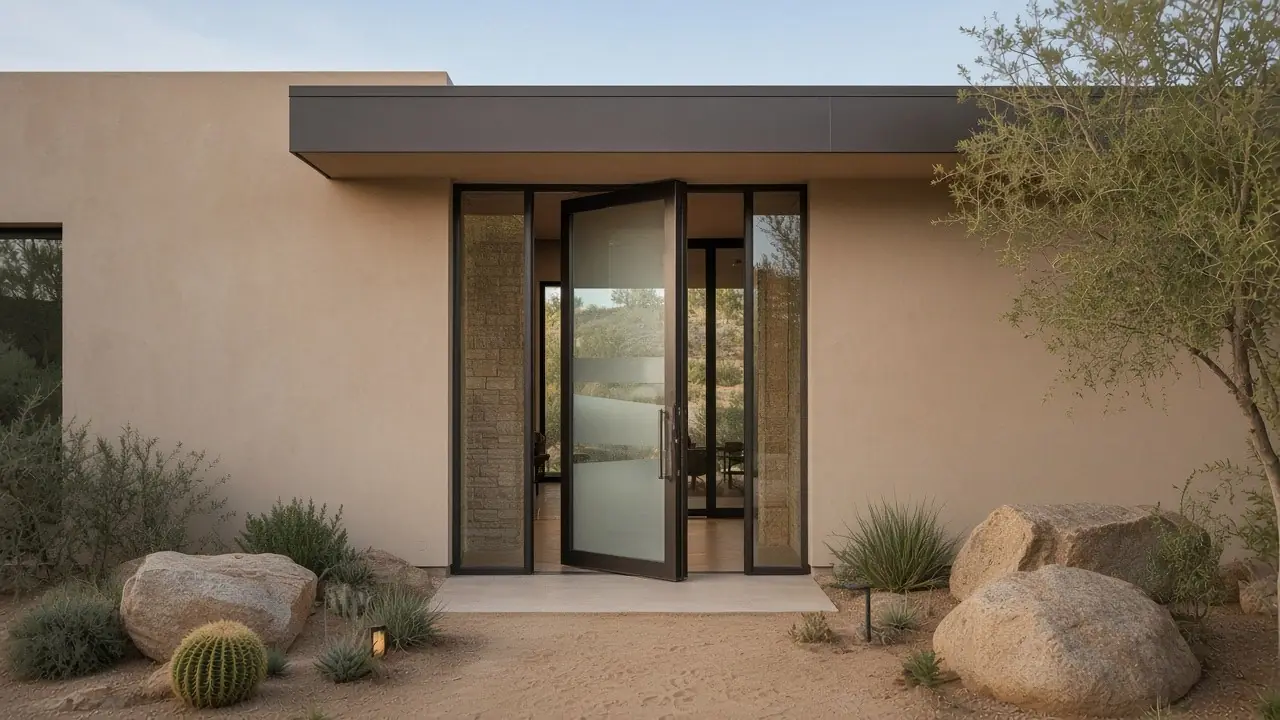
Short answer: a pivot front door turns on a pin set into the floor and the head instead of on side hinges, which lets it be much wider, taller and heavier than a hinged door. Before you order one in Scottsdale or Paradise Valley, settle five things: the size and pivot offset, the hardware rated for the door's weight, how it seals at the threshold and edges, how much afternoon sun hits it, and whether you're keeping the same opening or enlarging it, which decides the permit. If you're in an HOA, the design review committee approves it first. Lux Views Co. is a free referral service: fill out the short form and a participating independent dealer will measure, quote and handle the work.
If you're still choosing a door style, start with our pivot and entry doors page. This guide goes deeper on planning and approvals.
Sizes: how big a pivot door can go
The main reason people pick a pivot is size. Because the weight rides on a floor pivot rather than hanging from hinges on the jamb, pivot doors are commonly built much wider and taller than a standard entry door. The real limits come from:
- The hardware's weight and width rating. FritsJurgens, a common pivot hinge maker, rates its System M for doors from 20 to 210 kg and System M+ for 20 to 500 kg, with no height limit on the hinge itself (FritsJurgens technical documentation). Other makers publish their own ratings, so ask which hardware the quote includes.
- Door thickness. The same documentation sets a minimum door thickness of 40 mm (about 1.6 inches) for its hinges.
- The opening and structure. A taller or wider door needs a header sized for the new span and a floor that can take the pivot's anchoring. On a slab-on-grade Scottsdale home, the floor pivot is usually set into the slab or the finished floor.
- Getting it into the house. Very large doors are heavy and need room and crew to deliver and set.
Pivot offset: where the door turns
The pivot offset is the distance from the pivot point to the nearer edge of the door, and it changes how the door looks and moves:
- Small offset: the door swings close to the edge of the opening, much like a hinged door, and leaves most of the opening clear.
- Larger offset: when the door is open, part of it sits on each side of the opening, splitting it into two passages. That's the dramatic "floating" look, but it means less clear walkway on each side.
FritsJurgens' documentation puts the minimum at 91 mm (about 3.6 inches) from the pivot point to the door edge and the maximum at the middle of the door. Ask the dealer to sketch the open-door footprint on your entry, including where furniture, sidelites or a step sit.
Hardware: hinge, closer and lock
Pivot hardware comes in several types: floor pivots with a separate top pin, concealed pivot hinges built into the door, and systems with a built-in closer, speed control or hold-open positions. When you compare quotes, look for:
- the hardware maker and model, and the door weight it's rated for
- whether it includes a closer or speed control, and hold-open positions
- the lock and handle set (pivot doors often use long pull handles with a separate deadbolt or a multipoint lock)
- the finish, and whether it's rated for exterior use
Threshold and weather seals
A hinged door closes against a stop on three sides. A pivot door turns in the middle of its own edge, so sealing it is more design-dependent. Ask how the specific door seals:
- At the pivot side and the latch side, where the door edge meets the frame or wall
- At the top, where hardware gaps are set (FritsJurgens lists a 4 to 10 mm top gap for its systems)
- At the threshold, where the bottom gap for the pivot is set (11 mm for System M+/M). Many exterior pivots use a drop-down bottom seal or a raised threshold to close that gap.
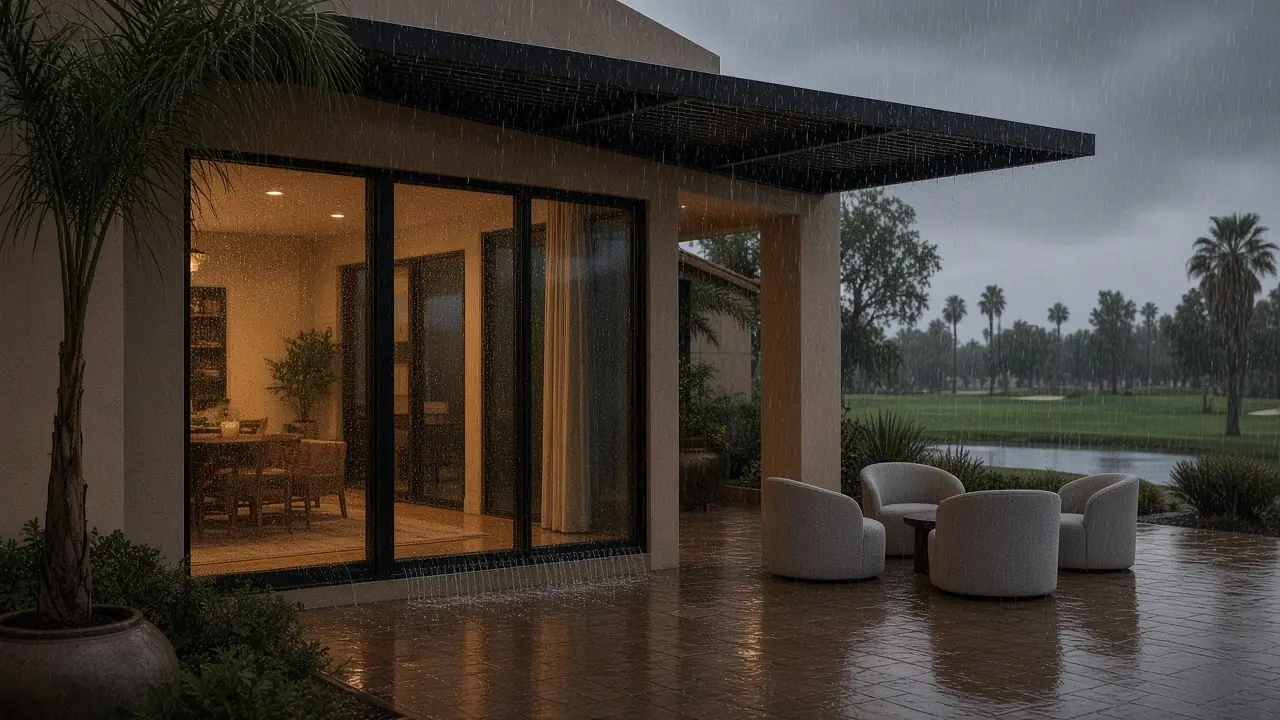
In the desert, dust storms and monsoon rain test those seals more than cold does. Have the dealer explain how water that gets past the seal drains out, especially if the entry isn't covered. The building code also limits how far the outside landing can sit below the threshold, so plan the step and threshold together.
Sun and heat on a big door
West- and south-facing entries in Scottsdale and Paradise Valley can take hard afternoon sun, and a bigger door means more surface soaking it up:
- Material: fiberglass and thermally broken aluminum with glass hold up well; wood looks great but wants a deep overhang and regular refinishing. Our guide to front door materials that hold up to Arizona sun compares them.
- Finish color: dark finishes absorb more heat. Ask how the factory finish is rated for desert exposure.
- Glass: glass in a door is a hazardous location under the building code, so it must be safety glass (tempered or laminated). A Low-E coating helps keep the entry cooler. See Low-E glass types compared.
- Shade: the overhang depth over the entry often matters as much as the material.
Replacing a hinged door with a pivot: same opening or bigger
Same opening. A pivot can often go into the existing rough opening. The work is mostly anchoring the pivot in the floor and head, setting the threshold for the pivot, and finishing the stucco and trim. Scottsdale's Home Improvement page lists door glass and hardware as work that doesn't need a permit, but it doesn't spell out a whole new exterior door, so have your dealer confirm the permit with the city.
Wider or taller opening. Most people switching to a pivot want more door. That usually means a new header and wall changes, which is structural work and changes the building exterior:
- Scottsdale: structural changes need a building permit with plan review. The city's One Stop Shop can confirm what your project needs.
- Paradise Valley: every building permit goes through the Town's online Citizen Portal, and the Town's Permits page explains the process. Building permit uploads include an HOA acknowledgement if you're in an HOA.
- Exits: IRC section R311.2 requires at least one side-hinged egress door per home, with at least 32 inches of clear width (measured with the door open 90 degrees) and 78 inches of clear height. Scottsdale enforces the 2021 IRC, and its 2022 local amendments don't change R311.2. Paradise Valley lists the 2015 IRC, which has the same R311.2 wording. If the pivot replaces your main entry, confirm another side-hinged exterior door meets it.
More detail is in Do I need a permit to replace windows or doors?
HOA rules for front doors
Front doors face the street, so design review committees look at them closely. What some communities' own documents say:
- Desert Mountain: replacement doors and windows are a Minor Modification on the Architectural Review Application, colored, mirrored or highly reflective glass isn't allowed, and the guidelines' fee schedule lists the Minor Modification review at $1,000 (fees can change, so confirm with the HOA).
- Grayhawk: doors and windows must be recessed rather than flush, and no exposed metal, including wrought iron, is allowed on doors or windows except ARC-approved security doors. That matters if you're considering an iron pivot.
- McCormick Ranch: the Executive Director can approve a front door replacement at staff level, front doors may be semi-flat or satin, and samples (a catalog page counts) go to the office in person or by mail.
- DC Ranch: door submittals need photos of the existing door and product cut sheets with exact size, material, color, finish and how it mounts.
- Troon North: the associations' design standards are now behind a resident login. Get the current standards from the HOA office or the resident portal before you order.
- Paradise Valley: many properties aren't in an HOA, but some subdivisions are, and the Town permit process applies either way.
Our HOA window and door rules by community page puts each community's published rules side by side.
What the quote should spell out
- the door maker, material, size, thickness and weight
- the pivot offset and swing direction, with a sketch of the open door
- the hardware maker and model, closer or speed control, and lock set
- safety glazing and Low-E coating for any glass
- how it seals at the sides, top and threshold, and how it drains
- any opening, header or floor work, and who pulls the permit
- HOA submittal help, removal of the old door, stucco and paint
- product and workmanship warranties, build lead time and install time
When you're ready, fill out the short form below to get matched with a participating independent dealer for a free in-home measure.
Frequently asked questions
Can I replace my hinged front door with a pivot door?
Often, yes. A pivot door can go into the existing opening if the floor and head can anchor the pivot hardware and the threshold is planned for the pivot. Many people want a wider or taller door, though, and that means a new header and wall work, which is structural and needs a building permit in Scottsdale or Paradise Valley, plus HOA approval in most communities.
What is a pivot offset on a front door?
It's the distance from the pivot point to the nearer edge of the door. A small offset makes the door swing almost like a hinged door; a larger offset puts part of the door on each side of the opening when it's open, so it splits the opening into two passages. FritsJurgens' technical documentation, for example, sets a minimum of 91 mm (about 3.6 inches) from the pivot point to the door edge, and a maximum of the middle of the door.
How heavy can a pivot front door be?
It depends on the hardware. FritsJurgens rates its System M for doors from 20 to 210 kg and System M+ for 20 to 500 kg. Heavier and taller doors need hardware matched to the weight and width, and solid anchoring in the floor and head, so ask the dealer which hardware model the quote includes and the door's weight.
Do pivot front doors seal well in Arizona?
They can, but sealing depends more on the product than with a standard hinged door. Because the door turns on a pivot instead of closing against a full jamb stop, ask how the specific door seals along the pivot side, the top and the threshold, and whether it uses a drop-down bottom seal. Dust storms and monsoon rain are the real test.
Do I need a permit for a pivot front door in Scottsdale?
If the opening gets wider or taller, yes: the header and wall changes are structural and need a building permit with plan review. For a same-size swap, Scottsdale's Home Improvement page lists door glass and hardware as no-permit work but doesn't spell out a whole new door, so have your dealer confirm with the city before work starts.
Do I need a permit for a pivot door in Paradise Valley?
Paradise Valley runs all building permits through the Town's online Citizen Portal, and structural changes such as a new header need one. Ask the Town's Building Division about a same-size door swap before you order, and loop in your HOA if you have one.
Can a pivot door be my home's only main exit?
Check before you design around it. Section R311.2 of the International Residential Code requires at least one side-hinged egress door per home, with a clear width of at least 32 inches and a clear height of at least 78 inches. Scottsdale enforces the 2021 IRC and its local amendments don't change that section; Paradise Valley lists the 2015 IRC, which has the same R311.2 wording. Most homes have another side-hinged exterior door, but confirm how yours meets it with your dealer and the plan reviewer.
Does my HOA have to approve a pivot front door?
In most master-planned communities, yes. Front doors are visible from the street, so design review committees look at them closely. Desert Mountain reviews replacement doors as a Minor Modification and bans mirrored or highly reflective glass, Grayhawk prohibits exposed metal such as wrought iron on doors except approved security doors, and McCormick Ranch allows staff-level approval for a front door replacement.