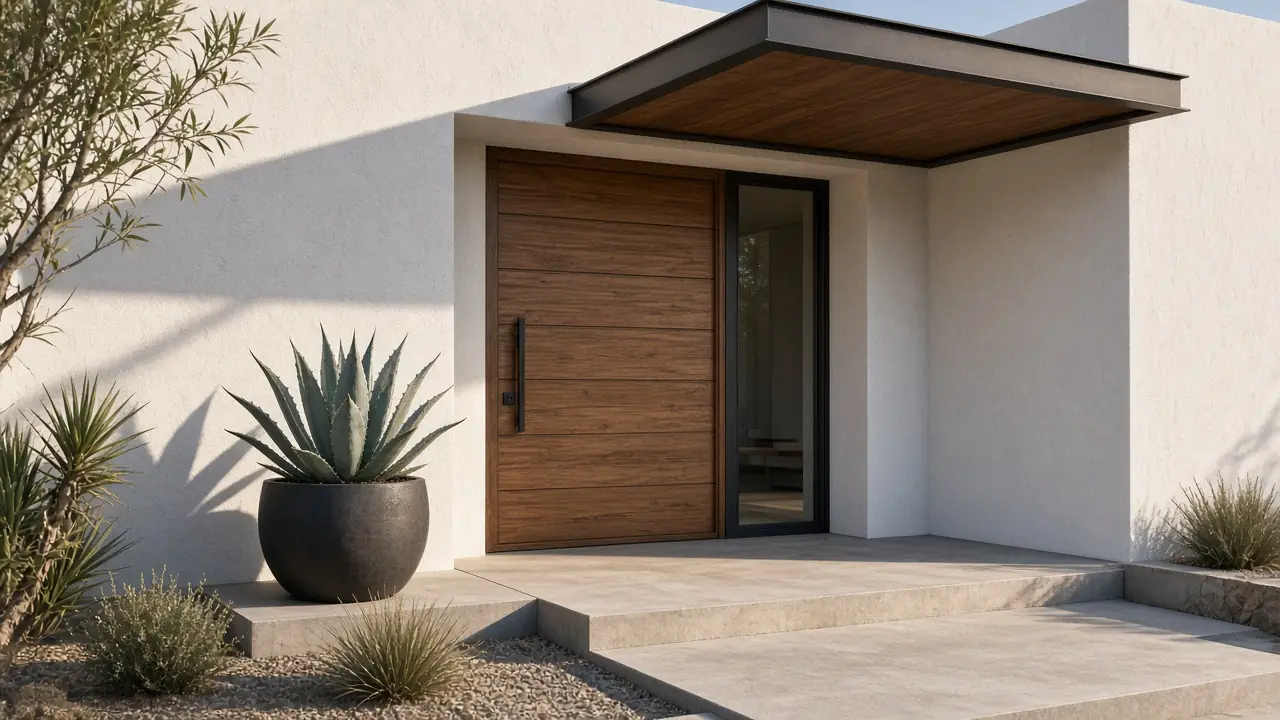
Short answer: for a front door that faces south or west and takes full afternoon sun, an insulated fiberglass door is the most common pick in Scottsdale and Paradise Valley because it doesn't swell, split, or rust. Steel is strong and budget-friendly but gets hot and works best in a shaded entry. Wood is beautiful but needs a deep overhang and regular refinishing here. Iron and thermally broken aluminum suit modern and custom homes when they're properly insulated and finished. Whatever you choose, how much sun the door gets, how deep your overhang is, and what color you finish it matter almost as much as the material.
Start with your entry, not the catalog
Before comparing materials, stand at your front door around 4 PM in summer and look at three things:
- Which way does it face? South and west entries take the harshest sun. JELD-WEN's door guidelines describe southern exposures as getting sun "from sunrise to sunset" and western ones as getting it "in the hottest part of the day."
- How deep is the overhang? A covered courtyard entry and a door flush with a sun-baked wall are very different jobs.
- Is there glass? Sidelights, transoms, and glass in the door add light but also heat and glare, and that glass has its own rules (see below).
The overhang rule of thumb
JELD-WEN publishes a door protection chart that sets overhang depth by climate and the direction the door faces. Measure from the bottom of the door (the threshold) up to the bottom of the overhang. Call that height H.
| Desert climate, door faces | Recommended overhang depth (JELD-WEN) |
|---|---|
| North | about half of H |
| East | about half of H |
| South | about 2 times H |
| West | about 2 times H |
So a west-facing door with 8 feet from threshold to overhang would want roughly 16 feet of cover by that chart, which few homes have. That's the point: most sun-facing Scottsdale front doors are "unprotected" by the manufacturer's definition, and JELD-WEN says doors without enough overhang on south, southwest, southeast or west exposures will need more frequent maintenance. It says overhangs are required for wood doors and recommended for steel and fiberglass.
Material by material
| Material | Strengths in the desert | Watch out for | Best fit |
|---|---|---|---|
| Fiberglass | Doesn't swell, split, or rust; foam-insulated cores; can mimic wood grain | Needs a proper finish (paint or stain) and maintenance; quality varies by line | South- and west-facing entries, low-maintenance owners |
| Steel | Strong, secure, usually the most affordable | Surface gets very hot in direct sun; dents; finish can fade or blister | Shaded or north- and east-facing entries |
| Wood | Unmatched warmth and character; custom shapes | Heat and dry air followed by monsoon humidity can warp and crack it; frequent refinishing | Deep covered entries and courtyards |
| Thermally broken aluminum | Slim frames, big glass, modern look | Ask about the thermal break and glass package | Contemporary homes, pivot and glass entries |
| Iron (wrought or steel) | Strong, dramatic, durable custom designs | Ask whether it's insulated and has thermal breaks and weatherstripping; dark finishes take heat | Spanish, Tuscan and custom estates |
A few notes from the manufacturers themselves:
- Finishing is part of the warranty. Therma-Tru's warranty FAQ says its fiberglass doors must be finished within 6 months of installation for continued warranty coverage, and bare wood parts like frames should be primed and painted or stained within 2 weeks. Its warranty document also says all six sides of the door must be finished. If a door arrives unfinished, ask who finishes it and when.
- The frame matters too. A rot-resistant composite frame avoids the rotted wood jambs that show up at the bottom of many older Arizona doors. Therma-Tru's warranty, for example, doesn't cover rot in non-rot-resistant frame parts like primed pine jambs.
- Warranties vary by product line, so ask for the warranty for the exact line being quoted, not the brand in general.
Color: lighter is easier on the door
JELD-WEN's guidelines say darker colors absorb more heat and that a sun-exposed door face "can reach temperatures well in excess of 120 degrees." Its rule of thumb: if you can't hold your hand on the door face for more than 30 seconds, the door is too hot. For doors with little protection, it suggests lighter colors to slow heat build-up. Therma-Tru doesn't recommend painting its PVC glass frames and grille bars dark if they're in direct sun.
That doesn't mean a black or deep bronze front door is off the table. It means you should pick a product and finish rated for it, and ask your dealer what the maker says about dark colors on your exposure.
Storm doors and security screen doors
Many Arizona homes add a security screen door. Two cautions from the manufacturers:
- JELD-WEN says that in hot climates a storm door "may not be a good choice," because heat builds up between the two doors and can cause warping and color damage.
- Therma-Tru says a properly installed and properly vented storm door won't void its door warranty, but it isn't responsible for damage the storm door causes to its door. It also doesn't recommend its PVC glass frames behind storm doors.
An open-mesh security screen traps less heat than a solid or glass storm panel, but rules differ by brand. If you want both, choose them together and ask the dealer to confirm the combination with the door maker's warranty.
Glass in and around the front door
- Safety glass is required. Building codes require safety glazing (tempered or laminated) in doors and many spots next to them, like sidelights.
- Use hot-climate Low-E on sun-facing glass, the same as windows. ENERGY STAR rates doors by how much glass they have, because glass changes how well a door insulates.
- Privacy glass (textured or frosted) is common on street-facing entries. It's also a style choice your HOA may review.
Permits and HOA approval
- Scottsdale: the city's Home Improvement page lists replacing glass panes inside doors and replacing hardware as no-permit work. It doesn't spell out swapping a whole exterior door, and widening an opening (say, for a wider door or a pivot door) changes the structure and needs a building permit. Have your dealer confirm with the city's One Stop Shop before work starts.
- Paradise Valley: the Town takes permit applications through its Citizen Portal. On hillside lots, the Town's Hillside and Non-Hillside Review Guide says some exterior changes may need Hillside Building Committee review.
- HOA: most master-planned communities review front door color, style, glass and size. DC Ranch, for example, asks for product cut sheets with exact size, material, color and finish, plus photos of what's being replaced. Get your community's current guidelines before you order.
Questions to ask every dealer
- Which way does my door face, and what does the maker say about that exposure and my overhang?
- Is the door factory-finished? If not, who finishes it, with what, and by when (and does that meet the warranty)?
- Is the frame rot-resistant, or is it wood that needs to be painted and maintained?
- What does the warranty cover for this exact product line, and does a storm or security door change it?
- Is the color I want recommended for a door in full sun?
- Is all the glass tempered or laminated, and what Low-E coating does it have?
- Are you replacing just the door slab or the whole unit (door and frame)? What happens to my stucco, trim and threshold?
- Who pulls the permit if one is needed, and who handles the HOA paperwork?
Get matched with a licensed door dealer
Lux Views Co. is a free referral service: we don't sell or install doors. Fill out the short form below and we'll connect you with licensed, independent dealers who work in Scottsdale and Paradise Valley, so you can compare entry door options and written quotes for your home.
Frequently asked questions
What is the best front door material for Arizona sun?
For a front door that takes direct afternoon sun, an insulated fiberglass door with a factory or properly applied finish is the most common pick because it doesn't swell, split or rust. Steel works well in shaded entries, and wood is best kept under a deep overhang. How much sun the door gets matters as much as the material.
How much overhang does a front door need in Arizona?
JELD-WEN's door protection guidelines say south- and west-facing doors in desert climates need an overhang about twice as deep as the distance from the threshold to the bottom of the overhang, and north- or east-facing doors about half that distance. Without enough overhang, sun-facing doors need more frequent finish maintenance.
Can I paint my front door a dark color in Arizona?
You can, but dark colors absorb more heat. JELD-WEN notes that a sun-exposed door face can get well above 120 degrees and recommends lighter colors for unprotected doors, and Therma-Tru doesn't recommend painting its PVC glass frames dark if they get direct sun. Check your door maker's finish rules before you pick a dark color.
Should I put a storm door or security door in front of my front door?
Be careful with a solid or glass storm door in full sun. JELD-WEN warns that heat can build up between the two doors in hot climates, and Therma-Tru says a properly installed and properly vented storm door won't void its warranty, but it doesn't cover damage the storm door causes. An open-mesh security screen door traps less heat; ask your dealer what your door's warranty allows.
Does a new front door need a permit in Scottsdale?
The City of Scottsdale lists replacing the glass in a door and replacing hardware as no-permit work. Its list doesn't spell out swapping a whole exterior door, and widening an opening is structural work that needs a building permit, so have your dealer confirm with the city before work starts. HOA approval is a separate step.
Do I need HOA approval for a new front door?
In most Scottsdale and Paradise Valley master-planned communities, yes, especially for a change in color, style, glass or size. DC Ranch, for example, asks for product cut sheets and photos of what's being replaced for any door or window change.