Short answer: for most Scottsdale and Paradise Valley homes, Cardinal LoĒ³-366 is the coating to beat. It's the triple-silver glass you'll see on most Valley quotes, because it balances bright, clear views (65% visible light) with strong sun control (0.27 SHGC) in Cardinal's standard double-pane unit. The newest step up is Cardinal Quad LoĒ-452+, a four-silver coating that cuts SHGC to 0.22 and blocks about 99% of UV, at the cost of some daylight (52%). LoĒ²-272 is the brighter, warmer all-climate option, LoĒ³-340 is the dark glare-control option, and Vitro Solarban 70 and 72 are Vitro's triple-silver counterparts to 366.
Every number on this page is a published center-of-glass value from Cardinal or Vitro. Your actual window's numbers depend on the glass thickness, gas fill, spacer and frame, so always confirm with the NFRC label on the product your dealer quotes.
Decoding the names: what "366" actually means
Cardinal's names carry a code. The superscript (or "Quad") shows the number of silver layers, and the last two digits land close to the glass's visible light transmission (366 is about 65%, 340 about 39%):
- LoĒ-180: one silver layer, high solar gain (built for cold climates and passive solar heating).
- LoĒ²-272 (and 270): two silver layers, moderate SHGC, "all-climate" glass.
- LoĒ³-366: three silver layers. Cardinal describes it as a clear coating that blocks more solar gain, reflects heat, and "even outperforms the tinted glass often used in warm climates."
- Quad LoĒ-452+: four silver layers. Cardinal calls it "new" and says it has "the lowest emissivity within the Cardinal family of LoĒ coatings." It comes standard with Neat+, an exterior coating Cardinal says keeps the glass cleaner longer.
- LoĒ³-340 (and 340+): three silver layers tuned for low SHGC with glare control, so it's much darker (around 39% light).
- LoĒ-i89: not a sun-control coating. It goes on the room-side surface (#4) to lower U-factor, and can be paired with any of the above.
So when someone says "452," they mean Quad LoĒ-452+. That's the name on Cardinal's product page and in its October 2026 data bulletin (listed there as LoĒ-452+).
The comparison table: Cardinal's standard double-pane unit
These are Cardinal's published values for its standard residential build: a 3/4-inch double-pane unit with two 3 mm (1/8-inch) lites, a 13 mm (1/2-inch) space, 90% argon, coating on surface #2, from Cardinal's IGU Performance Data bulletin CG09-10/26.
| Coating | Look (per maker) | Visible light | Exterior reflectance | SHGC | U-factor (argon) | UV transmitted | LSG* |
|---|---|---|---|---|---|---|---|
| Clear / clear (no Low-E) | Clear | 82% | 15% | 0.78 | 0.46 | 58% | 1.05 |
| LoĒ-180 | Clear, high solar gain | 79% | 15% | 0.64 | 0.26 | 29% | 1.23 |
| LoĒ²-272 | Moderate SHGC, high light | 72% | 11% | 0.41 | 0.25 | 16% | 1.76 |
| LoĒ³-366 | Clear, low SHGC, high light | 65% | 11% | 0.27 | 0.24 | 5% | 2.41 |
| Quad LoĒ-452+ | Neutral, low exterior reflection | 52% | 10% | 0.22 | 0.24 | 1% | 2.36 |
| LoĒ³-340 | Glare control (darker) | 39% | 13% | 0.18 | 0.24 | 2% | 2.17 |
*LSG (light-to-solar-gain) is visible light divided by SHGC. Higher means more daylight per unit of sun heat. We calculated it from the published numbers; it isn't a separate rating.
Adding LoĒ-i89 on surface #4 drops the argon U-factor to about 0.20 for 366 and 0.19 for 452+, with a small cost in light (63% and 51%) per the same bulletin.
Head-to-head with Vitro Solarban: same 1-inch build
Vitro publishes its Solarban numbers on a thicker unit: 1 inch overall with two 1/4-inch (6 mm) lites and a 1/2-inch space. Cardinal also publishes that exact build, so here's a fair, apples-to-apples comparison. Sources: Cardinal's CG09-10/26 bulletin (6 mm table) and Vitro's one-inch IGU performance data plus the Solarban 70 and Solarban 72 data sheets.
| Coating (surface #2) | Silver layers | Visible light | Exterior reflectance | SHGC | U-factor (argon) | UV transmitted | LSG* |
|---|---|---|---|---|---|---|---|
| Cardinal LoĒ²-272 | 2 | 70% | 10% | 0.40 | 0.25 | 14% | 1.75 |
| Cardinal LoĒ³-366 | 3 | 63% | 11% | 0.27 | 0.24 | 4% | 2.33 |
| Cardinal Quad LoĒ-452+ | 4 | 51% | 9% | 0.22 | 0.24 | 1% | 2.32 |
| Cardinal LoĒ³-340 | 3 | 38% | 13% | 0.18 | 0.24 | 2% | 2.11 |
| Vitro Solarban 60 (clear) | Not stated | 70% | 11% | 0.39 | 0.24 | Not published | 1.79 |
| Vitro Solarban 70 (formerly 70XL) | 3 | 64% | 13% | 0.27 | 0.24 | Not published | 2.37 |
| Vitro Solarban 72 (Starphire low-iron) | 3 | 68% | 13% | 0.28 | 0.24 | Not published | 2.43 |
| Vitro Solarban 90 (clear) | Not stated | 51% | 12% | 0.23 | 0.24 | Not published | 2.22 |
*Calculated by us as visible light ÷ SHGC.
What the numbers say:
- 366 and Solarban 70 are near twins. Same SHGC (0.27), same argon U-factor (0.24), one point apart on light. Vitro calls Solarban 70 "the most proven, commonly-specified triple-silver-coated low-e glass in the industry." It debuted in 2005, and Vitro notes it's applied to low-iron glass for annealed units.
- Solarban 72 is Vitro's triple-silver coating made for low-iron glass. Vitro says it has sun control similar to Solarban 70 while letting through 4% more visible light, so it's the clearest option in the triple-silver group.
- 452+ and Solarban 90 sit in the same low-SHGC tier (0.22 to 0.23) at about half the outside light.
- Solarban 60 behaves more like 272: bright, with more solar gain (0.39).
- Vitro's one-inch table doesn't list UV transmission, so we haven't put a UV number on the Solarban rows.
Why 366 is the default in the Valley
In the Phoenix area, SHGC is the headline number. ENERGY STAR's Southern-zone criteria for windows call for an SHGC of 0.23 or lower and a U-factor of 0.32 or lower (see best windows for Arizona heat). 366 gets you most of the way there without the darker look of a glare-control coating, and its LSG is the highest in Cardinal's lineup. That's why it shows up on so many quotes.
A 0.27 center-of-glass SHGC doesn't fail that 0.23 test, because the label rates the whole window. The frame blocks sun too. Milgard's V400 thermal chart, for example, lists whole-window SHGC of 0.22 for SunCoatMAX with argon and no grids, and lower with grids. Always compare the NFRC label on the exact window.
When to step up to 452+ (or down to 272)
Think room by room, and wall by wall:
- West and south walls that take full afternoon sun: this is where 452+ earns its keep. Dropping from 0.27 to 0.22 SHGC means about 19% less solar heat through the glass (by our math on Cardinal's numbers), and UV drops from 5% to 1%. That's real fade protection for rugs, wood floors and art.
- Big multi-slide and pocket door walls: a multi-slide wall puts a lot of glass in one opening, so the coating choice matters most there. If it faces west or isn't under a deep patio cover, price both 366 and 452+. If it's deeply shaded, 366's extra brightness may win. See multi-slide and pocket doors and sliding patio doors.
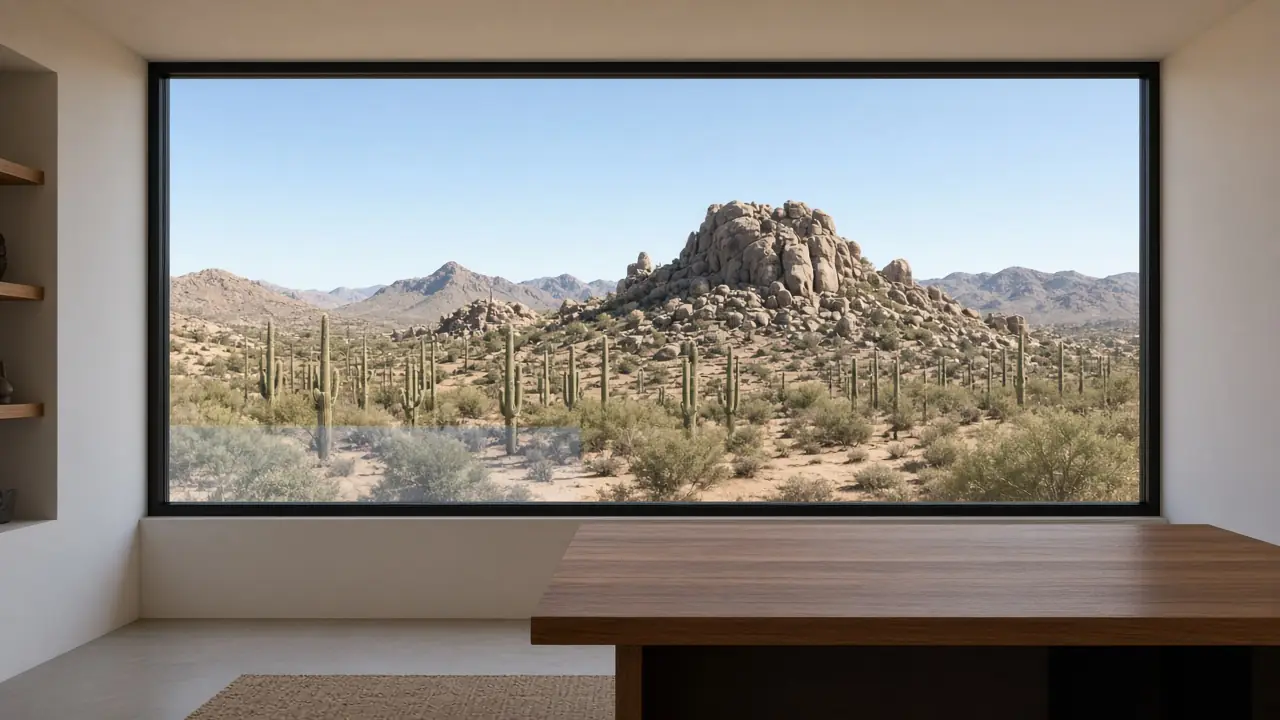
- View walls facing mountains, golf or city lights: brightness and clarity matter most. 366, or Solarban 72 on low-iron glass where a manufacturer offers it, keeps the view crisp. 452+ looks noticeably dimmer side by side (52% vs. 65% light), so look at samples outside before you decide.
- North-facing and deeply shaded glass: 272 can be fine here and keeps rooms brighter. Some dealers mix coatings by elevation; ask whether your manufacturer allows it, and whether your HOA requires every elevation to match.
- Glare-heavy rooms (media rooms, west-facing offices): 340 cuts light to around 39% with the lowest SHGC (0.18). Expect it to look darker from inside and out.
- Higher elevations like Desert Mountain with colder winter nights: adding LoĒ-i89 on surface #4 lowers U-factor from about 0.24 to 0.20.
Triple-silver vs. double-silver (and quad)
More silver layers let a coating be more selective: it passes visible light while turning away more of the sun's infrared heat. On Cardinal's own numbers, going from double-silver 272 to triple-silver 366 cuts SHGC from 0.41 to 0.27 while light drops only from 72% to 65%, and LSG jumps from 1.76 to 2.41. Quad 452+ pushes SHGC lower again (0.22) and UV to 1%, but you give up more daylight than you gain in LSG. In short:
- Double-silver (272): brightest, warmest. Best for mild or shaded spots.
- Triple-silver (366, Solarban 70/72): the desert sweet spot for clarity plus heat control.
- Quad-silver (452+): maximum heat and UV rejection with clear, neutral glass. Best on the hottest walls.
Outside appearance, reflectivity and your HOA
Many Scottsdale HOAs regulate how glass looks from the street. Grayhawk bans mirrored or reflective glass and film, Gainey Ranch prohibits reflective or mirrored glass, and Windgate Ranch bans mirrored tint. Good news: the residential coatings in these tables aren't mirror coatings. Cardinal lists exterior reflectance of 9% to 11% for 366, 452+ and 272, a little less than plain clear double-pane glass (14% to 15%). Vitro's Solarban 60, 70 and 72 list 11% to 13%. For contrast, Vitro's reflective Solarban R100 lists 32% exterior reflectance, the kind of glass those HOA rules are written to stop.
Tips for the HOA submittal:
- Ask your dealer for the glass maker's data sheet showing exterior reflectance and the NFRC label numbers.
- If your HOA asks for a glass sample (Gainey Ranch's window form does), request a sample of the actual coating you're ordering.
- Look at samples outside in direct sun and on an overcast day. 452+ and 340 read grayer than 366.
See HOA approval for new windows in Scottsdale and do you need a permit to replace windows or doors? for the paperwork side.
Brand names vs. the coating underneath
Window brands often rename the glass. Here's what manufacturers' own materials confirm, and what they don't:
- Western Window Systems: its Series 600 multi-slide spec lists argon-filled Low-E glass "from Cardinal Glass Industries," with LoĒ-270, LoĒ-366 and LoĒ-340 options plus LoĒ-i89. Its Series 600 sliding door data sheet rates the door with a 1-inch E366/argon/clear glass build.
- Milgard: Milgard says SunCoat is Low-E2 and SunCoatMAX is Low-E3. Its glass and glazing sheet describes SunCoatMAX as three-layer glass with 66% visible light and 95% UV blocking. Milgard doesn't name the coating supplier for SunCoat or SunCoatMAX on those pages (its V400 chart does list a separate "Cardinal 180" option), so we don't equate SunCoatMAX with any specific Cardinal or Vitro product.
- Andersen: offers Low-E4, SmartSun and PassiveSun glass. Andersen says SmartSun filters out 95% of UV and suits sunny West and South climates. It doesn't publish which coating SmartSun is.
- Pella: offers SunDefense Low-E for "very hot, sunny climates," blocking 94% of UV in dual-pane units. It doesn't publish the coating supplier.
- JELD-WEN: current options are SunResist, SunStable, SunFlow and HeatSave. JELD-WEN calls SunResist "triple-coated," says it blocks more than 90% of UV, and says it's typically used for ENERGY STAR Southern-zone products. It doesn't name the underlying coating.
When the brand name doesn't tell you, ask the dealer for the coating name, glass maker, and NFRC label for the exact unit, then compare labels.
Questions to ask a dealer about glass
- Which coating is on surface #2 (366, 452+, 272, 340, Solarban 70/72), and who makes it?
- What are the NFRC label numbers (U-factor, SHGC, VT) for each window and door size I'm buying, not just a sample size?
- Is the unit argon-filled? Is LoĒ-i89 (or a similar room-side coating) on surface #4, and do I need it at my elevation?
- Can I mix coatings by elevation (452+ west, 366 elsewhere), and will that pass my HOA?
- For big sliders and multi-slides: is the glass tempered or laminated, and does that change the numbers?
- Can I see an outdoor sample of the exact coating before I order?
- If I'm adding tinted glass or putting the coating anywhere but surface #2, does the glass maker approve it? (Cardinal recommends 452+, 240, 340 and 340+ only on surface #2 because of thermal stress risk.)
Get matched with a dealer who knows desert glass
Lux Views Co. is a free referral service, not a contractor. Fill out the short form below and we'll match you with licensed independent dealers who serve Scottsdale and Paradise Valley. Ask each one to quote 366 and 452+ on your sunniest walls so you can compare the labels side by side. Shopping for a full refresh? Start with energy-efficient windows or window replacement.
Frequently asked questions
What is LoE-366 glass?
LoĒ³-366 is Cardinal Glass Industries' triple-layer silver Low-E coating. In Cardinal's standard 3/4-inch double-pane unit (3 mm glass, 90% argon) it has 65% visible light transmission, a center-of-glass SHGC of 0.27, a U-factor of 0.24 and 5% UV transmission, which is why it's the go-to choice on so many Arizona window quotes.
What is LoE 452 glass?
It's Cardinal's Quad LoĒ-452+ (often shortened to "452"), a four-layer silver coating that Cardinal calls new. In the same 3/4-inch double-pane unit it has 52% visible light, a 0.22 SHGC, a 0.24 U-factor and 1% UV transmission, and it comes standard with Cardinal's Neat+ exterior coating. Cardinal says it has the lowest emissivity in its LoĒ family.
Is 366 or 452 better for Arizona?
Both are hot-climate coatings. 452+ blocks a little more sun heat (SHGC 0.22 vs. 0.27) and nearly all UV (1% vs. 5% transmitted), while 366 lets in more daylight (65% vs. 52%). For west-facing glass and big sliders that take afternoon sun, 452+ is worth pricing; for view walls where brightness and clarity matter most, 366 is the balanced pick.
Is Solarban 70 the same as LoE-366?
No. Solarban 70 (formerly Solarban 70XL) is Vitro's triple-silver coating and LoĒ³-366 is Cardinal's. On a like-for-like 1-inch unit (two 1/4-inch lites, 1/2-inch argon space) their published numbers are close: Solarban 70 is 64% visible light and 0.27 SHGC, LoĒ³-366 is 63% and 0.27, and both list a 0.24 argon U-factor.
Is LoE-272 good enough for Phoenix and Scottsdale?
It's a double-silver, all-climate coating with a center-of-glass SHGC of 0.41 in Cardinal's standard unit, so it lets in noticeably more sun heat than 366 (0.27) or 452+ (0.22). In the desert it usually makes the most sense on shaded or north-facing glass; on sunny west and south walls, a triple- or quad-silver coating does more.
Will Low-E glass look reflective or tinted, and will my HOA allow it?
Cardinal's 366, 452+ and 272 all list 9% to 11% exterior reflectance, a bit below plain clear double-pane glass (14% to 15%), so they don't read as mirrored. Several Scottsdale HOAs, including Grayhawk and Gainey Ranch, ban reflective or mirrored glass, so bring the coating's data sheet with your HOA submittal and avoid coatings sold as reflective.
Does the number on the glass data sheet match my window's NFRC label?
No. Glass makers publish center-of-glass values; the NFRC label rates the whole window, frame included. Milgard's V400 thermal chart, for example, lists whole-window SHGC of 0.17 to 0.22 with SunCoatMAX, below the 0.27 center-of-glass SHGC that Cardinal and Vitro publish for their triple-silver coatings. Compare products with the NFRC label, and use glass data to compare coatings.