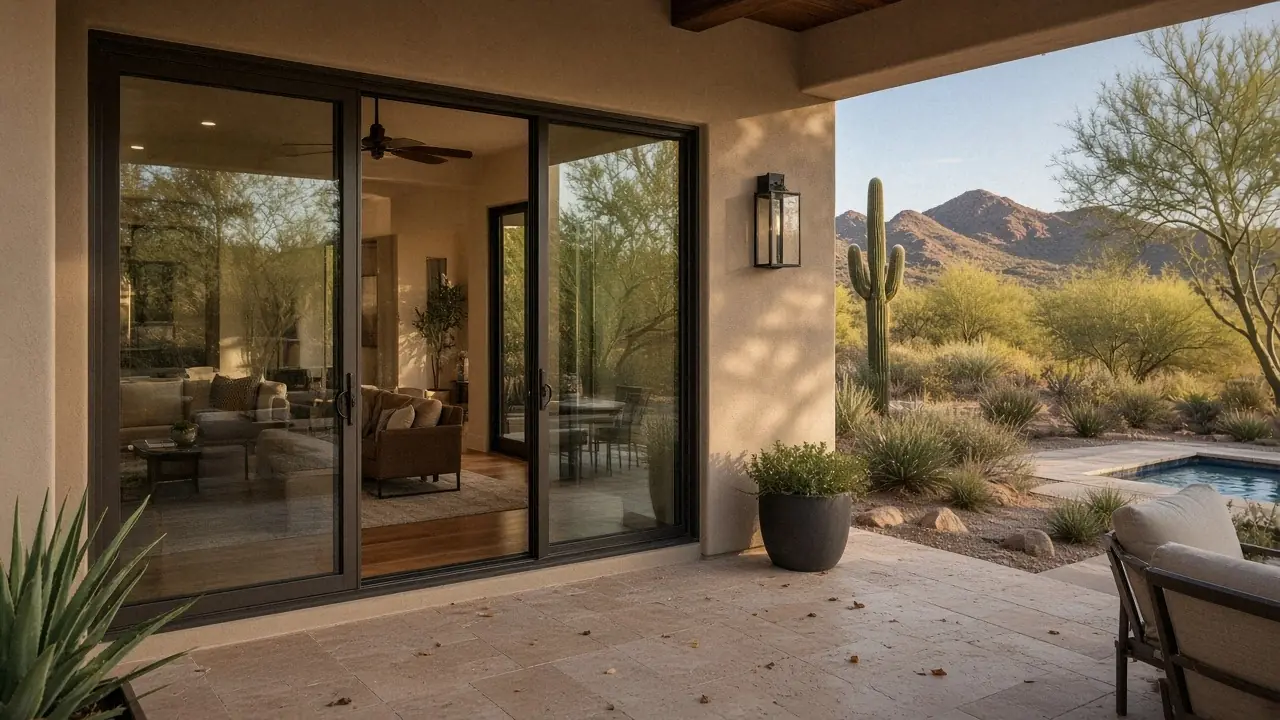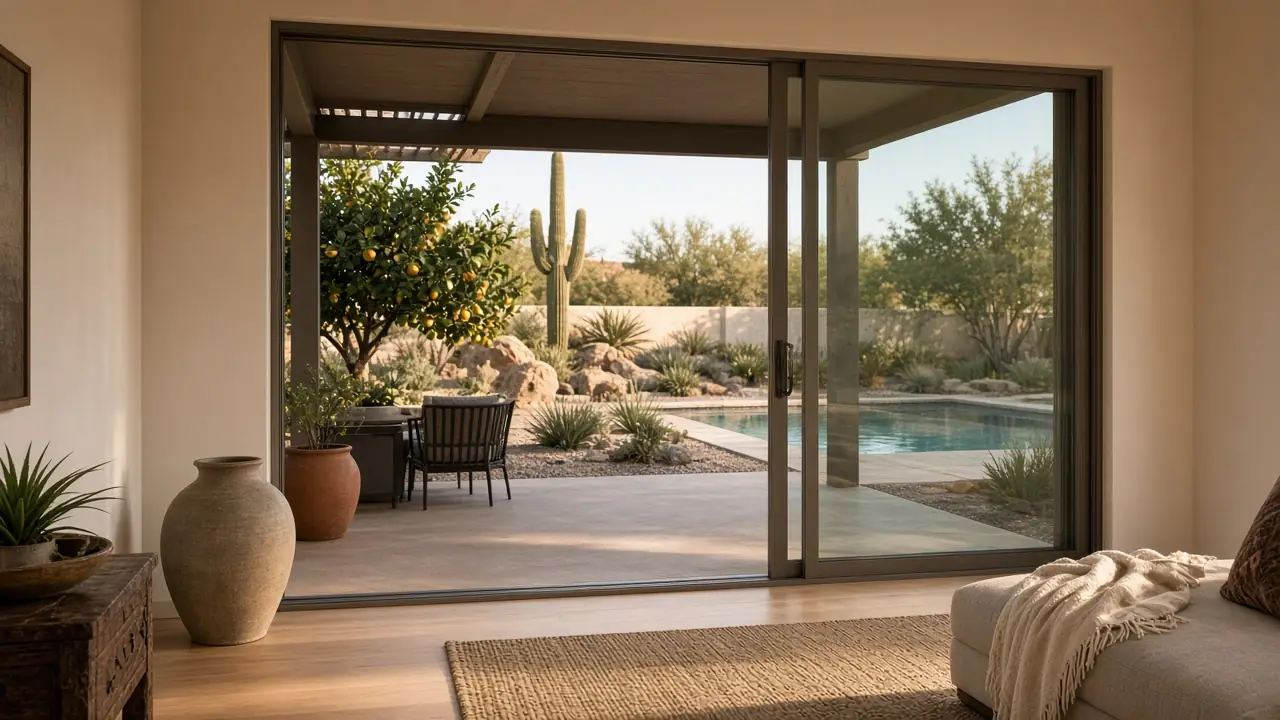
Short answer: most sliding doors that leak in the rain are leaking at the bottom because the track can't drain fast enough. Rain runs down the glass into the sill track, which is designed to hold some water and drain it outside through small weep holes. When those holes are clogged with dust, grit or sealant, or a monsoon storm drives water in faster than it can drain, the track fills and spills over the inside edge. Start by cleaning the track and weep holes and testing the drainage, the way your door's manufacturer describes. If it still leaks after that, the cause is usually worn weatherstrip, a panel that has dropped on its rollers, a damaged sill, or a problem with how the door was installed.
In Scottsdale and Paradise Valley, the leak almost always shows up during monsoon season, which the National Weather Service defines as June 15 through September 30. Months of dust and pool-deck grit settle in the track before the first storm, and then wind pushes rain sideways against the glass. That's why a door that's dry all winter can let in a puddle in July.
First: is water in the track actually a leak?
Not necessarily. Manufacturers build sliding doors to collect a little water and drain it back out:
- Milgard: it's normal for water to build up on the sill or the outside track; the weep system drains it to the outside as it builds up (Milgard care tips).
- Pella: it's normal for water to accumulate in the sill and track; on products with weep holes, it's meant to drain outside through them (Pella owner's manual).
- Andersen: during heavy rain it's normal for some water to collect on the sill; its "contain and drain" sill is designed to hold water and release it through weep holes. If the water doesn't drain or the pooling persists, the weep holes may be blocked by dirt, debris or sealant (Andersen Help Center).
It becomes a leak when water crosses the inside edge of the sill, shows up on the floor or baseboard, stays in the track long after the storm, or appears anywhere other than the bottom track.
Where the water shows up tells you a lot
| Where you see water | Most likely cause | Who usually fixes it |
|---|---|---|
| Track fills and spills over the inside lip in heavy rain | Clogged weep holes or a dirty track | You: clean and test the weep holes |
| Track fills even with clean, clear weep holes | Damaged or missing weep covers, a sill that slopes the wrong way, or a drainage defect | Repair specialist or the original dealer |
| Water at the bottom corners or under the frame | Sill or corner seal failure, or the opening's flashing | Professional: often an installation issue |
| Water where the two panels meet | Worn interlock weatherstrip or seals | Repair: new weatherstrip / seals |
| Drips at the top or down the side jambs | Panel out of alignment, worn head weatherstrip, failed perimeter sealant, or water from above the door | Professional water test |
| Door also drags or the gap at the top is uneven | Worn rollers; the panel has dropped and no longer seals evenly | Repair: rollers and adjustment |
| Wet drywall, swollen baseboard or soft flooring | Water has been getting past the door for a while | Professional: find the source and check for hidden damage |
Step 1: Clean the track and the weep holes
Do this on a dry day, ideally in May or early June before the first storm. Milgard says a good time to inspect and clean weep holes is when heavy rain is expected (Milgard care tips).
- Vacuum the track on both sides of the moving panel. Our hard-to-open sliding door guide has each brand's track-cleaning steps.
- Find the weep holes on the outside face of the bottom of the frame. They're small slots, often behind little plastic covers or flaps.
- Clear them gently. Milgard's steps: pop the covers off with a putty knife, insert a pipe cleaner and wiggle it to free debris, then press the covers back in (Milgard: clean weep holes). Andersen recommends a pipe cleaner or small brush, and Pella a small, soft brush. Pella notes weep holes may be on both the inside and outside of the frame.
- Check for hidden weep holes. On Andersen's single-frame gliding doors (400 Series Frenchwood, 200 Series Perma-Shield and Narroline), the weep holes sit under the stationary panel and aren't visible once it's installed (Andersen). If you can't find yours, ask the manufacturer or a repair specialist.
Don't poke at the drainage with a screwdriver, knife or drill, and don't pressure-wash the door. Pella's care guidance says not to power-wash (Pella), and Milgard's care guide says never to use high-pressure water hoses on its windows or doors (Milgard care guide).
Step 2: Test the drainage
After cleaning, pour a little water into the track and watch it drain out the weep holes outside. That's the last step in Milgard's weep-hole instructions (Milgard PDF). If it drains, you've likely found the problem. If water sits in the track or doesn't come out the other side, the drainage path is still blocked or damaged, and that's a job for someone who can take the panel out.
Step 3: Check the seals, the alignment and the lock
If the drainage works and the door still leaks, look at how the panel seals:
- Weatherstrip: Milgard recommends regularly checking weatherstrip so doors seal (Milgard care tips). Look for flattened, torn or missing pile and seals, especially where the two panels meet.
- Alignment: a panel riding low on worn rollers doesn't seal evenly. If the gap between the panel and the frame isn't even top to bottom, it needs adjusting or new rollers. The hard-to-open guide covers the alignment check.
- Keep it locked in storms: Andersen says its gliding doors are designed to perform at their published performance grade when closed and locked, and that weatherstrip on a door left unlocked can expand and push the panel away from the jamb (Andersen). Lock the door when a storm is coming.
What not to do: caulk the drainage shut
It's tempting to run a bead of caulk along the bottom of the door. Don't seal the weep holes, the track, or the joint where the sill drains. Andersen lists sealant among the things that block weep holes. Sealing the outside of the drainage path can trap water inside the door so it has nowhere to go but in. If the leak is at the corners, under the frame or around the perimeter, find the source first.
When it's an installation problem
A leak at the corners, under the sill or from above the door often isn't the door at all; it's how the opening was flashed and sealed. Andersen's installation guide for its 100 Series gliding doors, for example, says the installation flange and head flashing don't take the place of flashing tape or liquid flashing, that the door must be properly flashed and sealed, and that a continuous full-perimeter interior seal is required (Andersen installation guide). Pella's sliding patio door installation instructions note that the sill track profile must be sloped to the exterior (Pella PDF).
If your door is fairly new and leaking, contact the dealer who installed it first; the installation may be under their workmanship warranty. If it's old, ask a repair specialist or a dealer to do a controlled water test to find where the water is actually getting in before anyone starts replacing parts.
If water has been getting in for a while, check the floor and wall next to the door for soft spots, staining, swelling or a musty smell once everything is dry. Take photos before cleanup.
Multi-slide and pocket doors: the sill matters
Big indoor-outdoor openings are where the sill choice and the leak risk meet. Western Window Systems, for example, offers several sills for its Series 7600 multi-slide door. It describes its flush sill as the choice "when ease of entry is more important than performance against the elements," with weep holes in the track; its water barrier sills add a weep system and a raised interior leg in different heights and pressure ratings; and its newer water management sill keeps a flush floor look with an internal drainage system (Western Window Systems Series 7600).
If you're planning a multi-slide or pocket door on a west- or south-facing patio that takes the brunt of monsoon storms, ask the dealer which sill they're quoting, its tested water resistance rating, and how the patio and its slope will drain away from the door.
When a new door makes more sense
Repair first. But a new door is worth considering when:
- the sill is corroded, cracked or sloping toward the house,
- the leak keeps coming back after the drainage, seals and rollers are fixed,
- the door is also hard to slide, fogged between the panes, or an old single-pane or non-thermally-broken aluminum slider, or
- the opening was never flashed properly and the door has to come out anyway.
Our sliding glass door repair or replacement guide walks through that decision. Repairs like rollers, weatherstrip and glass generally don't need a permit in Scottsdale: the city's Home Improvement page lists repairing or replacing glass panes and hardware as no-permit work. A full door replacement is different; see permits for replacing windows and doors. If you're in an HOA community, approval usually comes first, and the best-time-of-year guide explains why it pays to have a new door in before June 15.
Questions to ask a repair specialist or dealer
- Where exactly is the water getting in: the track, the corners, the interlock, the head, or around the frame?
- Will you do a controlled water test to confirm it?
- Are the weep holes and weep covers working, and does the sill slope to the outside?
- Is the weatherstrip original, and can it be replaced with the manufacturer's parts?
- Has the panel dropped on its rollers?
- If you recommend a new door, how will the new opening be flashed and sealed, and which sill are you quoting?
- What's your workmanship warranty on leaks?
Get matched if the fix is a new door
Lux Views Co. is a free referral service, not a contractor. If your slider needs more than a cleaning and new seals, fill out the short form below, and we'll match you with licensed independent dealers who serve Scottsdale and Paradise Valley. They can find the source of the leak in person and put the recommendation and the full scope in writing. See also sliding and patio door replacement.
Sources
- Milgard: Window and door care tips, How to clean weep holes on a vinyl sliding door, Clean weep holes (PDF), Care and maintenance guide (PDF)
- Pella: Windows and patio doors owner's manual (PDF), Cleaning Pella windows and patio doors, Sliding patio door installation instructions (PDF)
- Andersen: Water standing in the sill (contain and drain), Unable to or hard to close gliding patio door, 100 Series gliding patio door installation guide (PDF)
- Western Window Systems: Series 7600 multi-slide door sill options
- National Weather Service Phoenix: Monsoon awareness
- City of Scottsdale: Home Improvement
Care steps are summarized from each manufacturer's published instructions as of October 25, 2026. Always follow the instructions for your specific door; sliding panels are heavy, so get help before removing one. Lux Views Co. is not affiliated with any manufacturer named here.
Frequently asked questions
Why does my sliding door leak only when it rains hard?
Sliding doors aren't watertight at the bottom. Rain that runs down the glass collects in the sill track and is supposed to drain back outside through weep holes. In a hard, wind-driven storm, water can enter the track faster than it drains, and if the weep holes are partly blocked, the track fills and spills over the inside edge. Light rain never fills it, which is why the leak only shows up in a downpour.
Is it normal for water to sit in my sliding door track?
Some water is normal. Milgard, Pella and Andersen all say it's normal for water to collect on the sill or in the track during rain, because the weep system is designed to hold it briefly and drain it outside. It's a problem when the water doesn't drain, keeps pooling after the rain stops, or comes over the inside edge of the sill.
How do I clean the weep holes on a sliding door?
Find the small slots on the outside face of the bottom of the frame. Milgard's instructions are to pop off the weep hole covers with a putty knife, wiggle a pipe cleaner in each hole to free debris, pour some water into the track to make sure it drains, and press the covers back in. Andersen and Pella recommend a pipe cleaner or a small soft brush. Some doors, including several Andersen gliding doors, have weep holes hidden under the stationary panel.
Should I caulk the bottom of my sliding door to stop the leak?
Not the weep holes or the drainage path. Andersen lists sealant as one of the things that can block weep holes, and a bead of caulk across the track or the outside of the sill can trap water inside the door instead of letting it out. Clean and test the drainage first; if it still leaks, have the door and its installation looked at before sealing anything.
Why is my sliding door leaking from the top?
Water at the top of the door or running down the jambs usually isn't a track problem. It can come from worn weatherstrip at the head, a panel that has dropped out of alignment, failed sealant where the frame meets the stucco, or water getting in above the door and traveling down behind the frame. Those are worth having a professional trace with a controlled water test.
Does a sliding door leak mean I need a new door?
Usually not at first. Clogged weep holes, a dirty track, worn weatherstrip and rollers that let the panel drop are all repairs. A new door starts to make sense when the sill is corroded, cracked or sloped toward the house, the leak keeps coming back after the drainage and seals are fixed, or the door is old and failing in other ways too.
Do I need a permit to fix a leaking sliding door in Scottsdale?
Repairs like weatherstrip, rollers and glass usually don't. The City of Scottsdale's Home Improvement page lists repairing or replacing glass panes and hardware as no-permit work. Replacing the whole door is different, so if a new door is the fix, have your dealer confirm the permit it needs.