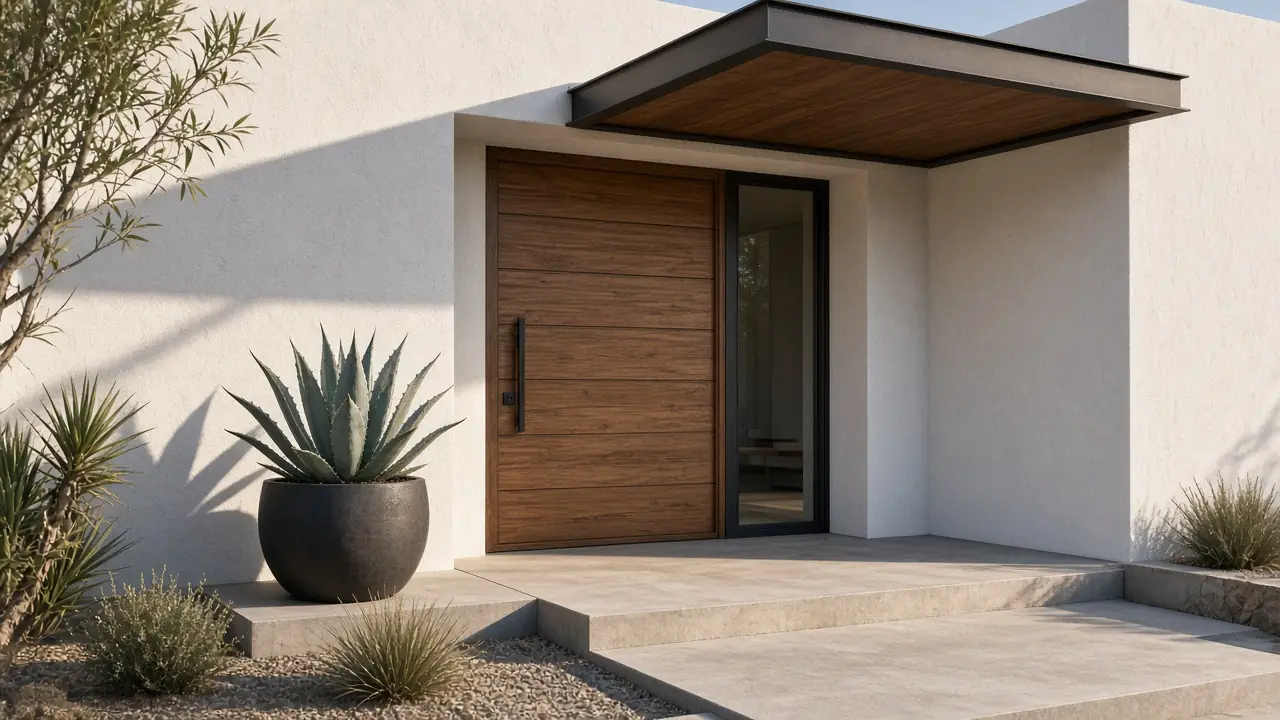
Short answer: yes, the outside face of an iron door gets hot in Scottsdale and Paradise Valley sun, especially a dark door on a west- or south-facing entry with no overhang. Whether that heat reaches your foyer depends on how the door is built. Steel conducts heat, so manufacturers recommend a thermal break (an insulating strip that keeps the outer and inner steel from touching), foam-filled cavities, dual-pane, tempered Low-E glass and good weatherstripping. Add shade and a sensible finish, check your HOA's rules on exposed metal, and ask for the door's tested U-factor, not just the glass rating.
Why iron doors heat up
Iron doors today are mostly steel: a 12-gauge steel slab and jamb, solid steel bars for the ironwork, and glass behind it. Apex Iron Doors' specifications put 12-gauge steel at 0.1046 inches thick and about 4.27 pounds per square foot. That mass and that metal are what make an iron door feel solid, and they're also why it behaves differently in the sun than wood or fiberglass.
Two things happen on a summer afternoon:
- The surface absorbs sun. A dark finish absorbs more than a lighter one, and a door with no overhang gets the full afternoon. My Iron Door Company's buyer's guide says finish color and glass selection "matter most" for hot-climate entries.
- The steel carries heat inward. Metal conducts. Abby Iron Doors says an iron door without a thermal break "can transfer outdoor temperatures straight inside," and Monarch Custom Doors says that without one, the metal conducts outdoor temperatures "directly into your interior space," which in hot climates means unwanted heat gain.
The glass is the other big path. A large glass area in a sunny entry lets heat in by radiation, which is why the glass spec matters as much as the steel.

What a thermal break does
A thermal break is a strip of low-conductivity material set between the outer and inner halves of the steel so they never touch. IronWroughtDoors describes it as isolating "the outside frame from the inside frame" with an ABS insulating barrier in the middle of the door, frame and threshold. Monarch inserts ABS barrier plates and dual seals through the jamb, scrollwork and threshold to eliminate "metal-on-metal contact," then adds polyurethane foam.
Three things to know before you compare quotes:
- Foam fill isn't a thermal break. Many doors are foam-filled as standard (IronDoor.com, Apex), but the steel skins can still be joined at the edges. IronDoor.com lists its slab at 2 inches without a thermal break and 2.75 inches with one, and calls the thermal break "an extra layer of insulation."
- Partial and full breaks are different products. Abby Iron Doors sells Thermal Guard (thermally broken jamb, threshold and kickplate) and Thermal Guard Max, where "the entire door assembly is thermally broken," including the panel and frame. Ask which parts are broken.
- Many brands market the break for cold climates. Legend Iron Doors recommends its thermal-break doors "for colder climates," and IronWroughtDoors says they're popular with Northeast buyers. The physics works the same way in summer. Abby calls its package "the recommended upgrade for hot, humid, and coastal climates," and Monarch says that in hot climates the break blocks unwanted heat gain.
IronWroughtDoors also notes condensation can still form on a thermal-break door when the indoor-outdoor temperature difference is large. In the Valley, that's rare outside winter mornings, but it's a normal effect, not a defect.
What's inside a well-built iron door
Here's what manufacturers list in their published specs. Use it as a checklist, not a ranking: these are each maker's own claims.
| Part | What manufacturers publish | What to ask |
|---|---|---|
| Steel | 12-gauge steel slab and jamb (Apex, IronDoor.com, Legend, Glory) | Gauge of the slab and the jamb |
| Insulation | Polyurethane foam in the slab, jamb and threshold (IronDoor.com, Apex, Glory) | Is every cavity filled, including the jamb? |
| Thermal break | Optional upgrade on most lines; ABS or fiberglass barrier (Monarch, Apex, IWD); partial vs full (Abby) | Which parts are broken: slab, frame, threshold? |
| Glass | Dual-pane tempered glass, 5/8 in. (IronDoor.com, Glory) or 3/4 in. argon-filled (Apex), Low-E option | Low-E coating, argon, and the glass U-factor and SHGC |
| Seals | Weatherstripping, door sweep, T-astragal on doubles (IronDoor.com); dual seals (Monarch) | Seal type and how it's replaced |
| Finish | Zinc galvanizing, then primer and paint, an epoxy system or clear lacquer (IronDoor.com, Apex, Glory, Legend) | Finish warranty, and whether rust is covered |
| Performance | Monarch publishes U-0.27 and R-3.70 for its thermal-barrier doors | A tested whole-door U-factor and SHGC, in writing |

The glass decides as much as the steel
On many iron doors, most of the face is glass. The glass carries sun straight into the entry, so it needs the same attention you'd give a west-facing window:
- Dual-pane, tempered, Low-E. Tempered glass is required: the building code treats glass in a swinging door as a hazardous location. Low-E coatings cut the heat that comes through. Our Low-E glass comparison explains why most Valley windows use a triple-silver coating.
- Operable glass. Many iron doors have glass panels that swing open behind the ironwork for airflow and cleaning, and some come with removable screens (IronDoor.com, Apex). Each opening glass panel adds a seal to maintain, so check how it closes and gaskets.
- Privacy glass. Textured or frosted glass changes the look, not the heat. Ask for the coating and the U-factor and SHGC of the exact glass you choose.
Energy code: when a mostly-glass door counts as a window
Scottsdale uses the 2021 IRC and IECC (our permit guide has the details). Under the IECC, an opaque door is one that's at least 50% opaque. A door that's more than half glass counts as fenestration, so the Climate Zone 2 limits that apply to windows here, U-factor 0.40 or lower and SHGC 0.25 or lower, apply to it too.
The code's fenestration section has two exemptions worth knowing:
- One side-hinged opaque door up to 24 sq ft is exempt from the U-factor requirement.
- Up to 15 sq ft of glazed fenestration per home is exempt from the U-factor and SHGC requirements.
A tall double iron door with large glass can easily pass 15 sq ft of glass, and many custom iron doors don't carry an NFRC label. Which rule applies to your door, and what paperwork the inspector needs, is the building official's call. Ask your dealer, before you order, how the door will meet the energy check.
Shade, finish color and the handle
The door is only half of it. The entry decides how much sun the door takes:
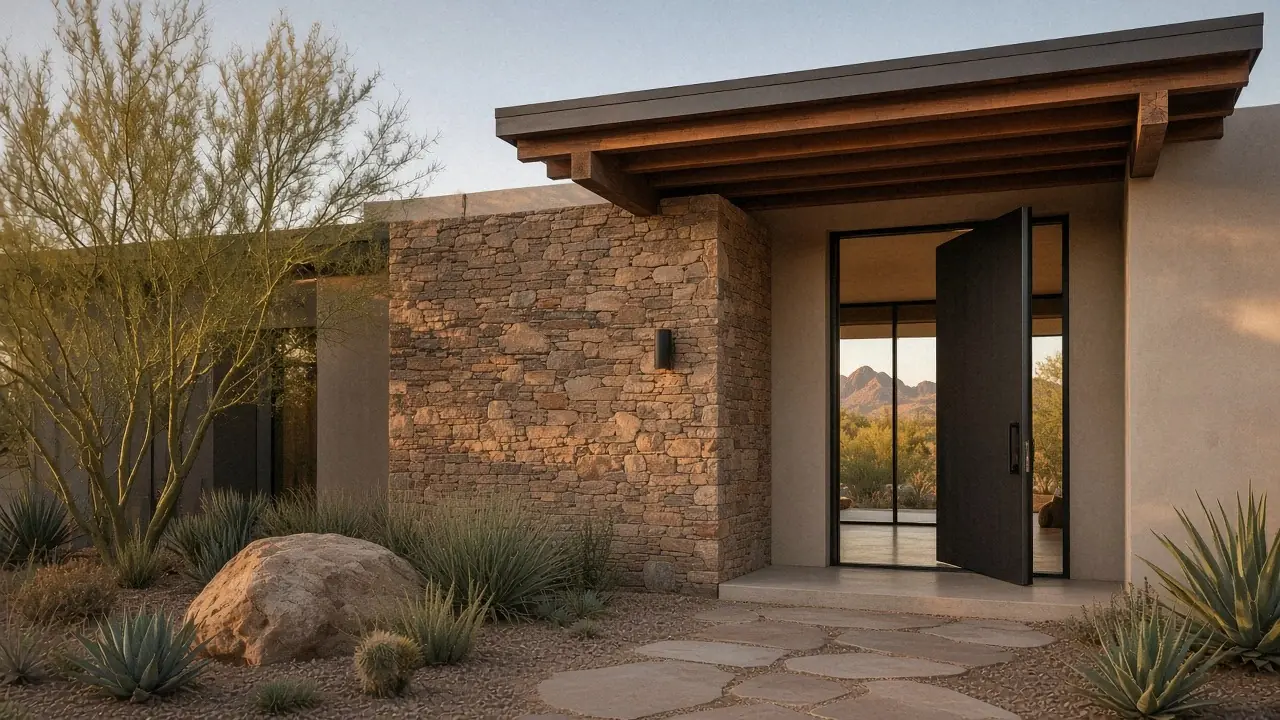
- Overhangs and recesses cut afternoon sun on the door. A recessed entry or a deep porch changes the experience more than any spec.
- Finish color. Dark finishes absorb more sun. If your HOA allows it, a bronze or lighter finish on a sunny west-facing entry runs cooler than flat black.
- Hardware. Metal handles in full sun get hot to the touch. Consider where the handle sits and whether it's shaded.
Our front door materials guide compares iron with fiberglass, steel, wood and aluminum for the same exposures, and covers why a glass storm door in front of a dark door can trap heat.
Rust and upkeep in a dry climate
The desert is easy on steel most of the year, but monsoon storms, sprinklers and hose spray aren't. Rust starts wherever water reaches bare metal. Manufacturers' care guides say much the same thing:
- Clean gently. Ironhaus's care and use guide says to dust with a soft cloth, use only very mild soap and water if needed, never abrasive or solvent cleaners, and not to use a high-volume water spray.
- Touch up chips right away, especially where raw steel shows. Most makers sell or include touch-up kits.
- Keep sprinklers and misters off the door. Repeated wetting and hard-water spray wear the finish.
- Read the finish warranty. Ironhaus's guide states its iron doors "are not warranted against rust." Ask your dealer what the door's warranty covers for finish, rust and seals.
Iron or fiberglass for a sunny entry?
Iron doors win on presence, security and custom design. Fiberglass doors don't conduct heat the way steel does and need less finish care. Neither choice is wrong. It depends on the look you want, how much sun the entry takes, and your HOA.
| Iron (steel) | Fiberglass | |
|---|---|---|
| Heat through the door | Steel conducts; a thermal break, foam fill and good glass limit it | Foam core, no metal path through the slab |
| Glass area | Often large; treated as fenestration if over half glass | Usually smaller lites or sidelites |
| Finish care | Touch up chips; keep water off | Repaint or restain on the maker's schedule |
| Lead time | Built to order (about 14 to 18 weeks quoted by Legend and IWD) | Many stock sizes; custom takes longer |
| HOA | Some communities limit exposed metal | Usually treated as a standard door change |
Permits and HOA rules
- Scottsdale: the city's Home Improvement page lists window and door replacement under a Minimum Window/Door Permit. Its list only mentions windows, so have your dealer confirm what a same-size door swap needs. A wider or new opening is a building permit with plan review.
- Paradise Valley: applications go through the Town's online Citizen Portal. Ask the Building Division which application applies, and check the hillside review rules if your lot is on a slope.
- McCormick Ranch: the MRPOA 2026 Rules and Regulations let the Executive Director approve "front door replacement" and "security/screen/iron doors" at staff level. Front doors and wrought iron may be semi-flat or satin. Physical samples are required for every project.
- Grayhawk: the Grayhawk Design Guidelines (Section L) require prior Architectural Committee approval for any change to doors or windows, say doors must be recessed, not flush, and state "no exposed metal including wrought iron is permitted on doors or windows" except security doors the committee approves. They also ask that front doors "make an entry statement of quality, substance and durability." Ask the committee before you order an iron front door.
- Other communities: our HOA rules hub collects the window and door rules for Desert Mountain, DC Ranch, Gainey Ranch, McDowell Mountain Ranch and Windgate Ranch from each association's own documents.
Questions to ask an iron door dealer
- Is the door foam-filled, and does it have a thermal break? Which parts: slab, frame, threshold?
- What's the door's tested whole-door U-factor and SHGC, and is it NFRC-labeled?
- What glass is it: dual-pane, tempered, Low-E, argon? Which coating?
- Is the glass operable, and how is it sealed when closed? Are screens available?
- What gauge is the steel, and what's the finish system (galvanizing, primer, paint or powder coat)?
- What does the warranty cover for the finish, rust, glass seal and hardware?
- How will it pass the energy check and the permit, and what does my HOA need to see?
- What's the lead time from drawing approval, in writing?
Get matched with a dealer
If you're weighing an iron front door, or iron against fiberglass for a sunny entry, Lux Views Co. can connect you with an independent, licensed dealer in Scottsdale or Paradise Valley. It's free, and there's no obligation. Fill out the short form below and tell us which way your entry faces and the look you want.
Sources
- Abby Iron Doors: Thermal package (Thermal Guard and Thermal Guard Max)
- Monarch Custom Doors: Thermal barrier wrought iron doors (ABS barrier plates, U-0.27 / R-3.70)
- Apex Iron Doors: Specifications
- IronDoor.com: Biltmore 23 product specifications (slab thickness, foam, glass, finish)
- IronWroughtDoors: Thermal break iron doors, lead times and sizes
- Legend Iron Doors: Thermal break iron doors and FAQ
- Glory Iron Doors: Thermal break iron entry door specifications
- My Iron Door Company: Custom iron doors buyer's guide
- Ironhaus Doors: Care and Use Instructions (PDF)
- 2021 IECC via UpCodes: opaque door definition, fenestration (prescriptive), R402.3.3 and R402.3.4; IRC hazardous locations for glazing
- City of Scottsdale: Home Improvement
- McCormick Ranch POA: 2026 Rules and Regulations (PDF) (Article II staff-level approvals; exterior colors)
- Grayhawk Community Association: Design Guidelines (Section L, Doors and Windows)
Frequently asked questions
Do iron doors get hot in the Arizona sun?
The outside face does. Steel conducts heat, and a dark iron door on a west- or south-facing entry with no overhang takes full afternoon sun. Whether the inside face and your entry get hot depends on how the door is built: manufacturers such as Abby Iron Doors and Monarch Custom Doors say an iron door without a thermal break can carry outdoor temperatures straight through the metal, while a thermally broken, foam-filled door with insulated Low-E glass slows that transfer.
Are iron doors insulated?
Most made-to-order iron doors are foam-filled. IronDoor.com, Apex Iron Doors and Glory Iron Doors all list polyurethane foam in the door and jamb cavities. Foam alone doesn't stop heat moving through the steel itself, though. That's what a thermal break does, and it's usually an upgrade, not standard.
What is a thermal break on an iron door?
A strip of low-conductivity material set between the outer and inner steel so they never touch. IronWroughtDoors describes it as isolating the outside frame from the inside frame; Monarch uses ABS barrier plates and dual seals in the jamb, scrollwork and threshold. Ask whether the break runs through the slab, the frame and the threshold, or only part of the system: Abby, for example, sells a partial package (jamb and threshold) and a full one (the whole assembly).
Are iron doors energy efficient?
They can be, if they're built for it. Monarch publishes a U-factor of 0.27 for its thermal-barrier doors and calls 0.41 the industry common figure. Many custom iron doors don't publish a tested whole-door U-factor at all, so ask the dealer for the door's tested U-factor and SHGC, not just the glass rating.
Do iron doors rust in Arizona?
They can wherever water reaches bare steel, usually at a chip, scratch, weld or the bottom edge. Manufacturers zinc-galvanize and paint or powder-coat the steel, and their care guides say to touch up any chip right away, avoid high-volume water spray, and keep sprinklers off the door. Ironhaus's care guide says its iron doors are not warranted against rust, so read the finish warranty before you buy.
Do I need HOA approval for an iron front door?
In most master-planned communities, yes. McCormick Ranch lets the Executive Director approve front door and security, screen and iron door replacements at staff level. Grayhawk requires prior approval for any door change and its design guidelines don't allow exposed metal, including wrought iron, on doors or windows except approved security doors, so ask the Architectural Committee before you order.
Does an iron door with a lot of glass have to meet the energy code?
Under the 2021 IECC, which Scottsdale uses, a door that's more than half glass counts as fenestration, so the U-factor 0.40 and SHGC 0.25 limits for Climate Zone 2 apply. One side-hinged opaque door up to 24 sq ft is exempt from the U-factor limit, and up to 15 sq ft of glazed fenestration per home is exempt. Which rule applies to your door is the building official's call; ask your dealer how the door will pass.
How long does a custom iron door take?
It's built to order. Legend Iron Doors lists a standard 14 to 16 weeks from drawing approval, and IronWroughtDoors lists 15 to 18 weeks for its thermal-break doors. Ask your dealer for the lead time in writing, measured from drawing approval, not from deposit.