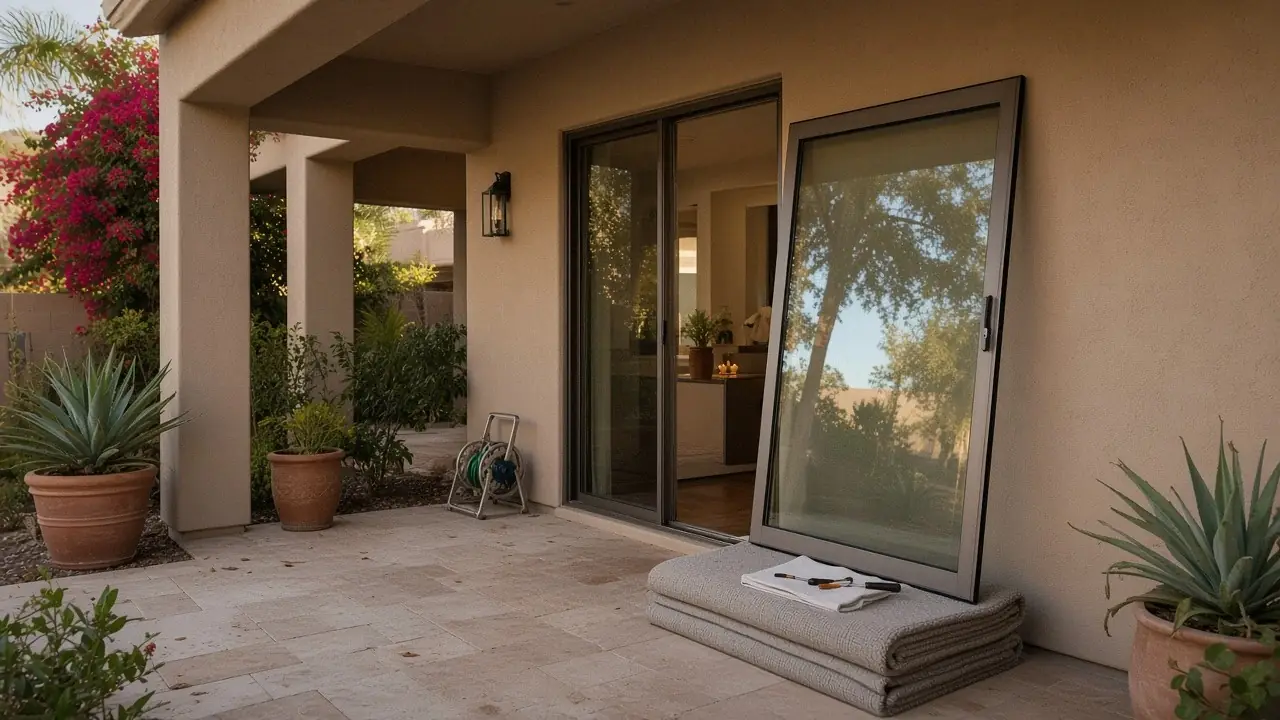
Short answer: a sliding glass door panel comes out by lifting it up into the head track and swinging the bottom out past the sill. If yours won't budge, something is usually still holding it: anti-lift blocks or a head stop at the top, rollers that aren't fully lowered, or the panel sitting at the wrong spot along the track. Clear those three and most panels release. If it still won't come out, a newer tile floor, a tight header or a broken roller may be in the way, and that's the point to stop and get a repair specialist, or, if the door is worn out, get matched with a dealer for a new one.
In Scottsdale and Paradise Valley homes, the usual reasons to pull a panel are new rollers, a deep track cleaning after dust storms, or moving big furniture through the opening (Andersen lists that one too). Sliding panels are big, heavy, tempered dual-pane glass, and every manufacturer we checked says to do this with help, so line up a second person before you start.
Before you start
- Find the brand. Look for a label or etching in a glass corner or on the frame edge. Steps differ by brand and even by product generation, so use your door maker's own instructions where you can.
- Know which panel moves. The operating (moving) panel is the one you take out. Fixed panels are screwed or bracketed in place, and Pella says the fixed panel on its wood sliding doors should not be removed (Pella support).
- Get help and the right tools. Pella says two people are required to remove a movable panel safely, Milgard recommends two people plus safety glasses and gloves for its roller steps, and Andersen says to use a reasonable number of people with enough strength and to support the panel in the frame at all times (Pella owner's manual; Milgard roller instructions (PDF); Andersen care guide (PDF)). Milgard's list: a Phillips screwdriver, a 4-inch putty knife, sawhorses and the replacement parts.
- Set up a landing spot. Padded sawhorses or blankets on a flat surface, out of the walkway. Keep kids and pets away; Milgard says the same.
- Take the screen off first if it's in the way. Milgard's screen steps: raise the screen's rollers with the screws at the bottom, lift, and slide it toward you (Milgard).
How removal works on most sliders
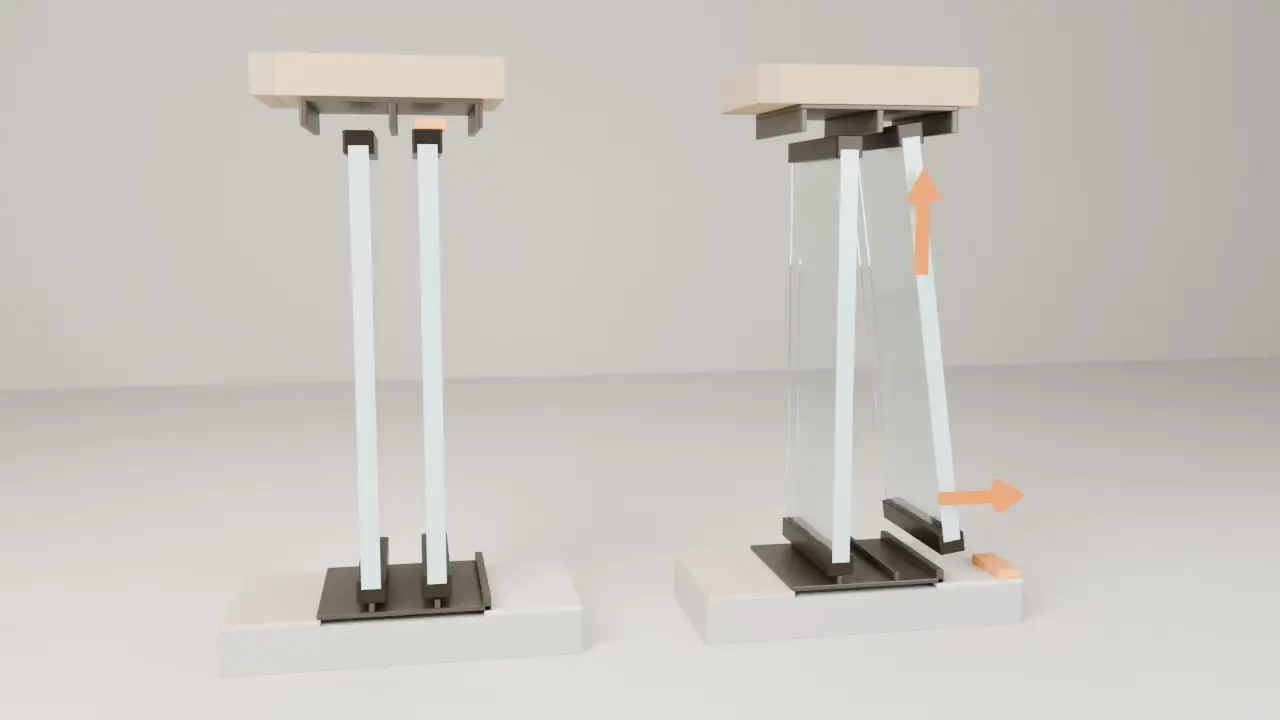
The common sequence:
- Clear the head. Remove anti-lift blocks, clips or a screwed-on head stop at the top of the frame. These exist to keep the panel from being lifted out from outside. Milgard's installation instructions for one of its vinyl sliding door lines list anti-lift clips among the door's parts (Milgard (PDF)), and parts maker Prime-Line's first step for a stuck panel is to check the upper track and remove any anti-lift devices (Prime-Line). Save every screw.
- Lower the rollers all the way. Pop the small caps at the bottom of the panel and turn each adjustment screw to drop the panel as low as it goes. On Milgard and Pella doors, counterclockwise lowers the panel.
- Put the panel where it releases. Milgard says to move it to within a few inches of fully open; Pella's installation booklet says about 8 inches open for its vent panels, and some Andersen panels only release where notches line up with retainers on the sill.
- Lift and tip. With a helper, lift the panel up into the head track and swing the bottom out past the sill, one side at a time if needed. Milgard suggests sliding a putty knife under each roller to guide it over the sill.
- Carry it flat-side up to the sawhorses, not by the glass edges.
Brand by brand
| Door | What the manufacturer says |
|---|---|
| Milgard vinyl sliding doors | Open the door about 3/4. Remove the adjust-hole covers, lift the panel's weight with a putty knife and lower each roller as far as it goes (#3 Phillips). Move the panel to within a few inches of fully open, lift it up into the head and out at the bottom; a second person guides the rollers past the sill (PDF). |
| Andersen gliding patio doors | Close and lock the operating panel, remove the head stop screws, open the door and tip the panel out from the top, then remove it from the sill track. Support the panel at all times until the head stop is back on (care guide). On A-Series doors the head stop also lowers and rotates out, and a stationary panel slides 6 inches until notches align with sill retainers (A-Series PDF). |
| Pella wood sliding doors (Reserve, Architect, Lifestyle Model 4) | Unlock and open the movable panel, remove the panel retainer screw and retainer, lower the panel through the dust-plug holes (counterclockwise), then grasp it from the exterior and lift the bottom off the track and away from the sill. Two people required; the fixed panel should not be removed (owner's manual). |
| MI Windows and Doors 910 Series | Remove the anti-lift brackets in the head or mainframe, adjust the rollers up into the panel, lift the panel upward and rotate the bottom inward (PDF). |
| Western Window Systems | Carefully remove the panels for track and roller service, and hire a professional if that's too difficult (care guide). |
Can't get it out? The usual reasons
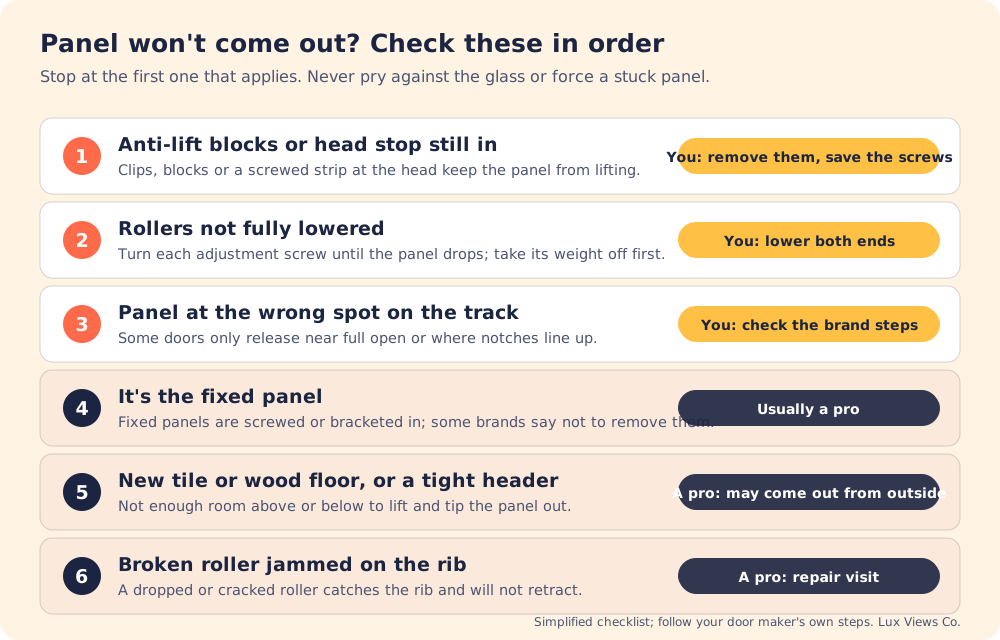
- Something is still holding the top. A head stop, anti-lift block or clip you missed. Look along the whole head track from inside and outside.
- The rollers aren't fully lowered. Prime-Line notes that rollers can be adjusted so far that they lock the door on the track; turn them back up into the frame, counterclockwise on most doors (Prime-Line). Do both ends. Milgard says to take the panel's weight off the roller with a putty knife or suction cup while you turn, and not to use battery or air-powered tools, which can strip the screw (Milgard (PDF)).
- The panel is at the wrong spot. Try the position your brand calls for (near full open on Milgard; Andersen's notches on some panels).
- A newer floor is in the way. Prime-Line says raised hardwood or tile floors added after the door went in can prevent removal; then the door has to come out from the outside, and it says that should be done by a professional. Worth checking if the floor was redone after the door went in.
- The header is tight. If the head of the frame has dropped or was shimmed tight, there's no room to lift the panel. This Old House notes a door that still won't slide after a tune-up can point to a poor installation or a structural issue such as an undersized header or a rotten sill (This Old House).
- A roller broke and dropped. A cracked roller can hang below the panel and catch the sill rib, and won't retract with the screw.
Two things never to do: don't remove the exposed screws on the face or corners of the panel (Prime-Line warns they hold the glass frame together; adjust only the screws behind the caps), and don't pry against the glass. If a panel is stuck halfway, keep it supported, put the head stop back if you can, and get help.
Putting it back
Reverse the steps, and finish with an adjustment:
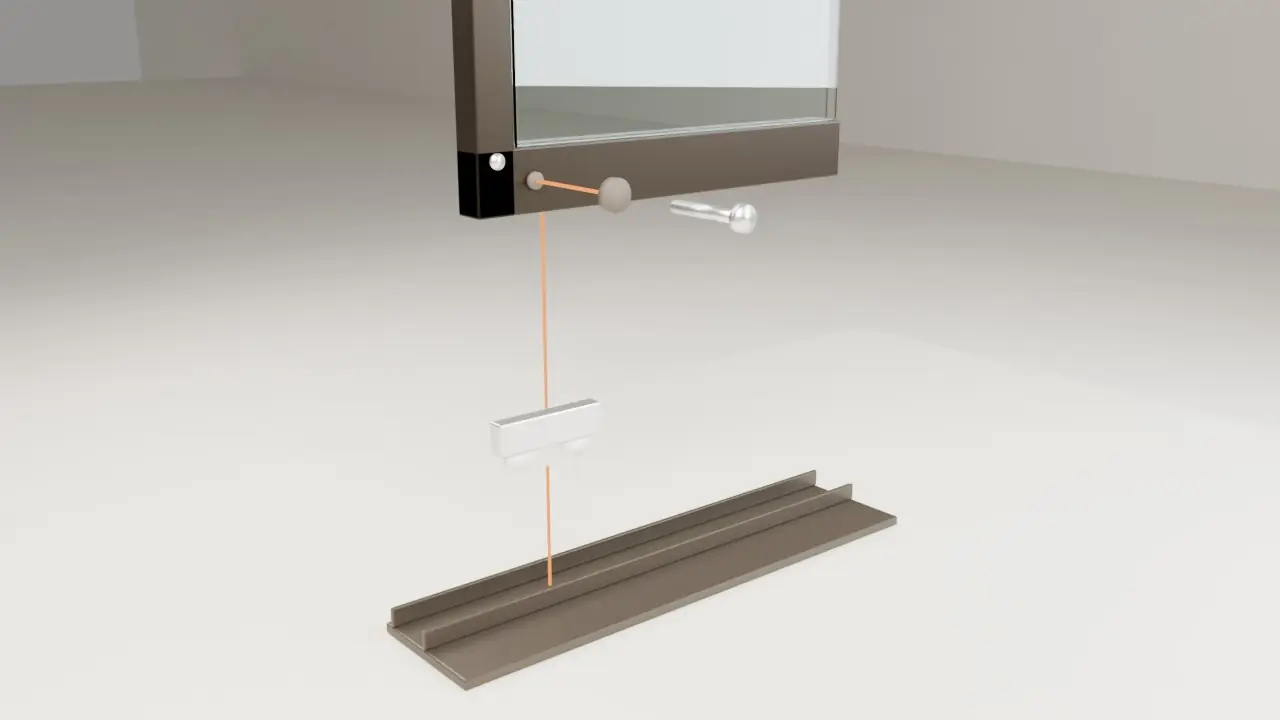
- Seat it. Milgard: with the panel lowered all the way, lift it up into the head of the frame and in at the bottom, guiding each roller onto the track with a putty knife.
- Raise it evenly. Raise both ends just until the panel slides without dragging. Milgard aims for rollers near the middle of their adjustment range and an even gap (reveal) between the panel and the side jamb from top to bottom; then check that the lock engages, and adjust the strike if it doesn't (Milgard (PDF)).
- Re-install the head stop or anti-lift blocks before you let go of the panel for good. Andersen says to support the panel until the head stop is attached and not to overtighten its screws.
- If the door is part of a pool barrier, test its alarm or self-closing hardware before anyone uses the pool. Scottsdale's amended pool code (section 305.4) covers doors that open directly to a pool (Scottsdale (PDF)).
Repair it or replace it?
Once the panel is out you can see what's really going on. For the fuller decision, see our sliding glass door repair or replacement guide; in short:
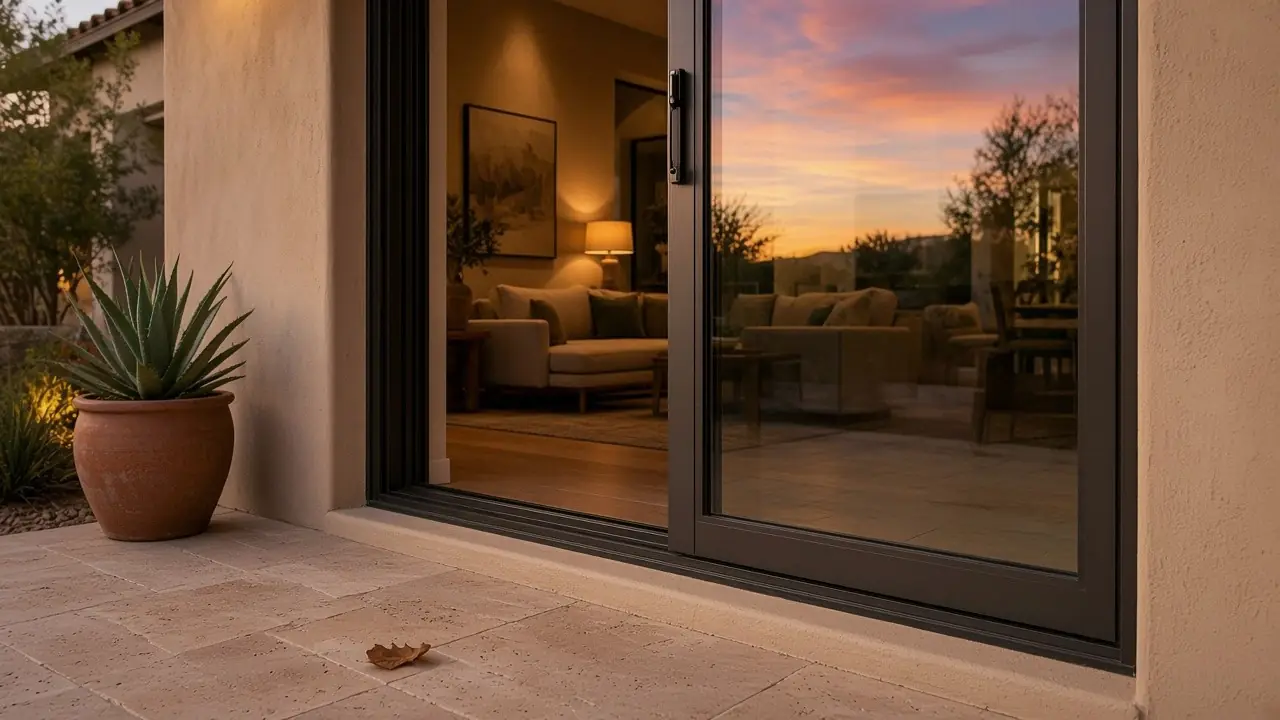
- Usually a repair: worn or cracked rollers (Andersen says to replace both together), a lock or handle, worn weatherstrip, or a dirty track. If the door was only hard to slide, start with our hard-to-open sliding door fixes.
- Often a replacement: a bent or corroded sill, a frame out of square, parts that are no longer made, fogged glass on top of other problems, or an older single-pane or non-thermally-broken aluminum slider that heats the room. Milgard's own instructions say that if the part of the track the roller rides on has severe wear or damage, consider replacing the track (Milgard (PDF)).
Permits: the City of Scottsdale's Home Improvement page lists repairing or replacing glass panes and hardware as no-permit work, and window replacement under a Minimum Window/Door Permit; confirm what a whole-door swap needs. In Paradise Valley, ask the Town's Building Division through its Citizen Portal. A new door may also need HOA review, especially if the frame color, grids or glass tint change; see HOA rules by community.
If you replace it: SRP's window replacement rebate terms say sliding glass doors can qualify when they're at least 80% glass and ENERGY STAR certified, along with the U-factor and SHGC limits in the terms and conditions (PDF). Rebate terms can change, so check them before you order. For the glass itself, see Low-E glass types compared.
Questions to ask a repair specialist or dealer
- Can you identify the door's brand and series, and are original rollers and track parts still available?
- Why wouldn't the panel come out: rollers, the head, the floor, or the frame?
- Are you replacing both rollers, with the manufacturer's parts or universal ones?
- Is the sill solid and the frame plumb, level and square? Will a repair hold?
- If the floor was raised, will the panel have to come out from outside, and does that affect the stucco or trim?
- If you recommend a new door, what exactly can't be repaired, and what permit and HOA steps apply?
Get matched if it's time for a new door
Lux Views Co. is a free referral service, not a contractor. If your slider needs more than new rollers, fill out the short form below and we'll match you with licensed, independent dealers who serve Scottsdale and Paradise Valley. They can look at the door in person and put the recommendation and full scope in writing. See also sliding and patio door replacement and, for a wider opening, multi-slide vs. bifold doors.
Sources
- Milgard: How to install a vinyl sliding patio door roller (PDF), Vinyl sliding door installation instructions (PDF), How to clean and lubricate a sliding door (PDF), How to remove a sliding screen door, How-to guides
- Andersen: Caring for your gliding patio door (PDF), A-Series panel assembly, installation and removal (PDF), Panel replacement instructions
- Pella: Removing/replacing panels on sliding patio doors, Windows and patio doors owner's manual (PDF)
- MI Windows and Doors: 910 Series patio door replacement instructions (PDF)
- Western Window Systems: Care and maintenance guide (PDF)
- Prime-Line: How to remove and replace sliding glass doors
- This Old House: How to fix a sliding door
- City of Scottsdale: Home Improvement, Pool code section 305 with amendments (PDF)
- SRP: Window replacement rebate terms and conditions (PDF)
Removal steps are summarized from each manufacturer's published instructions as of November 1, 2026. Always follow the instructions for your specific door; sliding panels are heavy tempered glass, so work with a helper and stop if a panel won't release. Lux Views Co. is not affiliated with any manufacturer named here.
Frequently asked questions
Why can't I get my sliding glass door out of the track?
Usually one of three things is still holding it: anti-lift blocks or a head stop at the top of the frame, rollers that haven't been lowered all the way, or the panel sitting at the wrong spot along the track. If all three are handled and it still won't lift, a newer tile or wood floor, a tight or sagging header, or a broken roller jammed on the sill rib may be the problem, and that's a job for a repair specialist.
How do you take a sliding glass door off the track?
On most sliders: remove the screen, take out any anti-lift blocks or the head stop, lower both rollers with the adjustment screws, slide the panel to the spot your manufacturer calls for, then with a helper lift it up into the head track and swing the bottom out past the sill. Some brands differ; Andersen, for example, has you remove the head stop and tip the top of the panel out. Follow your door maker's instructions.
Which way do I turn the roller screw to lower a sliding door?
On Milgard and Pella sliders, turning the adjustment screw counterclockwise lowers the panel (retracts the rollers) and clockwise raises it. Milgard says to lift the panel's weight off the roller with a putty knife or suction cup while you turn it, so the screw doesn't strip.
Can I use a drill to adjust sliding door rollers?
Milgard says battery or air-powered tools are not recommended for adjusting its sliding door rollers, because they can strip the screw head or the threads of the adjustment nut. Use a hand screwdriver (Milgard calls for a #3 Phillips on its vinyl sliding doors).
Can one person remove a sliding glass door?
Manufacturers say no. Pella says two people are required to remove a movable sliding door panel safely, Milgard recommends two people for its roller replacement steps, and Andersen says to use a reasonable number of people with enough strength and to support the panel at all times until it's out or the head stop is back on.
Should I remove the fixed panel of a sliding glass door?
Usually not. Pella says the fixed panel of its wood sliding doors should not be removed. Andersen's stationary panels can come out (screws at the sill filler, a head bracket, then slide and pull), but it's more involved. If the fixed panel is the problem, it's usually a repair or replacement visit.
Do I need a permit to replace sliding door rollers in Scottsdale?
Not for a repair. The City of Scottsdale's Home Improvement page lists repairing or replacing glass panes and hardware as work that doesn't need a permit. Replacing the whole door is different: the city lists window replacement under a Minimum Window/Door Permit, so have the dealer confirm what a full door replacement needs.