Short answer: there are four ways to get the look of a window divided into small panes. True divided lites (TDL) use separate pieces of glass held in a real muntin bar. Simulated divided lites (SDL) bond bars to the outside and inside of one dual-pane unit, and the best ones add a dark shadow (spacer) bar in the airspace so the bar looks solid. Grids between the glass (GBG) are sealed inside the airspace, so the glass stays smooth and easy to clean. Removable interior grilles clip onto the room side. For most Scottsdale and Paradise Valley homes the real choice is SDL (more depth and shadow, more cleaning, usually more cost) versus GBG (flatter look, easiest care), and your HOA and existing windows often decide it for you.
Grids (manufacturers often say "grilles," and the bars are "muntins") used to be structural: glass came in small sizes, so windows were built from many small panes. Today they're a style choice. That matters here, because Valley architecture runs from 1970s ranch and mid-century homes to Santa Barbara, Spanish Colonial, Tuscan and modern desert custom homes, and each has a grid look that fits it and one that looks wrong.
The five grid types, from most authentic to simplest

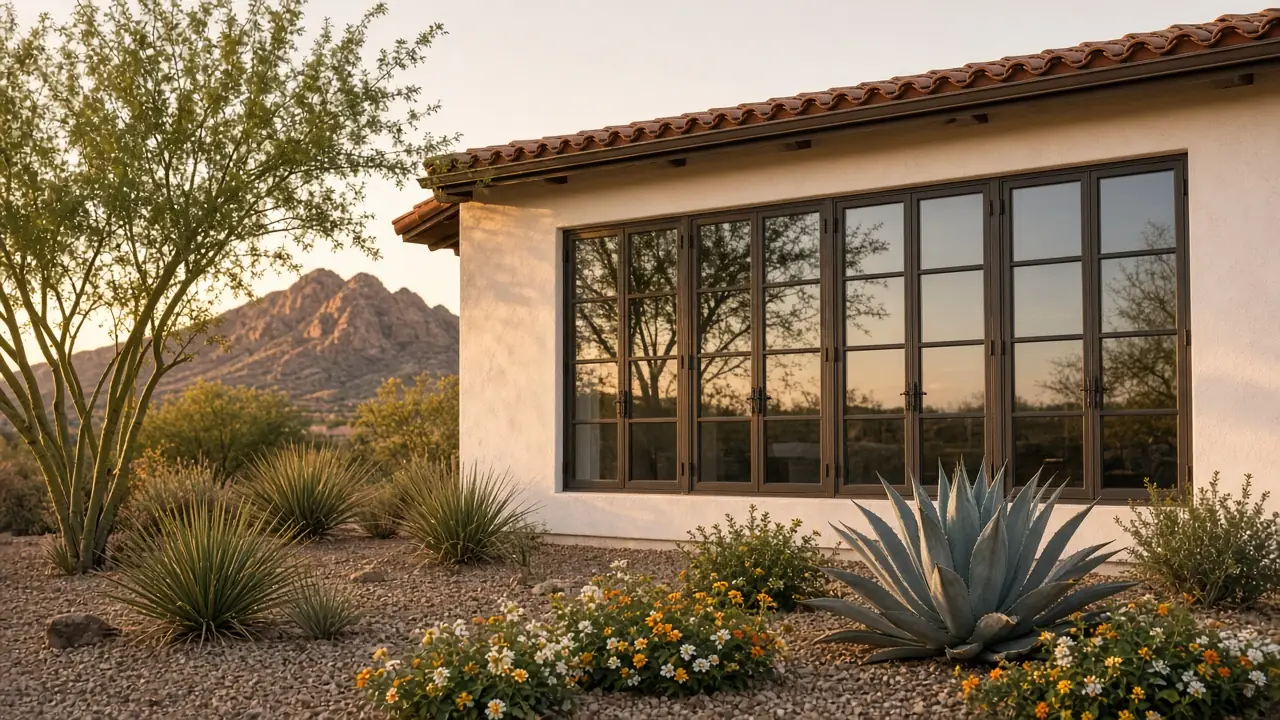
1. True divided lites (TDL), also called authentic divided lites (ADL). Each small pane is its own piece of glass (today, usually its own small insulated unit) set into a real muntin. It's how windows were built for centuries. Marvin still offers authentic divided lites on wood-exterior units. The trade-offs: many more glass edges and seals, wider bars, and the most cost. In the Valley you'll mostly see TDLs on high-end custom and historic-style homes, such as Silverleaf's Spanish Colonial and Tuscan estates, and on steel windows.
2. Simulated divided lites (SDL), no spacer. One dual-pane unit with bars permanently bonded to the outside and inside glass surfaces. From most angles it looks like divided glass, with real depth and shadow lines. Look at it from the side, though, and you can see through the airspace between the two bars.
3. SDL with a shadow bar (spacer bar). The same SDL bars plus a dark bar sealed in the airspace right behind them, so the bar looks solid all the way through. It's the closest look to a TDL without separate panes. The names vary: Marvin calls it SDLS, Pella offers SDL with optional spacer on its Lifestyle Series and Integral Light Technology grilles on Pella Reserve, and Andersen calls it full divided light (FDL), with an "energy spacer" version. WinDor's current SDL is a 1-inch flat bar with a shadow bar.
4. Grids between the glass (GBG). An aluminum or composite grid sealed inside the airspace of the dual-pane unit. Both glass surfaces stay smooth, so you clean it like plain glass. GBGs come in flat profiles and contoured (sculptured) profiles, which have rounded faces that catch light a little more. Milgard, Pella, Marvin, WinDor and Andersen (Finelight) all offer them. Many lines offer two-tone GBGs, such as bronze outside to match the frame and white or another color inside.
5. Removable interior grilles. Wood or composite grilles that clip or latch to the room side so they can come off for cleaning. Andersen offers them (not on its 100 Series), and Pella offers roomside grilles in several widths. They don't show from outside unless paired with an exterior bar.
Exterior-only and combination grids. Some lines put a bar on the outside only, paired with a GBG or nothing inside. Andersen's 100 Series offers Finelight grilles between the glass with permanent exterior grilles, and on triple-pane units Pella bonds SDL bars to the outside only, with grilles between the glass behind them. It's a way to get exterior shadow lines from the street with an easy-clean inside.
Profiles: why two grids with the same pattern look different
The pattern is the layout. The profile is the shape and width of each bar, and it changes the look as much as the pattern does.
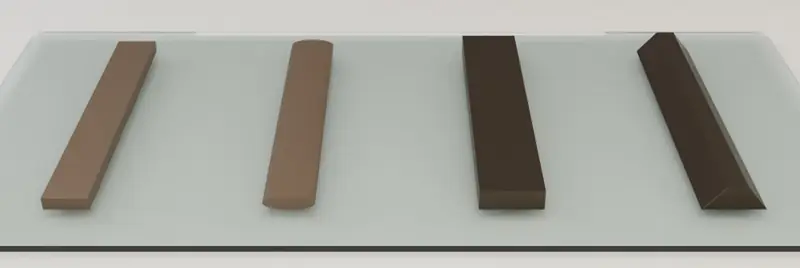
- Flat GBG: the thinnest and most minimal. WinDor's flat GBG drawing shows 0.625 in. wide, and Milgard's C700 Series lists a 5/8" flat grid.
- Contoured or sculptured GBG: rounded, so it catches light. Milgard's C700 lists a 15/16" sculptured grid, Andersen's Finelight contoured grilles come in 3/4" and 1", and Pella's Lifestyle Series GBG is 3/4".
- Square SDL: crisp, modern edges. Pella and Marvin both offer square profiles for contemporary homes.
- Putty and ogee SDL: traditional shapes. Pella describes putty as mimicking glazing putty applied with a knife and ogee as an S-shaped double cove. Western's simulated steel line uses 0.875" SDLs designed to look like a steel window's putty glaze.
Width rule of thumb: narrow bars (5/8" to 7/8") read as refined and modern; wider bars (1-1/8" and up) read as heavier and more traditional. Wider "check rail" bars (Milgard's 2-3/8" on the C700, Andersen's 2-1/4") imitate the meeting rail of a hung window, so a picture window can match the single-hungs beside it.
One detail from Cardinal IG's technical bulletin: with thick glass, such as laminated or heavier tempered units, the gap between the SDL bar outside and the bar inside gets more visible from an angle, which breaks the "solid bar" illusion. Cardinal's advice is that the applied bars should get wider as the glass gets thicker. A shadow bar solves most of it.
Grid patterns, matched to Valley architecture
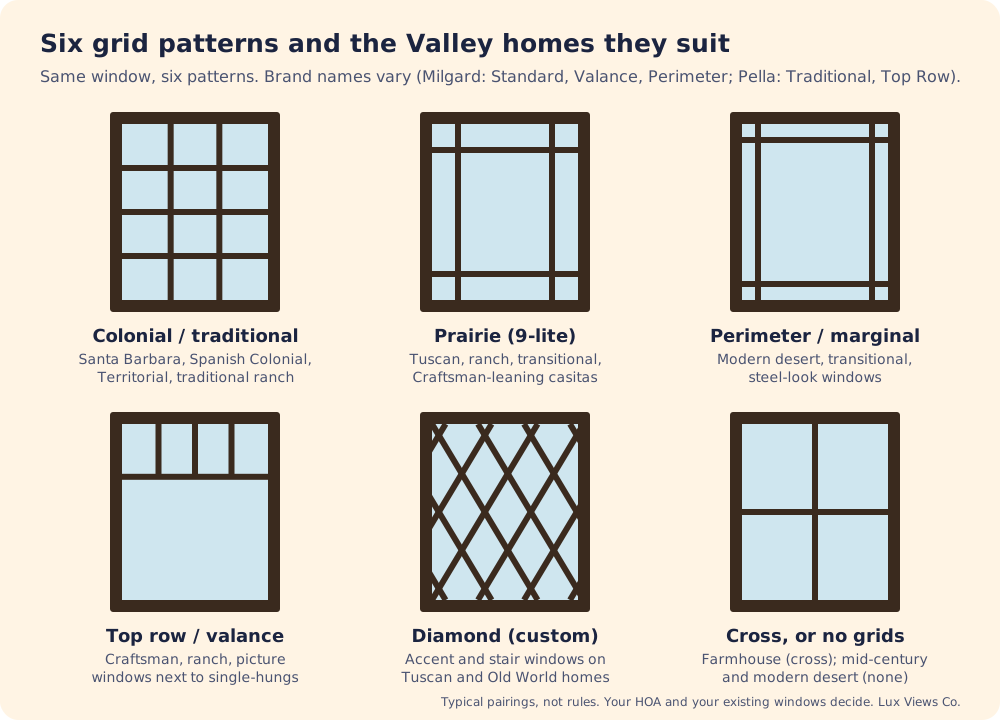
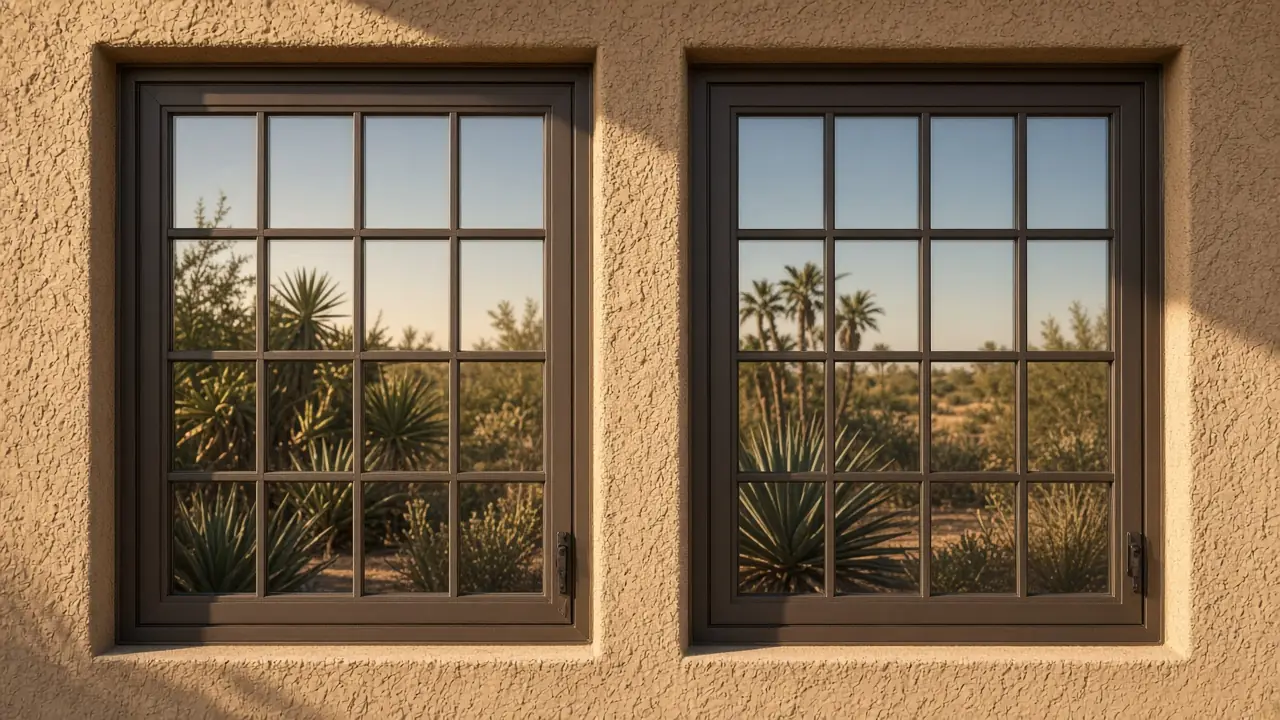
- Colonial / traditional (equal squares). The classic grid. Milgard calls it "Standard" and says it can cover the whole window or just the top sash. It suits Santa Barbara, Spanish Colonial, Territorial and traditional ranch homes. Bronze or black SDLs on white stucco is a common Paradise Valley look.
- Prairie (9-lite). Narrow lites around the edge with small corner squares and one big open center. Pella notes it leaves more glass unobstructed. It works well on Tuscan, ranch and transitional homes, and on view walls where a full colonial grid would chop up the mountains.
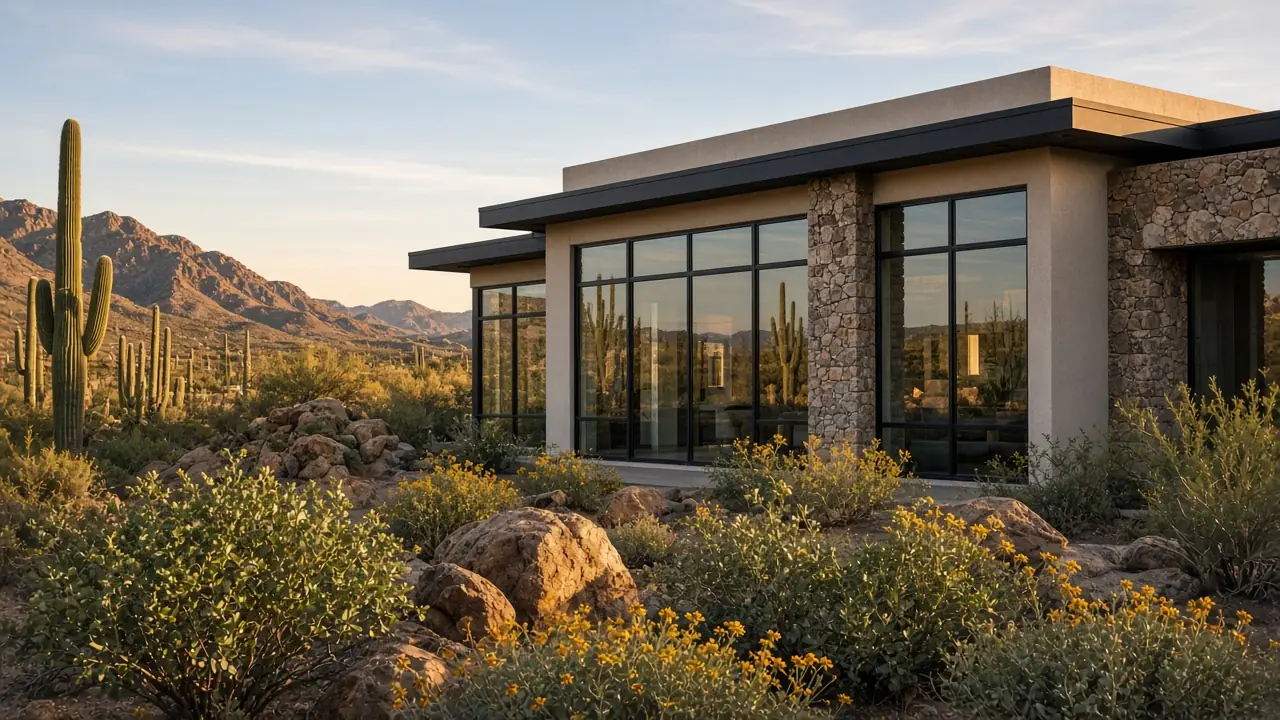
- Perimeter / marginal. A single outline around the edge of the glass. Milgard offers Perimeter grids that meet in all four corners or only at the top, across one window or a whole bank of windows and doors. It's the go-to for modern desert and transitional homes, and it pairs with steel-look frames.
- Top row / valance / craftsman. Bars only across the top. Milgard calls it Valance and Pella calls it Top Row, which Pella ties to Craftsman style. It suits ranch homes, casitas and picture windows.
- Diamond and custom. Diamonds, arches, radius cuts and sunbursts are usually custom orders. Save them for accent windows (stair landings, entries, powder rooms) on Tuscan and Old World homes. Pella notes standard patterns usually cost the same, but custom ones don't.
- Cross, or no grids. A single cross is the farmhouse look. Mid-century and modern desert homes usually look best with no grids at all: slim frames and clear glass. If you're replacing 1970s and 80s windows in McCormick Ranch, see the McCormick Ranch 1970s & 80s window guide.
SDL vs. GBG vs. TDL: side-by-side comparison
| True divided lite | SDL + shadow bar | SDL (no spacer) | GBG (between glass) | Removable interior | |
|---|---|---|---|---|---|
| Look and depth | Real panes, the deepest shadows | Closest to TDL, solid from every angle | Strong shadow lines; see-through from the side | Flat behind the glass; can disappear in glare | Inside only |
| Cleaning | Pane by pane, inside and out | Pane by pane, inside and out | Pane by pane, inside and out | Like plain glass | Remove, then clean like plain glass |
| Energy | Many glass edges; depends on the unit | Rated on the window's NFRC label; Andersen says its energy-spacer FDL matches its SDL ratings | Bars are outside the glass package | Same U-factor as plain glass if 3 mm+ gap each side (NFRC 100) | Doesn't change the glass |
| Desert sun and heat | Exterior bars weather like the frame | Exterior bar weathers like the frame | Exterior bar weathers like the frame | Protected inside; nothing exposed | Inside, shaded |
| Dust and monsoon grime | Collects on every bar | Collects on the bars | Collects on the bars | Nothing to collect on | Inside only |
| Relative cost | Highest | High | Moderate to high | Lowest grid option | Low to moderate |
| HOA and historic acceptance | Best for "authentic" rules | Usually accepted where SDL is required | Often accepted | Fine where any grid is allowed; may fall short where depth is required | Doesn't change the exterior look |
| Resale | Valued on period custom homes | Reads as premium | Reads as upgraded | Neutral | Neutral |
| Add later? | No | No | No | No | Ask the dealer |
Energy: what grids really do to U-factor, Low-E and tempered glass
This is where most grid articles stop at "SDLs are energy efficient." Here's what the rating rules actually say.
Grids between the glass. The NFRC 100 procedure, which manufacturers use to rate U-factor, lets a unit with dividers between the panes be rated the same as the identical unit without dividers, as long as there is at least 3.00 mm (0.118 in.) of air or gas space between the divider and both panes. Cardinal IG's bulletin on internal grilles repeats that rule and notes that whether the gap is met is the window maker's decision. In practice, a well-made GBG unit is rated like the same glass without grids.
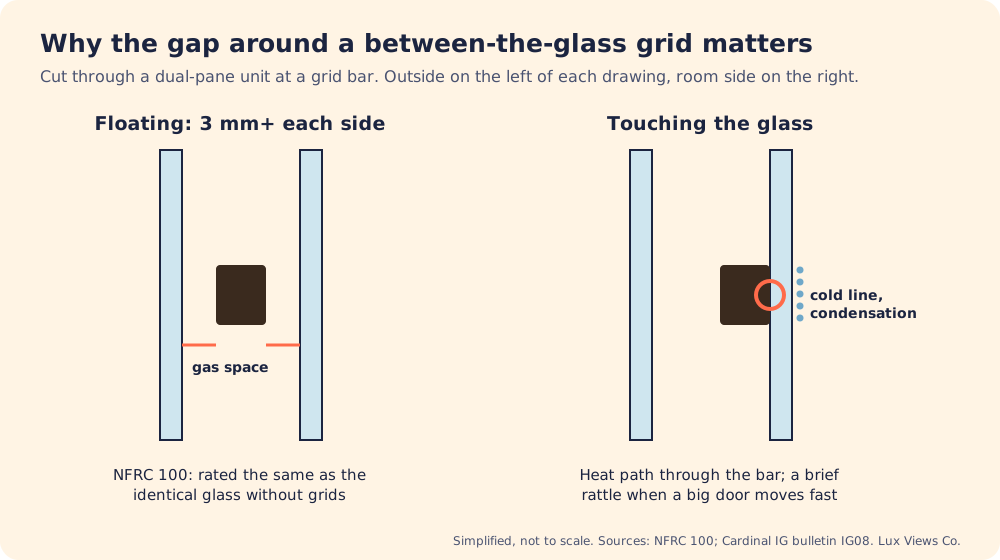
When a GBG touches the glass. Cardinal lists the conditions that can push the panes onto the grid: higher outside air pressure, installing at a lower altitude than where the unit was made, strong buffeting wind, tempered glass with some bow, and units made near their minimum thickness. Where the grid touches, the unit loses insulating value at that spot, and condensation can form on the room-side glass behind the bar. In large glass with long grid spans, a door that's swung or slid quickly can make the grid tap the glass for a moment. Cardinal says that brief rattle is not a defect. If you have big patio doors and that bothers you, SDLs or no grids are the quieter choice.
Low-E coatings. On a typical Arizona dual-pane unit the Low-E coating sits on an airspace surface, and a GBG sits in that same airspace without changing which coating you get. Pick the glass on its own merits (see Low-E glass types compared and best windows for Arizona heat), then add grids. Pella's spec for Lifestyle Series SDLs notes they're available only on units glazed with Low-E insulated glass with argon, so grid choice and glass choice are linked on some lines. Andersen notes full divided light isn't available on its triple-pane products.
Bars count against glass area. Every bar covers glass. A grid doesn't make the glass less efficient, but it slightly reduces the daylight and view through the window. On a west-facing view wall, a perimeter or prairie pattern keeps most of the glass open.
Tempered and laminated glass. Doors and glass near doors, tubs and floors need safety glass, and laminated glass is common for sound and security. Both work with grids, with two notes from Cardinal's bulletin: tempered glass can bow slightly, which is one cause of GBG contact, and thicker glass makes the gap between SDL bars more visible, so wider SDL bars or a shadow bar look better.
The rebate check. SRP's window rebate requires the window to meet U-factor and SHGC limits. Compare the actual NFRC label for the exact window with grids, not the brochure number for the plain unit. See the best windows for Arizona heat guide for the current terms, which can change.
What each brand actually offers
Taken from each maker's own product pages and specs as of November 2026. Options vary by series, size and region, so confirm the details for your exact window with the dealer.
| Brand and line | Between the glass (GBG) | SDL / shadow bar | True divided / other | Widths and colors |
|---|---|---|---|---|
| Milgard C700 fiberglass | 5/8" flat; 15/16" sculptured | SDL (bars on both faces) | 2-3/8" check rail | Patterns: Standard, Standard Half, Valance, Perimeter |
| Milgard V250 Style Line vinyl | Flat; sculptured | None listed | 2-1/4" check rail | Standard, Standard Half, Valance, Perimeter, Perimeter Corner; Milgard says it can do nearly any pattern |
| Andersen 100 / 200 / 400 / A-Series | Finelight contoured 3/4" and 1" | SDL with permanent or removable interior; full divided light with spacer, or energy spacer | Finelight + exterior grilles (100 Series only); removable interior (not 100 Series) | 5/8" to 3-1/2" by line; exterior Fibrex matches the exterior color; interior pine, oak, maple or white |
| Pella Lifestyle Series | 3/4" contoured aluminum, several interior colors; exterior white, black or matched to cladding | 7/8" SDL with or without spacer | Roomside removable; Pella Reserve: Integral Light Technology | Traditional, Prairie, Top Row, Cross, custom |
| Marvin | GBG, two-tone available | SDL; SDLS (with spacer bar) | Authentic divided lites (wood-exterior units) | Modern: aluminum SDLs 7/8" and 1-1/8", five colors, plus a 2-7/8" simulated frame |
| Western Window Systems | Customizable grids | Simulated divided lites | Simulated steel divided lites (0.875" SDLs that look like steel putty glazing) | Classic or contemporary styles |
| WinDor 1550 / 1750 / 2750 / 3750 | Flat 0.625"; contoured | 1" flat SDL with shadow bar | Patterns vary by product |
Sources: Milgard grids, Milgard C700 picture window options, Milgard V250 picture window options, Andersen grille options, Andersen help center grille styles, Pella window grids guide, Pella Lifestyle Series overview (PDF), Marvin divided lites, Western design options, Western simulated steel line (PDF), WinDor 2750 grid profiles (PDF), WinDor SDL update. For more on one Milgard line, see the Milgard C700 guide.
HOA rules: grids are part of "match the style"
In most master-planned Scottsdale communities, grids are an exterior design element, so adding, removing or changing them can trigger review. From the associations' own documents:
- Scottsdale Ranch: the SRCA windows checklist asks you to state grid or non-grid, frame material and color, and whether it's a full or partial replacement.
- McCormick Ranch: the MRPOA 2026 Rules and Regulations allow staff-level approval of exterior window replacement if the windows match the color and style of other windows within that subdivision. A grid change can push you to full committee review.
- Gainey Ranch (The Pavilions): the March 2026 Pavilions rules say swing doors may not have divided or simulated door glass. That matters if you were planning French doors with grids to match your windows. Pavilions windows must also have dark bronze frames.
- Desert Mountain: a new frame color means all windows have to be replaced so the frames match. Grid color usually follows the frame, so plan it the same way.
The HOA Window Rules Directory has each community's rules and dated links to the official PDFs, and do I need HOA approval to replace windows walks through the process. Rules change, so download the current documents before you order.
Partial replacement: how to match the grids you already have
Replacing a few windows, or adding a door next to existing windows, is where grids go wrong most often. Check these on the existing windows before you order:
- Type: run a fingernail across the outside glass. Feel a bar? It's an SDL or a TDL. Smooth glass with a grid inside? It's a GBG.
- Profile and width: measure the visible bar width and note whether it's flat, contoured, square or sloped.
- Colors, both sides: many GBGs and SDLs are two-tone, so match the outside color to the frame and check the inside separately.
- Pattern and lite count: count the lites across and down on each sash. On single-hungs, note whether grids are on both sashes or only the top.
- Sightlines: on a row of windows or a door beside windows, the horizontal bars should line up across all of them. Ask the dealer to draw the elevation with bar heights.
- Brand and series: the label in the frame or the spacer often names the maker. The same brand and line is the easiest match. Andersen says it can match virtually any existing grille pattern.
Doors. Patio and French doors use the same grid types, but check two things. Large door glass with long GBG spans is where Cardinal notes a brief rattle can happen. And confirm your HOA allows divided glass on doors at all (see the Gainey Ranch Pavilions rule above). See French doors and sliding patio doors.
Buying checklist
- Decide the look from the street first: if you want real shadow lines, choose SDL, ideally with a shadow bar. If you mainly want easy cleaning, choose GBG.
- Match the architecture: colonial for Santa Barbara and Spanish Colonial, prairie or perimeter for Tuscan and transitional, none or perimeter for modern desert and mid-century.
- Pick the profile and width (and two-tone colors) to match your existing windows or the style you want.
- Check the HOA before you order, and include the grid type and pattern in the submittal. Start with the HOA directory.
- Ask for the NFRC label for the exact unit with grids, and confirm it still meets any rebate or code limits.
- Ask about safety glass: tempered or laminated glass where required, and wider SDL bars or a shadow bar with thicker glass.
- Have the dealer draw the elevation with grid lines, so bars line up across windows and doors.
- Order grids with the window. Except for removable interior grilles, they can't be added later.
If you'd like quotes that line up the same grid type, width and pattern across brands, fill out the short form below and we'll match you with independent, participating dealers who carry these lines. Related reading: window replacement in Scottsdale, energy-efficient windows, foggy double-pane windows (GBGs live inside the sealed unit, so a failed seal fogs around them too), and the Paradise Valley and Gainey Ranch pages.
Sources: manufacturer pages and PDFs linked above; ANSI/NFRC 100 (dividers rule); Cardinal IG technical bulletin IG08, "Use of Internal Grilles" (PDF); SRCA windows checklist (PDF); MRPOA 2026 Rules and Regulations (PDF); Gainey Ranch Pavilions rules, March 2026 (PDF). Checked November 2, 2026.
Frequently asked questions
What is the difference between SDL and GBG grids?
Simulated divided lite (SDL) bars are bonded to the outside and inside faces of the glass, so they have real depth and cast shadows. Grids between the glass (GBG) are sealed inside the airspace of a dual-pane unit, so both glass surfaces stay smooth. SDLs look closer to old divided-pane windows; GBGs are easier to clean and usually cost less.
What is an SDL with a shadow bar or spacer bar?
It's an SDL with a dark bar added inside the airspace, lined up behind the outside and inside bars. Without it you can see through the gap between the bars at an angle; with it, the bar looks solid all the way through, like a true divided lite. Marvin calls it SDLS, Pella offers SDL with optional spacer, Andersen calls it full divided light, and WinDor's 1-inch SDL includes a shadow bar.
Do window grids reduce energy efficiency?
Usually not much. The NFRC 100 rating procedure lets a dual-pane unit with grids between the glass be rated with the same U-factor as the same glass without them, as long as there is at least 3.00 mm (0.118 in.) of air or gas space between the grid and both panes. Bars applied to the glass surfaces don't change the glass package itself. The window's actual NFRC label is the number to compare.
Can you add grids to windows later?
Not grids between the glass or SDLs: Pella says its grids must be added at the time of purchase, and Andersen says full divided light and Finelight between-the-glass grilles must be ordered with the unit. Removable interior grilles are the one type made to come off and go back on. Ask the dealer whether they can be ordered for your exact window.
Do grids between the glass rattle?
They can, briefly. Cardinal IG's bulletin on internal grilles says long grilles in large glass can touch the glass for a moment when a swinging or sliding patio door is opened or shut quickly, causing a short rattle, and that this is not a product defect. A grid that rests on the glass all the time can also make a cold line where condensation forms behind it.
Do window grids block light or the view?
Some. Every bar covers a strip of glass, so more lites and wider bars mean less open glass. For a view window, a perimeter, prairie or top-row pattern keeps the center open; a full colonial pattern divides the view the most.
How do you clean windows with grids?
GBGs clean like plain glass, since both surfaces are smooth. SDLs and true divided lites have to be cleaned pane by pane, inside and out, and dust collects along the top edges of the bars. Removable interior grilles come off so you can clean the inside glass.
Can French doors or a sliding door match my window grids?
Usually, if you order them from the same brand and line with the same grid type, bar width, color and pattern, and line the bars up with the windows beside them. Check the HOA first: the Gainey Ranch Pavilions rules, for example, say no divided or simulated door glass is acceptable on swing doors there.
Do I need HOA approval to change my window grids?
Often, yes. In a master-planned community, adding, removing or changing grids changes how the house looks from the street. The Scottsdale Ranch window checklist asks you to state grid or non-grid, and McCormick Ranch allows staff-level approval for window replacement only when the windows match the color and style of others in the subdivision.