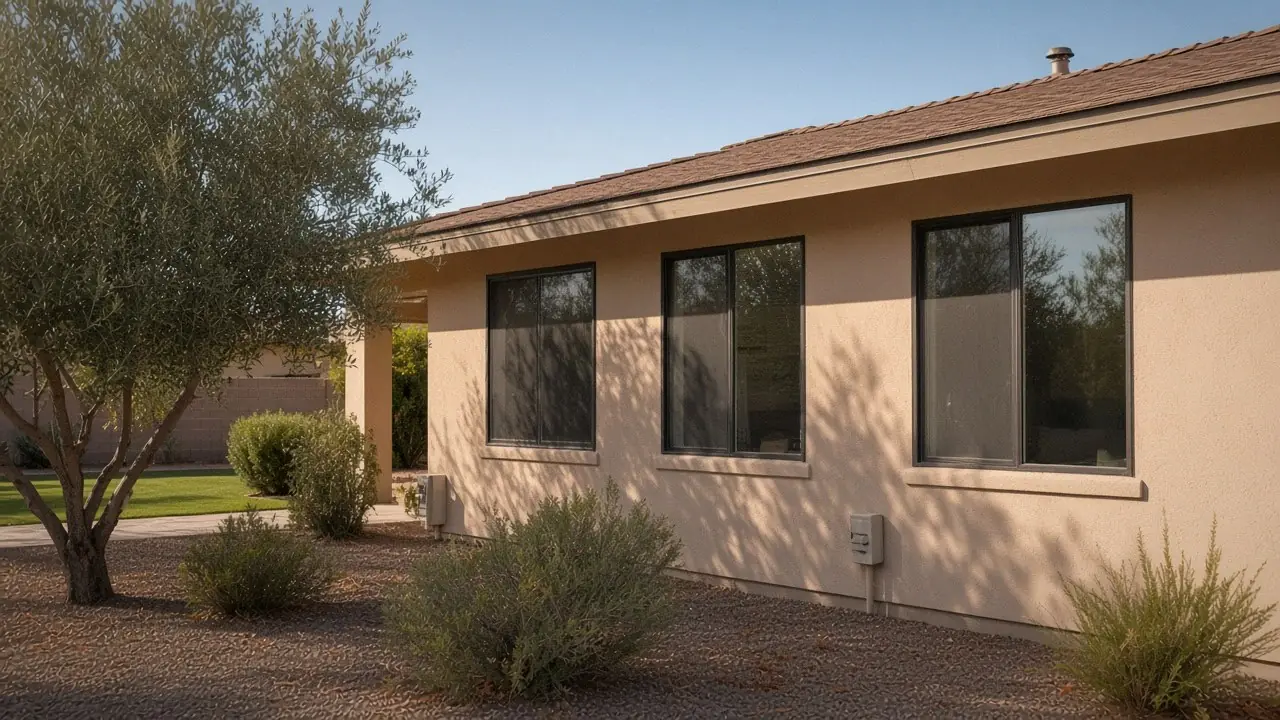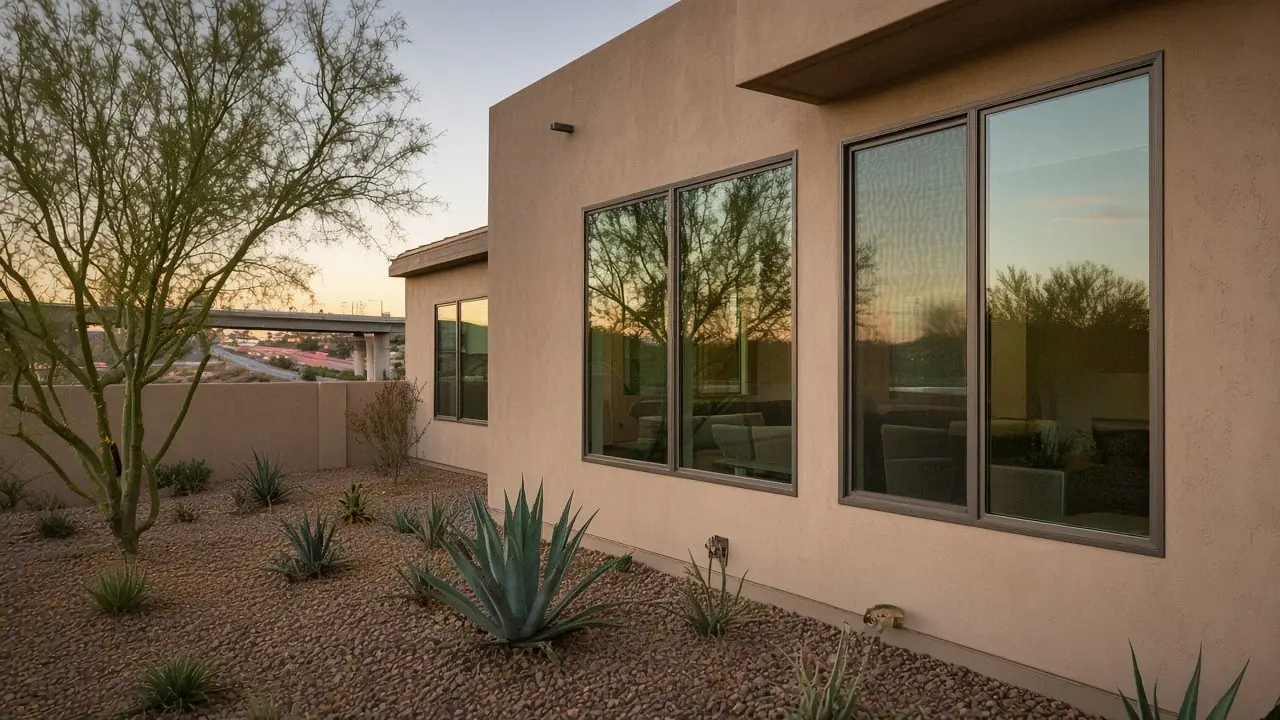
Short answer: for freeway hum and aircraft, the glass makeup matters more than the number of panes. A dual-pane window with one thicker pane (an "STC upgrade") or one laminated pane usually beats a standard triple-pane unit, and it has to be paired with a tight, well-sealed frame, because sound follows air through every gap. Compare windows by their tested OITC rating (the one built for traffic and aircraft), not just STC. If your current windows are old single-pane or leaky aluminum, almost any well-installed modern dual-pane window will be a big step up.
Where Scottsdale noise comes from
Scottsdale is quiet by big-city standards, but a few sources come up again and again:
- The Loop 101 (Pima Freeway). It runs along Pima Road through central Scottsdale, then turns west across north Scottsdale near the Airpark. Freeway noise is mostly low-pitched tire and engine rumble, the hardest kind for glass to stop.
- Scottsdale Airport and the Airpark. The city's noise complaint program covers the Scottsdale Airport Influence Area, which it describes as bounded by 40th Street to the west, 112th Street to the east, Jomax Road to the north and Mockingbird Lane to the south (City of Scottsdale). The airport runs a voluntary curfew program that asks operators to fly outside 10 p.m. to 6 a.m., but as a public airport it stays open 24 hours (Airport Noise).
- Sky Harbor traffic. The city says FAA flight path changes created tighter corridors for Phoenix Sky Harbor commercial traffic, increasing overflights in some Scottsdale areas and reducing them in others (FAA Flight Path Updates).
- Busy arterials, Old Town nights, neighbors. Scottsdale Road, Shea, Frank Lloyd Wright, pool parties, leaf blowers and dogs are higher-pitched noise, which behaves differently from freeway rumble.
Don't count on a new sound wall. Scottsdale's Roadway Noise Abatement Policy (amended April 2022) considers mitigation as part of roadway projects that add capacity, says the city won't mitigate for isolated properties such as one or two homes, and generally mitigates only the first floor (City of Scottsdale policy, PDF). ADOT's 2017 noise policy says it has no Type II program, which is the voluntary kind that adds walls along existing freeways (ADOT Noise Abatement Policy, PDF). For an existing home, the windows and doors are usually the part you control.
How glass stops sound (and why a third pane often doesn't help)
Sound makes the glass vibrate, and the vibrating glass re-radiates it into the room. Three things make that harder: more mass (thicker glass), panes that don't vibrate at the same pitch, and damping (a soft interlayer that soaks up vibration).
Andersen puts it simply: "there's no such thing as a soundproof window," but glass construction "has the greatest influence on a window's ability to dampen noise." It adds that when both panes are the same thickness "they vibrate at the same frequency making it easier for the sound to pass," which is why its STC upgrade pairs panes of different thicknesses. It also warns that going from dual-pane to triple-pane "will not necessarily yield the same dramatic results" (Andersen, Sound Abatement).
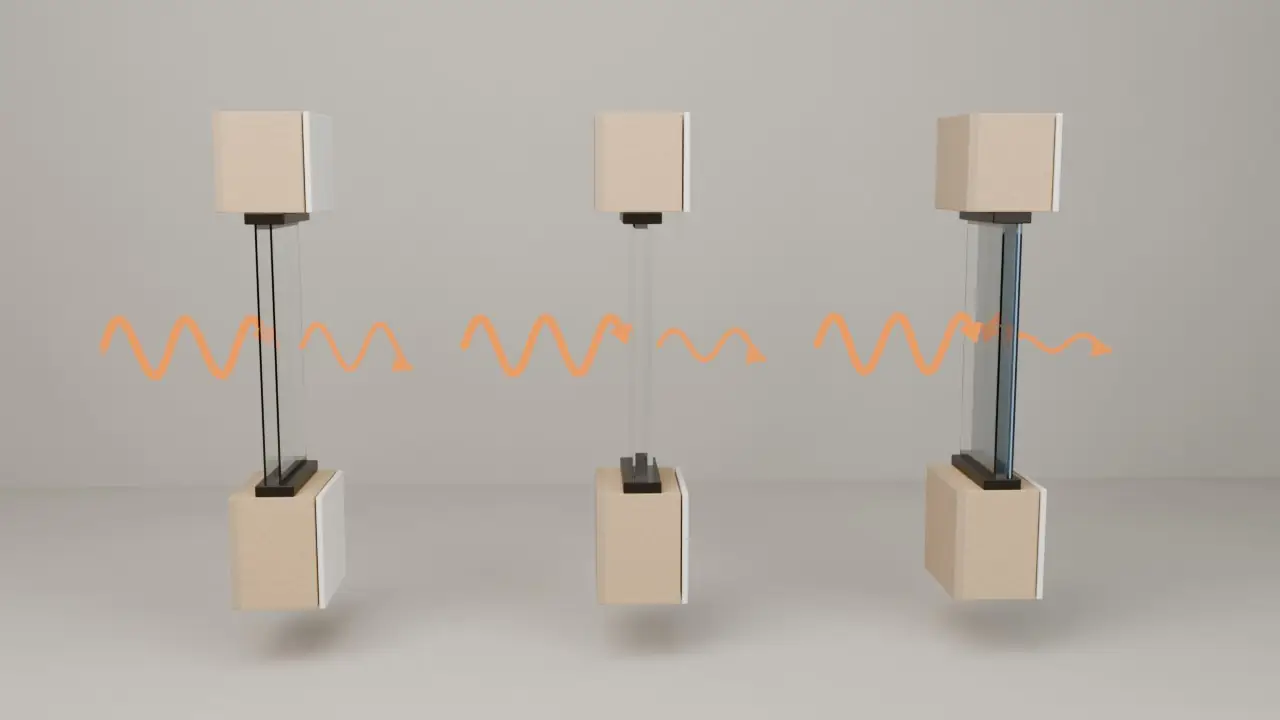
The glass makers' own numbers show the same pattern. Guardian Glass's acoustic estimates for center-of-glass performance put a 6 mm / 1/2 in air / 6 mm dual-pane unit at OITC 29 and a 6 mm triple-pane unit with two 1/2 in air spaces at OITC 29 as well. The third pane lifts the STC estimate (34 to 37) but leaves the traffic-noise rating where it was. Swapping one pane for laminated glass with an acoustic interlayer moves the dual-pane estimate to OITC 35 (Guardian Glass, Expert Series: Glass Acoustic Performance, PDF). Those are lab estimates for the glass alone; a whole window usually tests lower.
STC vs. OITC: the two numbers to ask for
Both ratings come from lab tests under ASTM standards (E90 for the test, E413 for STC, E1332 for OITC), and for both, higher is quieter.
- STC (Sound Transmission Class) was designed around indoor sounds like voices, TV and music. Pella notes it emphasizes higher-frequency sounds (Pella).
- OITC (Outdoor-Indoor Transmission Class) was developed in 1999 for outdoor noise reaching indoors: construction, planes, sirens and traffic, which are lower in frequency (Pella). Andersen lists OITC as the measure for traffic, airplane noise and construction.
Guardian explains why small number differences matter: each 10 dB step is roughly a doubling or halving of how loud something seems. It also warns that STC and OITC aren't linearly related, so a strong STC doesn't guarantee a strong OITC, and that a site-installed panel can lose up to about 6 dB versus the lab sample.
Andersen gives a plain-English scale for STC: about 30 is "where most dual-pane windows perform" (you could hear and understand a loud conversation outside), 30 to 35 is "elevated" (you'd hear it but couldn't follow it), and 36 to 40 is "high" (loud conversations would hardly be audible). It puts a typical dual-pane window at STC 25 to 30.
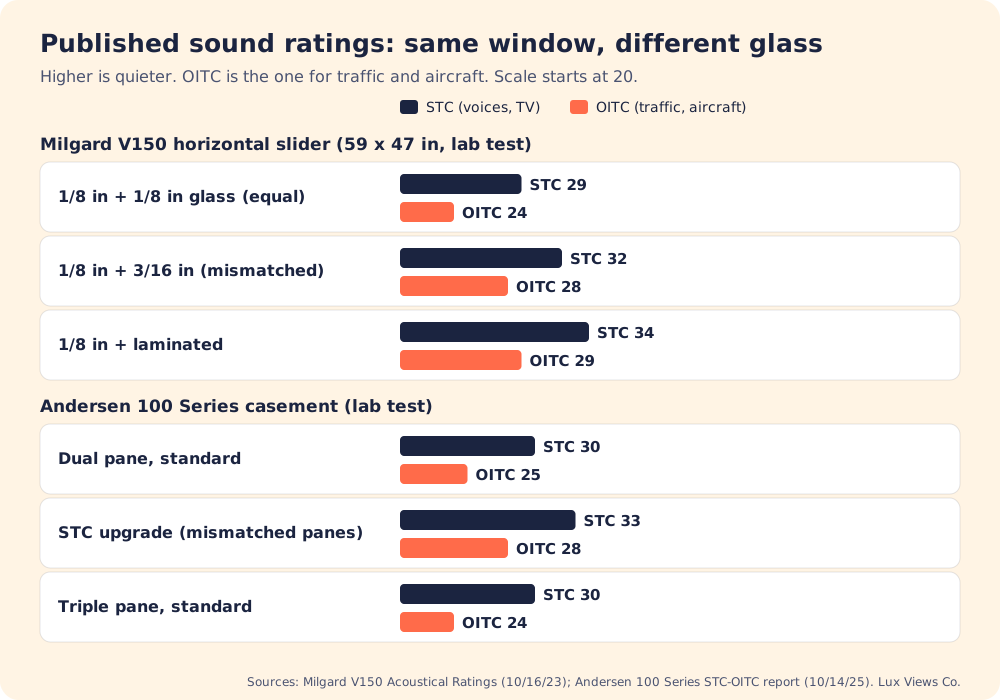
Two real examples, both from the manufacturers' published test reports:
- Milgard V150 vinyl horizontal slider (59 x 47 in test size): equal 1/8 in panes STC 29 / OITC 24; 1/8 in + 3/16 in mismatched glass STC 32 / OITC 28; 1/8 in + laminated STC 34 / OITC 29 (Milgard V150 Acoustical Ratings, PDF, updated 10/16/23).
- Andersen 100 Series casement: standard dual-pane STC 30 / OITC 25; STC upgrade (mismatched) STC 33 / OITC 28; standard triple-pane STC 30 / OITC 24 (Andersen 100 Series STC-OITC report, PDF, data as of 10/14/25).
When you compare quotes, ask each dealer for the tested STC and OITC of the exact product type and glass package they're quoting. A casement, a slider and a patio door in the same series can test differently.
Laminated glass: the strongest single upgrade
Laminated glass is two lites bonded with a plastic interlayer, usually PVB. Andersen says the glass-interlayer-glass makeup reduces the glass's vibration and with it sound's ability to pass, and that typically only one pane of the dual-pane unit is laminated. Acoustic-grade PVB damps more than standard PVB: in Guardian's table, a single laminated 6 mm / 6 mm lite moves from OITC 32 with standard 0.060 in PVB to OITC 35 with acoustic PVB.
What laminated glass changes besides noise:
- Safety. Andersen notes laminated glass is commonly used where safety glass is needed. If a pane breaks, the interlayer tends to hold the pieces together.
- Weight. Thicker or laminated glass is heavier, which matters on big sliders and multi-slide panels. Ask whether the rollers and frame are rated for the glass you're ordering.
- Energy numbers. Laminated glass still goes into a sealed dual-pane unit with a Low-E coating, so heat control comes from the coating as usual. Check the NFRC label for the final U-factor and SHGC, since the glass package changes them. Our Low-E glass comparison covers which coatings suit Valley sun.
Mismatched panes and triple-pane: when they make sense
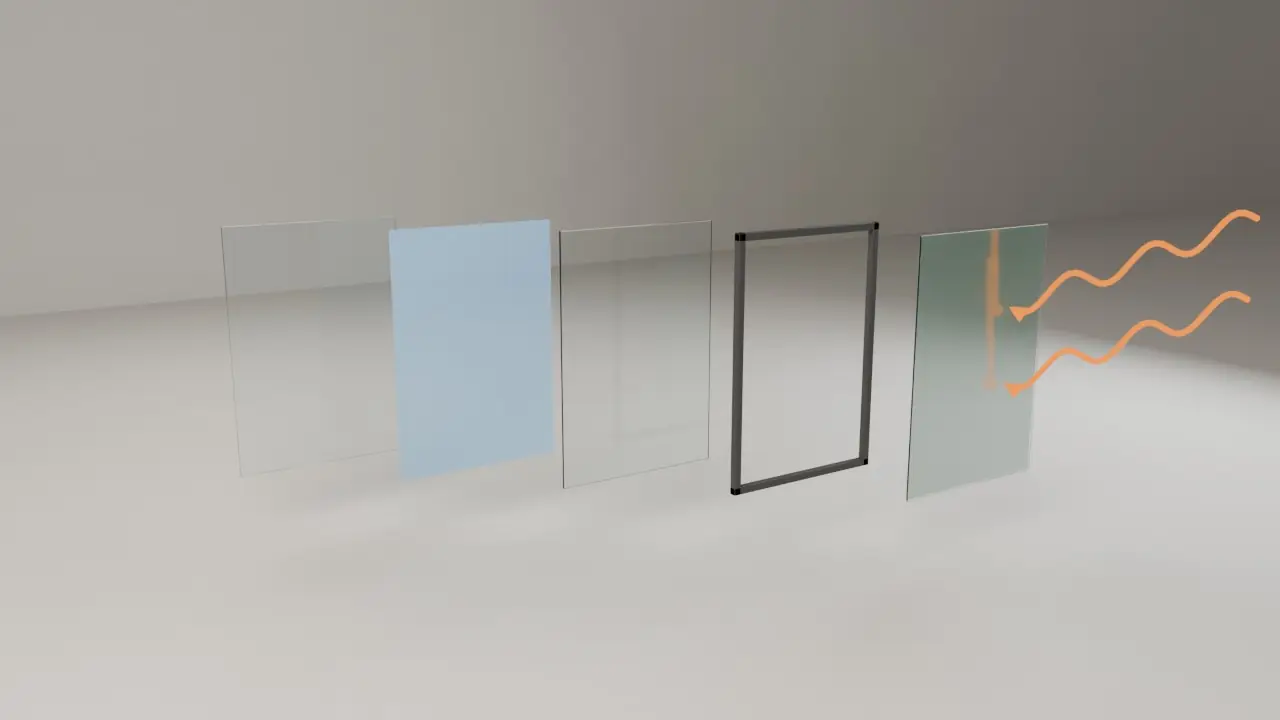
The cheapest acoustic step on many lines is simply a thicker pane on one side. Andersen offers its STC upgrade on 100 Series and E-Series windows. Milgard's V150 chart shows the 1/8 + 3/16 in combination adding about 3 to 4 points over equal 1/8 in panes on its slider.
Triple-pane can help when it's built for sound. Pella says a third pane and gas space improve STC, and that mixing glass thicknesses with the third pane improves it further. Pella's Lifestyle Series Sound Control package is a triple-pane design with mixed glass thicknesses, which Pella says delivers 52% noise reduction compared with single-pane windows (Pella). A standard triple-pane unit with three equal panes, as the Andersen and Guardian numbers show, may not do much for traffic noise.
Two more details from Cardinal Glass Industries' acoustical bulletin: a wider air space helps (its estimate for 3 mm / 3 mm glass climbs from STC 28 / OITC 25 at a 6.5 mm gap to STC 33 / OITC 28 at 19.5 mm), and argon fill "has no measurable effect on acoustical properties." Argon is there for energy, not sound. Cardinal also notes that a finished window's rating "will typically be reduced from the base glass acoustical rating" because of the frame (Cardinal IG09, Glass Acoustical Information, PDF).
In a hot climate, triple-pane is mostly a noise or cold-night upgrade, not a heat upgrade. Our best windows for Arizona heat guide explains why the Low-E coating and SHGC matter more for summer.
Sliding doors are often the weak spot
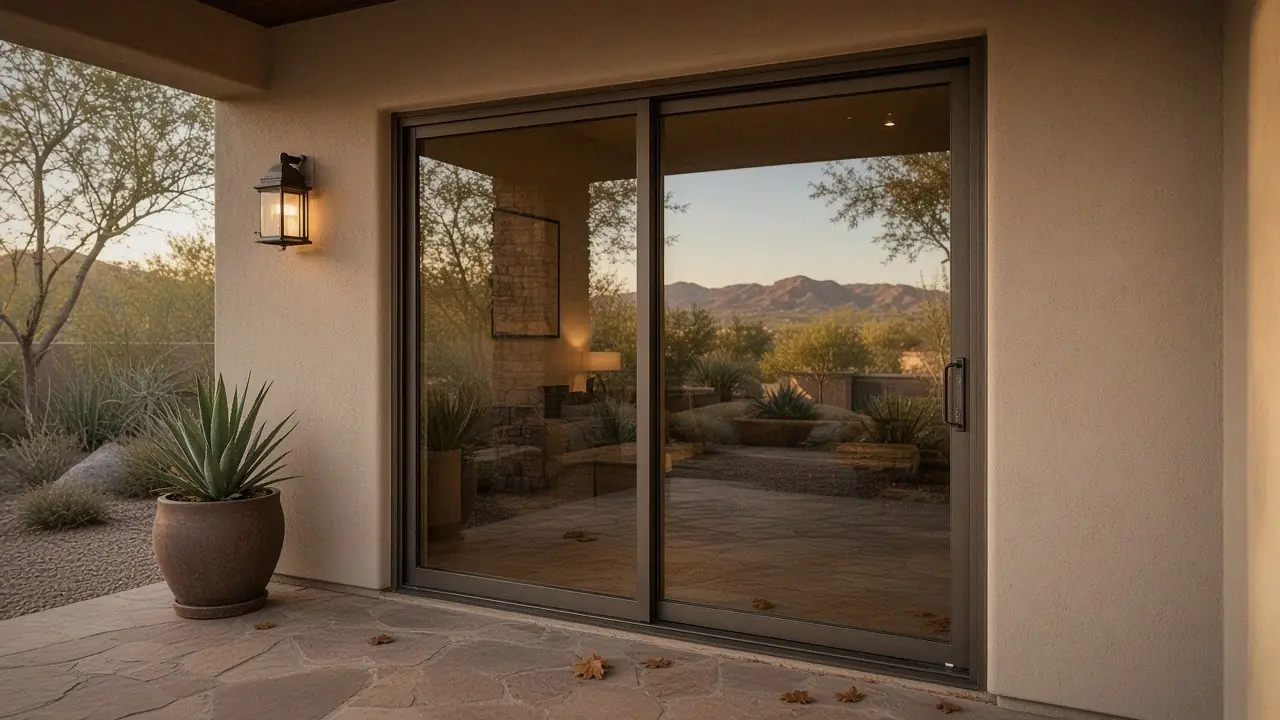
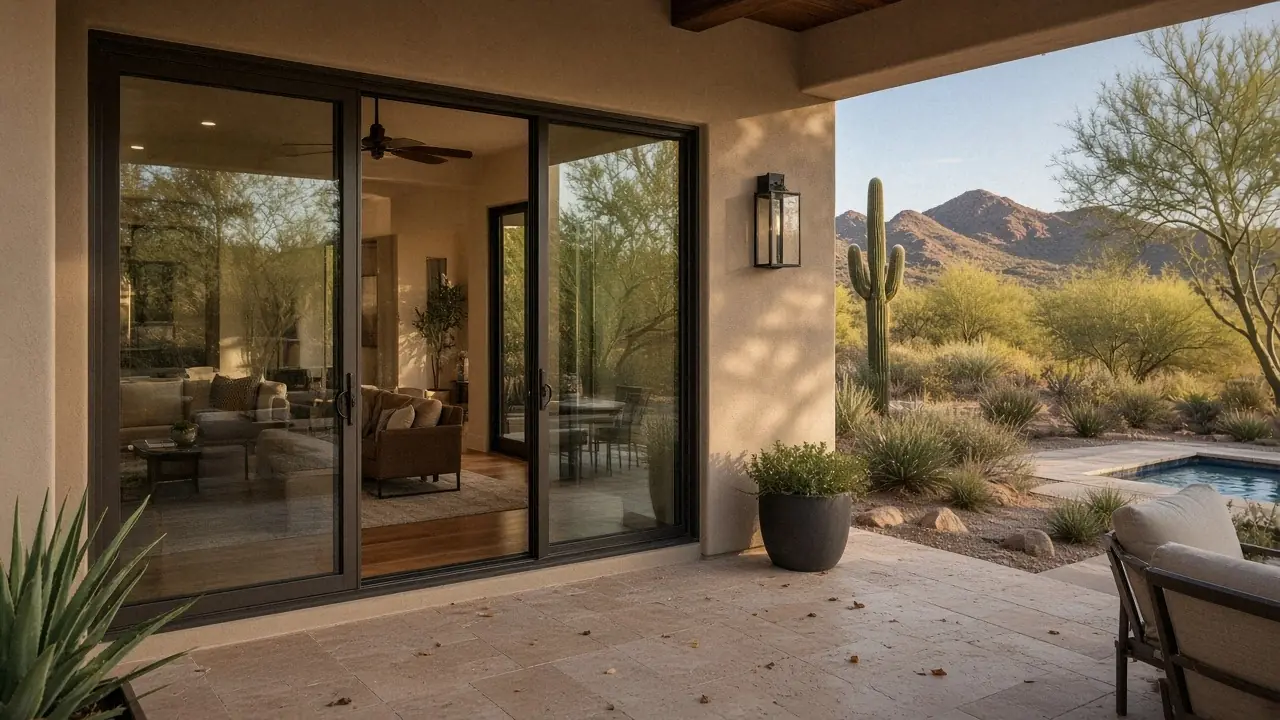
In a family room that faces the freeway, the biggest piece of glass is usually the sliding patio door, and sliders are harder to quiet than windows. In Andersen's 100 Series report, the 2-panel gliding patio door tests STC 28 / OITC 23 with standard dual-pane glass and STC 29 / OITC 25 with the STC upgrade, lower than the casement windows in the same report.
Two things help:
- Ask for the door's own rating, with the same glass upgrade as the windows. If a dealer only quotes window ratings, ask why.
- Keep the seals tight. Worn interlock weatherstrip and a panel that sits too low leak air, and air leaks carry sound. Our drafty windows and doors guide and sliding door hard to open guide cover the fixes.
Seal the gaps first: sound follows air
The federal Building America Solution Center lists noise among the things air leaks let in, along with drafts, dust, pollen and insects (PNNL Building America Solution Center). A great acoustic window installed with an open gap between the frame and the wall will underperform, which is part of why Guardian expects field results below lab numbers.
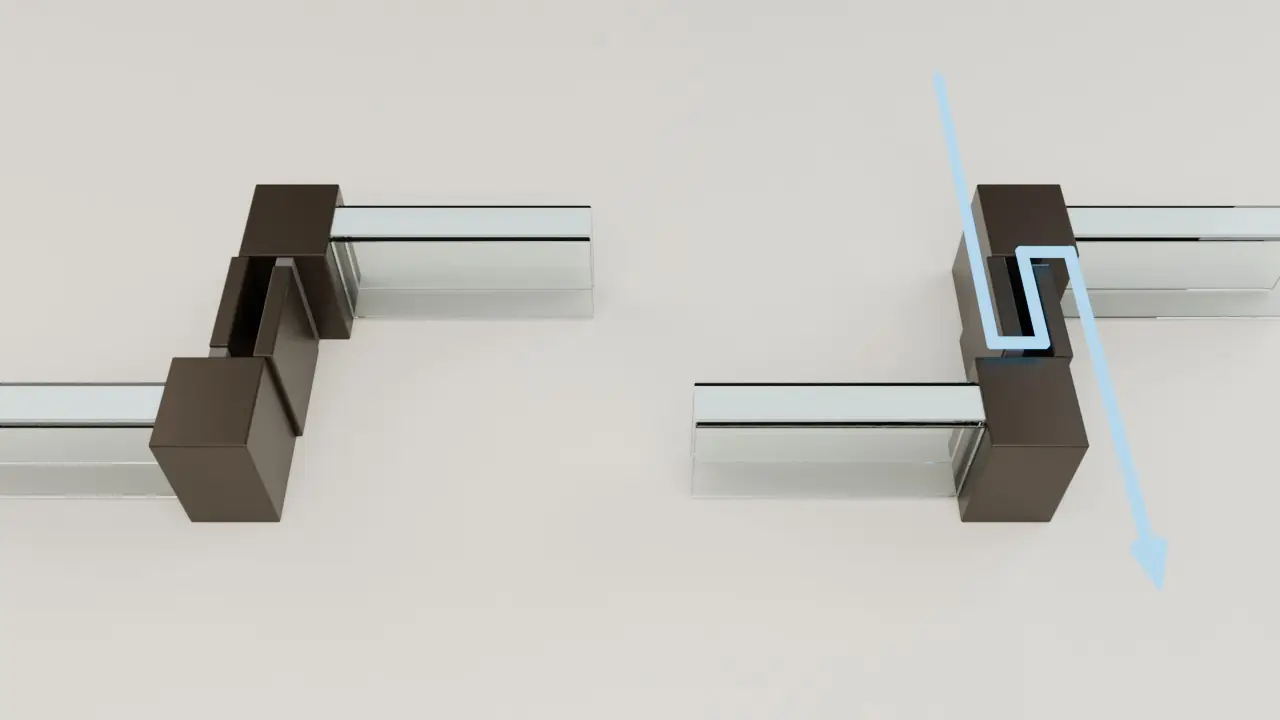
Before you order, check the cheap things:
- Weatherstrip and locks. A window or slider that doesn't close tightly leaks sound. See sliding door won't lock if the panel won't pull in.
- Gaps around the frame. Interior trim can hide open spaces between the window frame and the framing. Ask how the dealer's crew seals the perimeter on both the interior and exterior side.
- Other openings. Fireplace dampers, attic vents, a hollow front door and through-wall AC units also let sound in. New windows won't fix those.
If you're replacing windows anyway, the installation method matters too. Our retrofit vs. full-frame guide explains the trade-offs; a full-frame replacement exposes the rough opening so it can be sealed and insulated.
Match the upgrade to the noise
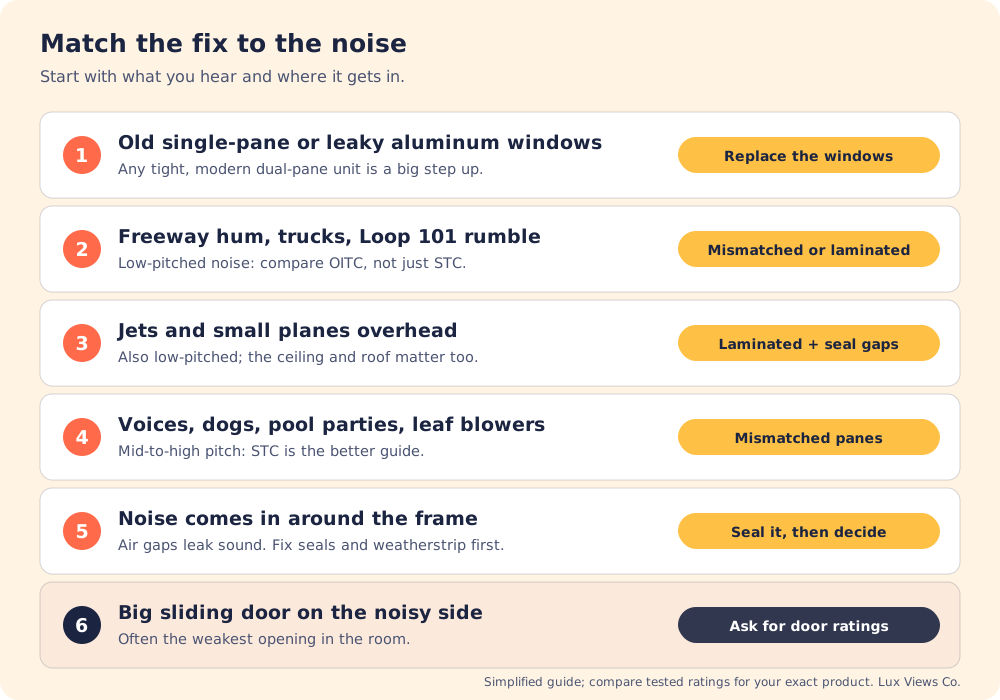
- Freeway rumble (Loop 101): mismatched or laminated glass on the walls that face it, and compare OITC.
- Aircraft: laminated glass on bedrooms and living areas facing the flight path, tight seals, and remember the roof and attic carry sound too.
- Voices, pool parties, dogs: an STC upgrade is often enough.
- Only one or two rooms are the problem: you don't need the same glass on every window. Many homeowners upgrade only the bedrooms or the side facing the noise.
For a home inside an airport noise zone, an acoustic consultant can measure and specify. Guardian points to the National Council of Acoustical Consultants for finding one.
Scottsdale airport zones, permits and HOA review
Airport zones. Scottsdale Revised Code sec. 5-358 requires noise attenuation that meets the building code's sound-transmission requirements for new developments with noise-sensitive uses (homes included) in the AC-2 and AC-3 zones of the Airport Influence Area. New development in AC-1 and AC-2 also has to grant the city an avigation easement and include an airport noise and overflight disclosure (City of Scottsdale Airport Vicinity Development Checklist, PDF). That rule is for new development. It doesn't require an existing homeowner to upgrade windows, but it's a good sign your area was mapped as noise-exposed.
Permits. Acoustic windows are permitted like any other window. The City of Scottsdale lists "adding or replacing windows, except for replacing the glass in an existing frame" under a Minimum Window/Door Permit, and lists glass panes and hardware as no-permit work. In Paradise Valley, everything goes through the Town's Citizen Portal. Parts of the Kierland area are in the City of Phoenix, where Phoenix's permit rules apply instead (Kierland area notes). Our Scottsdale and Paradise Valley permit guide has the details and official fees, which can change.
HOA review. Acoustic glass usually looks like ordinary clear glass, but new windows still need HOA approval in most master-planned communities. McCormick Ranch, for example, handles window replacements that match the existing color and style at staff level, and Gainey Ranch requires association approval. Check the Scottsdale HOA Window Rules Directory for your community's current rules and fees, which may change.
SRP rebate. SRP's window replacement rebate pays $3 per square foot for windows with an NFRC U-factor of 0.32 or lower and SHGC of 0.23 or lower, installed by an Arizona-licensed contractor before April 30, 2027 (SRP). Acoustic glass can still qualify if the finished window meets those numbers. Terms can change, so check SRP before you order.
Questions to ask a dealer
- What are the tested STC and OITC ratings for the exact window types and glass package you're quoting, and can I see the test report?
- Is the upgrade mismatched glass, laminated glass, or a sound package with three panes? Which pane is laminated?
- What does the sliding door in the same quote test at?
- How will the frame-to-wall gap be sealed and insulated, inside and out?
- Do the acoustic glass options still meet the NFRC U-factor and SHGC I need, and for SRP's rebate?
- Who pulls the permit and handles the HOA submittal?
Get matched with a dealer who can quote acoustic glass
Lux Views Co. is a free referral service, not a contractor. Fill out the short form below and we'll match you with licensed independent dealers in Scottsdale and Paradise Valley who can quote windows and doors with tested sound ratings, laminated or mismatched glass, and the permit and HOA paperwork included.
Sources
- Andersen: Sound Abatement, 100 Series Window and Door Acoustic Performance (STC/OITC, PDF, data as of 10/14/2025)
- Milgard: V150 Windows and Doors Acoustical Ratings (PDF, updated 10/16/23)
- Pella: How to Choose Soundproof Windows, Lifestyle Series overview (PDF)
- Cardinal Glass Industries: IG09, Glass Acoustical Information (PDF, 08/2020)
- Guardian Glass: Expert Series: Glass Acoustic Performance (PDF)
- U.S. DOE / PNNL: Building America Solution Center, Add Weatherstrip to Windows and Doors
- City of Scottsdale: Airport Noise, Airport Noise Complaints, FAA Flight Path Updates, Airport Vicinity Development Checklist, Short Form (PDF), Roadway Noise Abatement Policy (PDF, amended April 2022), Home Improvement
- Arizona Department of Transportation: Noise Abatement Policy, May 2017 (PDF)
- SRP: Window replacement rebate
Frequently asked questions
Do noise reducing windows really work?
They reduce noise, but no ordinary window makes a room silent. Andersen says there's no such thing as a soundproof window, only windows that reduce sound, and that glass construction has the biggest effect. Swapping old single-pane or leaky windows for tight dual-pane units makes the most noticeable difference, and mismatched or laminated glass adds more.
Is triple-pane or laminated glass better for noise?
For most outdoor noise, laminated or mismatched-thickness glass does more than a standard third pane. Andersen's 100 Series casement test shows standard triple-pane at STC 30 / OITC 24, the same as or lower than its standard dual-pane (30 / 25), while its mismatched-pane upgrade tests 33 / 28. Triple-pane helps more when the panes are different thicknesses, which is how Pella builds its Sound Control package.
What is a good STC rating for windows?
Andersen says a typical dual-pane window is about STC 25 to 30, and to look in the 30 to 35 range if sound reduction is a priority. For traffic and aircraft, also compare OITC, which weights the low-pitched rumble more heavily. Ask for the rating of the whole tested window, not just the glass.
What's the difference between STC and OITC?
Both are lab ratings where higher is quieter. STC (Sound Transmission Class) was built around indoor sounds like voices and TV. OITC (Outdoor-Indoor Transmission Class) puts more weight on low frequencies such as traffic, aircraft and construction, so it's the better number for a home near a freeway or under a flight path.
Will new windows block airplane noise from Scottsdale Airport?
They can cut it, but aircraft noise also comes through the roof, attic vents and walls, so windows are one part of the fix. Laminated glass and well-sealed frames are the usual window upgrades for aircraft noise. Scottsdale requires noise attenuation only for new noise-sensitive development in certain airport zones (AC-2 and AC-3); existing homes aren't required to upgrade.
Does argon gas make windows quieter?
No. Cardinal Glass Industries' acoustical bulletin says argon filling has no measurable effect on acoustical properties. Argon improves insulation (U-factor). For sound, what helps is thicker or mismatched glass, laminated glass and a wider air space between the panes.
Do I need a permit for noise reducing windows in Scottsdale?
Usually, yes, the same as any window replacement. The City of Scottsdale lists replacing windows under its Minimum Window/Door Permit, while swapping only the glass in an existing frame doesn't need one. In Paradise Valley, applications go through the Town's Citizen Portal; ask the Building Division what your scope needs.
Does laminated glass still qualify for the SRP window rebate?
It can, if the complete window meets SRP's requirements. SRP's window rebate calls for an NFRC-rated U-factor of 0.32 or lower and an SHGC of 0.23 or lower, installed by an Arizona-licensed contractor before April 30, 2027. Check the NFRC label for the exact glass package you order, since acoustic glass changes the numbers. Rebate terms can change.